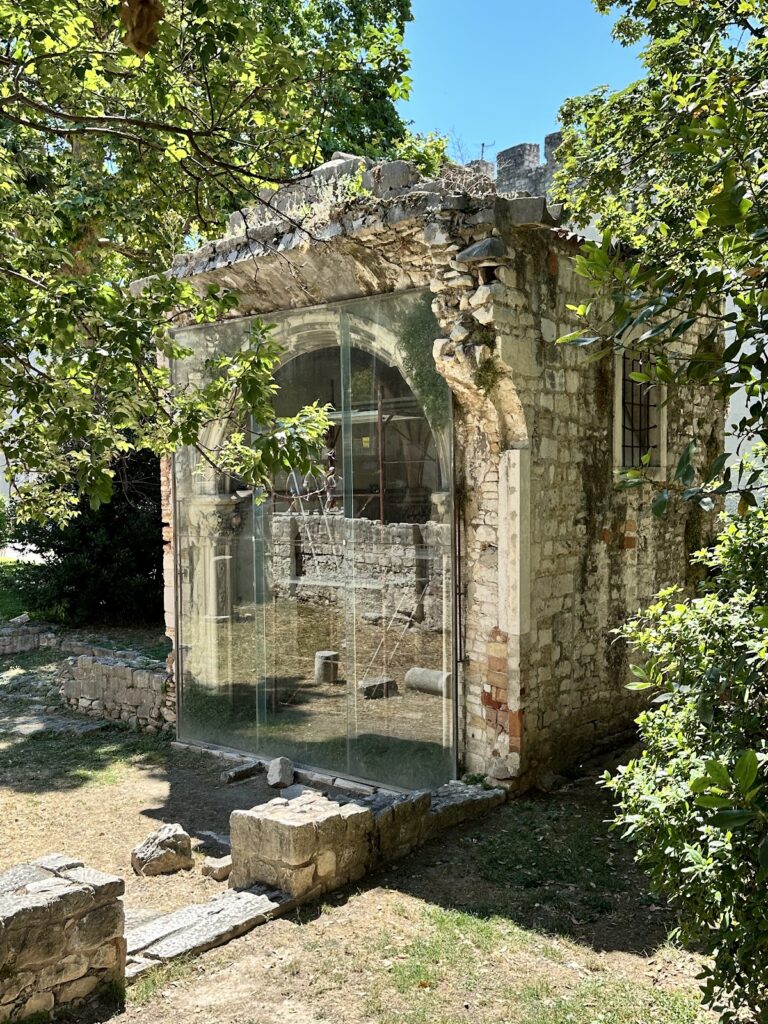
Church of St. Nicholas on Marjan: A Romanesque Church in Split


Site at a Glance
- Rating
- 4.6
- Popularity
- Low
- Country
- Croatia
- Primary era
- Medieval
- Eras represented
- Medieval
- Civilizations
- Hungarian, Kingdom of Croatia
- Site type
- Religious
- Remains
- Church
On this page6 sections
History
The Church of St. Nicholas on Marjan is a Roman Catholic church in Split, Croatia, built in the thirteenth century in the Romanesque style, a medieval form known for solid masonry, simple shapes, and rounded arches. Its cornerstone was blessed on 13 January 1219 by Treguan, the Bishop of Trogir.
Foundation and Benedictine Ownership
The church was commissioned by Rako, a resident of Split, and his wife, Elizabeta. They donated it to Bogdan, the abbot, or head, of the Benedictine monastery of St. Stephen at Sustipan. Benedictines belong to a Western Christian monastic order organized around the Rule of Saint Benedict.
Later Religious Use
A confraternity, a religious brotherhood formed around shared worship or charitable activities, was associated with the church during the fourteenth century. In the sixteenth century, hermits took over the building from the Benedictines and used it as a residence. The hermitage was removed in 1922.
The church was damaged by the Turks in the seventeenth century. During the twentieth century, responsibility passed to the Marjan Society, which carried out a renovation in 1919 and a restoration in 1990. The church is protected as an individual immovable cultural property and classified as sacred architectural heritage under registration number Z-3426.
Remains
Church Building and Setting
The church stands on a plateau on Marjan’s southeastern slope, about 200 metres above the First Lookout, with a view over Split. It is a single-nave stone building with a simple rectangular plan. At the eastern end, a rectangular apse, the termination of the sanctuary, contains an old stone altar table known as a mensa.
A Romanesque-Gothic bell gable is attached to the southern wall beside the apse. This is a wall-like structure with openings for bells rather than a separate enclosed bell tower. The otherwise simple facade is crowned by a fifteenth-century Gothic-Renaissance statue of Christ, combining Gothic elements with the emerging Renaissance style.
Interior Artwork
The interior contains a painting of St. Nicholas by Anđelo Uvodić, a painter from Split.