St. Michael’s Church, Berat: A Medieval Byzantine Orthodox Church


Site at a Glance
- Rating
- 3.7
- Popularity
- Low
- Country
- Albania
- Primary era
- Medieval
- Eras represented
- Medieval
- Civilizations
- Byzantine
- Site type
- Religious
- Remains
- Church
On this page5 sections
History
St. Michael’s Church is a medieval Byzantine church in Berat, Albania, built by the Byzantine Christian tradition probably during the fourteenth century. Dedicated to the Archangel Michael, a protector and leader of the heavenly host in Christian tradition, it belongs to the Orthodox Christian tradition of the Albanian Orthodox Church, Albania’s autocephalous Eastern Orthodox church.
The church originally stood within the lower fortifications of Berat Castle. Its construction is placed in the thirteenth or fourteenth century, with the fourteenth century regarded as the probable building period. The church is now included in the Historic Centres of Berat and Gjirokastra, a UNESCO World Heritage property.
Albania designated St. Michael’s Church a cultural monument in 1948 as a religious cultural monument. After Enver Hoxha’s 1967 Ideological and Cultural Revolution and the declaration of Albania as an atheist state, religious buildings were taken over by the state. St. Michael’s suffered major damage for more than 30 years before being restored.
The building serves again as an Orthodox church. Its liturgical commemorations take place on 19 September and 21 November.
Remains
Building and Setting
Cross-shaped Chapel
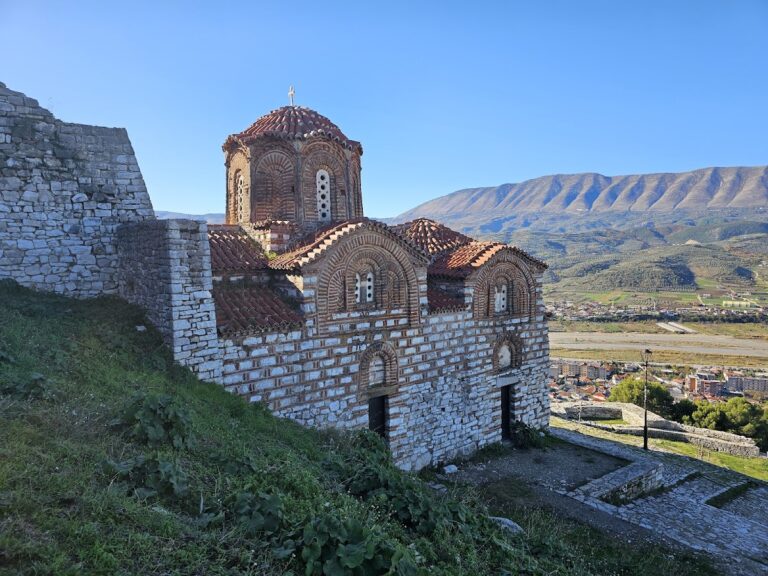
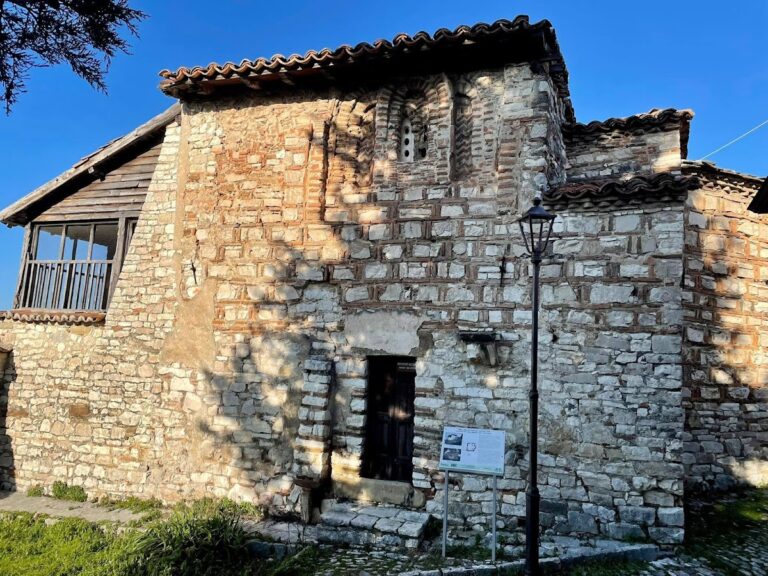
The relatively small church stands on a steep rock on the southern slope of the castle hill, below the southern walls of Berat Castle and outside the Kalaja quarter. It is a cruciform chapel, meaning that its plan forms a cross, and it was built without internal supports. A dome rises above the main body on a drum, a cylindrical or polygonal structure that lifts a dome above a building, while a narthex, or entrance vestibule, occupies the western side.
Stone and brick form the walls, which combine courses of red brick with stone. The cross-shaped plan is crowned by the dome. In comparison with other churches in Berat, the building has more developed proportions and a tendency toward greater refinement in its architectural forms.
Interior Decoration
Only a few traces of the wall paintings remain inside the church. A collection of frescoes and icons is preserved, providing surviving evidence of its religious decoration and Orthodox use.