Hamza-beg Mosque: An Ottoman Religious Landmark in Sanski Most


Site at a Glance
- Rating
- 4.9
- Popularity
- Very Low
- Country
- Bosnia and Herzegovina
- Primary era
- Early Modern
- Eras represented
- Early Modern
- Civilizations
- Ottoman
- Site type
- Religious
- Remains
- Mosque
On this page6 sections
History
Hamza-beg Mosque is an Ottoman-style mosque in Sanski Most, Bosnia and Herzegovina, built before 1557 by Hamza-beg Biharović, an Ottoman sanjak-bey, or provincial governor and military-administrative official. Biharović, who came from the area around Sanski Most, probably Kamengrad, established the mosque as a waqf, a permanent charitable endowment supporting a religious or public institution. It became the largest mosque in Sanski Most and is associated with its founder’s death in 1557, although it probably already existed by 1555.
Wartime destruction and rebuilding
The mosque was damaged during the Austro-Turkish War of 1693–1696, a conflict involving Austria and the Ottoman Empire. Croatian troops serving Austria destroyed Sanski Most during the war, and the mosque was rebuilt in 1705. That rebuilding phase is commemorated by an inscription beneath the minbar, the pulpit used for the Friday sermon.
Hamza-beg Mosque was destroyed during both World War I and World War II, then reconstructed in 1984. On 27 June 1992, during the Bosnian War, members of the Army of Republika Srpska demolished the mosque. Its building materials and gravestones were removed to a waste site. Reconstruction began in July 1997, supported by donations from the local Muslim community and its diaspora, as well as funding from a Saudi humanitarian organization. The rebuilt mosque was ceremonially opened on 6 August 2000.
Religious life and heritage status
The mosque’s religious role continued through the Ottoman and modern periods. Hafiz Muhamed-beg, an honorific used for someone who had memorized the Quran, was recorded as a religious teacher there in 1891. Salih ef. Arnautović held the same role in 1899; efendi was an Ottoman-era title for an educated or respected man, including a religious official. The mosque was placed on the provisional list of national monuments of Bosnia and Herzegovina by the Commission to Preserve National Monuments of Bosnia and Herzegovina.
Remains
The mosque is an Ottoman-style religious building associated with four minarets, and it is described as the only mosque in Bosnia and Herzegovina with that number. The earlier structure had one stone-built minaret with a wooden interior, while a small dome occupied the center of the ceiling. These features belong to the architectural history of a building that underwent repeated rebuilding after wartime destruction.
Inscription and interior feature
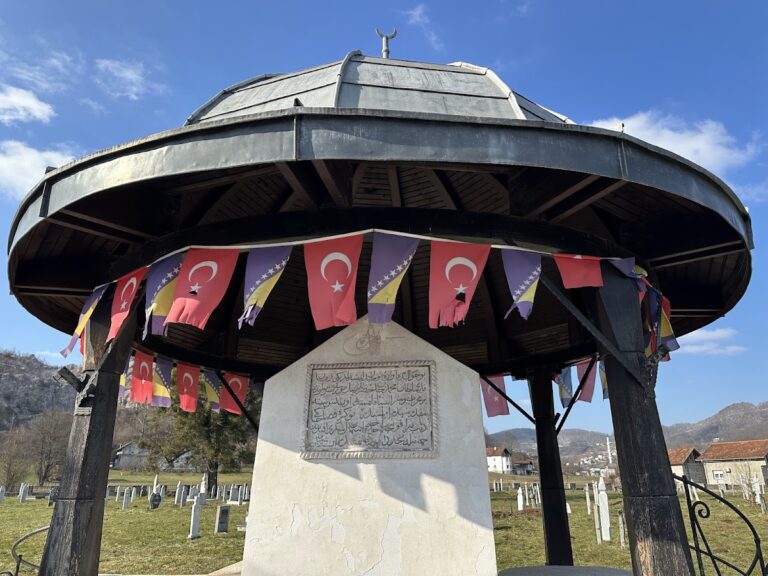
A 1705 inscription in talik, a flowing style of Arabic-script calligraphy used for handwritten texts in the Islamic world, was placed in the passage beneath the minbar. It reads: “It is the duty of every Muslim man and woman to seek knowledge. Hadith. Written by the poor Hasan, imam, 1117.” The inscription connects the rebuilt mosque with religious teaching and the transmission of Islamic knowledge.
Adjoining cemetery
A Muslim cemetery adjoins the mosque. Its oldest gravestones date to approximately 1751–1752, providing physical evidence of the religious community associated with the mosque in the eighteenth century.