Zvečaj: A Medieval Town-Fortress in Bosnia and Herzegovina


Site at a Glance
- Rating
- 4.6
- Popularity
- Very Low
- Country
- Bosnia and Herzegovina
- Primary era
- Medieval
- Eras represented
- Medieval
- Civilizations
- Kingdom of Bosnia
- Site type
- Military
- Remains
- Castle
On this page7 sections
History
Zvečaj is a medieval town-fortress in Bosnia and Herzegovina, positioned near the upstream entrance to the Vrbas canyon on the route between Banja Luka and Jajce. Its origins may reach back to the twelfth century, although its construction date remains uncertain. Together with Bočac and Greben, it controlled a narrow passage of considerable military importance.
Medieval Court and Stronghold
Zvečaj first appears in the historical record on 15 January 1404, when Grand Duke Hrvoje Vukčić Hrvatinić, a powerful Bosnian nobleman, used the fortress as his court while concluding an alliance with Dubrovnik against King Stjepan Ostoja of Bosnia. On 15 March 1419, Ostoja’s son received envoys from Dubrovnik at Zvečaj and confirmed privileges previously granted to the city.
Ottoman and Hungarian Control
After the fall of Ključ in 1463, the Ottomans occupied Zvečaj and established a garrison of 50 janissaries, elite Ottoman infantry soldiers, together with 30 other troops. They appointed Konstantin of Ostrovica, who was also a chronicler, as commander. Later that year, King Matthias Corvinus of Hungary recaptured the fortress during his campaigns against the Ottomans in the Balkans. He stayed at Zvečaj during his invasion of the region in 1480.
The Ottoman-Hungarian treaty of 1519 referred to Zvečaj, Banja Luka, and the Vrbas area as possessions of King Louis II of Hungary and Bohemia. Ottoman forces recovered the fortress in 1528, during the governorship of Gazi Husrev-bey, an Ottoman governor and military administrator in Bosnia. Andrija Dresneky surrendered Zvečaj without resistance. In a declaration dated 10 February 1528, King Ferdinand I identified Dresneky as a traitor and ordered the confiscation of his possessions in Požega County.
Later Military Use and Decline
Zvečaj continued to serve in defensive warfare around Banja Luka and elsewhere in Bosnia. Its later history included the Battle of Banja Luka on 4 August 1737, when the Bosnian Ottoman army defeated an Austrian force in five assaults. The defense was organized by Bosnian vizier Hećimoglu Ali Pasha, who assembled approximately 10,000 soldiers after failing to obtain assistance from Istanbul.
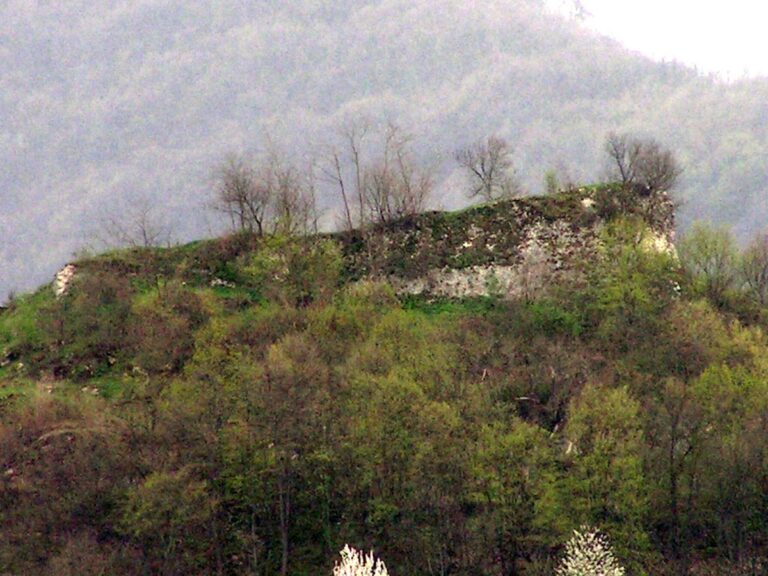
The fortress remained in use until the nineteenth century. It is now a ruin, with remains described as neglected and deteriorating. Zvečaj and the ruins of its fortified town are included on Bosnia and Herzegovina’s provisional list of national monuments, and the site is owned by the Government of Bosnia and Herzegovina.
Remains
Fortress Setting and Construction
Zvečaj occupies the southern side of a steep slope in the Vrbas canyon, on the left bank of the Vrbas River near the Tijesno locality. The fortress stands about 10 kilometres upstream, or south, of Banja Luka, and approximately 40 kilometres downstream from Jajce. Its position at the narrow canyon entrance was strengthened by a high vertical rock rising beside the river.
The stronghold was spacious and irregular in plan, with its form adapted deliberately to the rocky terrain. Limestone was the principal building material, laid in dry-stone walling. The surviving complex includes the general ruins of the fortress and its fortified town, which remain in a ruinous condition.
Surviving Tower
A tower approximately 10 metres high is the principal surviving element apart from the general ruins. It stands as the clearest remaining part of the defensive complex, while the wider fortress has deteriorated over time.
Nearby sites