Moštanica Monastery: A Serbian Orthodox Monastic Complex in Bosnia and Herzegovina


Site at a Glance
- Rating
- 4.9
- Popularity
- Very Low
- Country
- Bosnia and Herzegovina
- Primary era
- Early Modern
- Eras represented
- Early Modern, Modern
- Civilizations
- Ottoman
- Site type
- Religious
- Remains
- Monastery
On this page13 sections
History
Moštanica Monastery is a Serbian Orthodox female monastery in Bosnia and Herzegovina, near Prijedor, dedicated to the Archangel Michael. It belongs to the Eparchy of Banja Luka, the territorial jurisdiction of the Serbian Orthodox Church governed by a bishop. Its origins are traditionally placed as early as 1111, although other traditions date its construction or refoundation to the late medieval period or the early sixteenth century.
Uncertain origins and early traditions
The monastery’s founder and foundation date remain uncertain. Traditions connect its beginnings with Stefan Dragutin and King Milutin, medieval Serbian rulers of the Nemanjić dynasty, as well as with Saint Simeon Nemanja, Saint Sava, or monks from Mileševa Monastery. The claim that Moštanica was founded by the Nemanjić dynasty cannot be established with certainty.
One tradition holds that monks from Mileševa came to Moštanica after their monastery was burned and devastated in the early sixteenth century. They are said to have rebuilt an existing church. Another tradition maintains that the monastery was moved from an earlier location, possibly after its first complex had been burned and destroyed.
The monastery in the sixteenth and seventeenth centuries
The first written reference to Moštanica is the Otočnik, an Orthodox monastic manuscript written there in 1579 during the abbacy of Gregory. Its production indicates that a developed religious community was already active at the monastery, or at an earlier institution on the same site. The manuscript is now preserved at Hilandar, the Serbian Orthodox monastery on Mount Athos.
Following the Ottoman conquest of Kostajnica in 1556, Orthodox settlers in the surrounding region rebuilt or re-established Moštanica. The first documented rebuilding took place in 1557 during the tenure of Serbian Patriarch Makarije Sokolović. Popular tradition also links this work with Hasan Pasha Predojević, an Ottoman military and administrative official, although that attribution remains uncertain.
Moštanica developed as a religious and scribal centre. A Gospel was written there in 1607 during the abbacy of Seraphim. The hieromonk Gavril, a monk ordained as a priest, donated a copy of Chrysostom’s homilies that had been written on Mount Athos in 1635. A further record from 1698 refers to book production connected with the monastery.
Repeated destruction and rebuilding
The monastery was repeatedly caught up in conflicts between the Ottoman Empire and Austria, as well as in regional uprisings. It was burned in 1638 and rebuilt in 1642. A second burning in 1683 was followed by rebuilding in 1699. After another destruction in 1719, the monastery was rebuilt in 1720. It was burned again in 1786 and rebuilt in 1792 under Abbot Venijamin Vlainić.
Further destruction came in 1811, followed by rebuilding in 1833 under the archimandrite and abbot Gerasim Gvoić. An archimandrite is a senior monastic title in Eastern Christianity. During Petar-Pecija Popović’s uprising, the monastery was burned again in 1858 and rebuilt in 1863.
After another burning on 16 September 1875, Moštanica stood deserted for six years. It was rebuilt in 1883, with the repairs supervised by the hieromonk Ćiril Adžić. The hajduk Petar-Pecija, who was killed fighting the Ottomans in 1875, was buried near the monastery. A commemorative plaque was placed there in August 1933.
War damage and protection
The Ustasha, a Croatian fascist movement and regime active during the Second World War, burned the monastery for the ninth time in 1941. The monks were expelled, while the church, sacristy, and archives were set on fire. Part of the archive was saved, although the location of the surviving documents is now unknown.
During the Kozara offensive in July 1942, German forces bombed the monastery. Reconstruction followed in 1947. In 1953, the state of Yugoslavia placed Moštanica under legal protection as an important cultural and historical monument. The monastery is also protected as a cultural heritage monument, a legally recognized site or structure valued for its historical, architectural, or cultural importance.
Relics, traditions, and continuing religious life
Moštanica’s history is linked with the martyr Theodore, although traditions differ about his identity. One tradition identifies him as Theodore Komogovinski, also known as the monk Teodor Sladić, whose hand was preserved as a relic. Another connects the monastery’s name with the Great Martyr Theodore Tiron, an early Christian martyr.
According to the tradition surrounding the relic, it was transferred in the eighteenth century to Komogovina because of wartime danger. A new church and monastery were built there and called Moštanica after Theodore’s relics. That institution later became known as Komogovina. The name Moštanica itself is traditionally linked either to the nearby Moštanica River or to the relics of Theodore. In the river tradition, the name is explained through the word for “bridge,” recalling the river’s reputed 44 wooden footbridges.
Periods of destruction also led monks connected with Moštanica to establish other monasteries. Monks who fled the burning of 1638 founded Lepavina, while the hieromonks Jovo Svilokos and Silvester Prodanović founded Komogovina after the destruction of 1683.
Moštanica is also associated with Deacon Avakum, who fled to Serbia after the destruction of 1811 because of Ottoman persecution. During Hadži Prodan’s uprising in 1814, he was executed by impalement. A commemorative plaque was installed at Moštanica in 1933. The monastery continues to function as an Orthodox religious institution, and the traditional Assembly at Moštanica is held there.
Remains
Setting and main church
Moštanica stands at about 202 metres above sea level in the valley of the Moštanica River, on the northern slopes of Kozara and against the slope of Mala Gradina. The complex occupies a sheltered area of level ground surrounded by linden trees. A wooden footbridge crosses the river near the monastery, and a cross stands on a bridge over the water. Hermitages traditionally called the monks’ caves lie south of the complex.
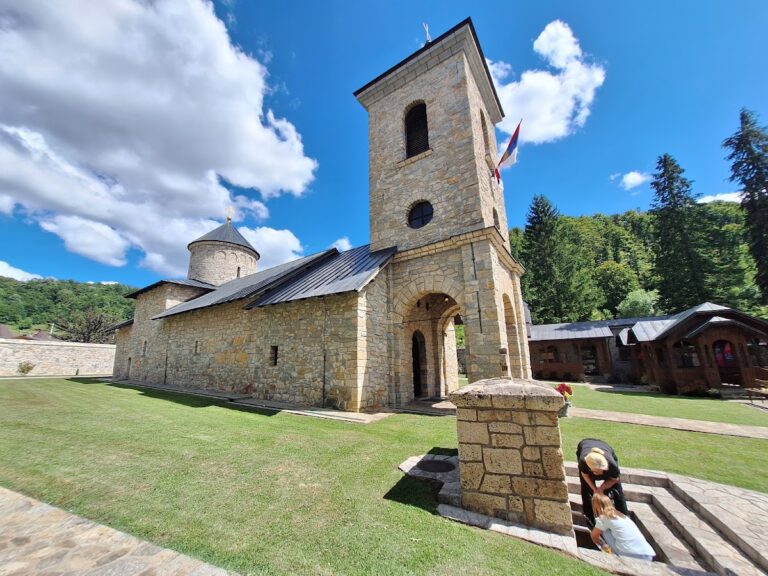
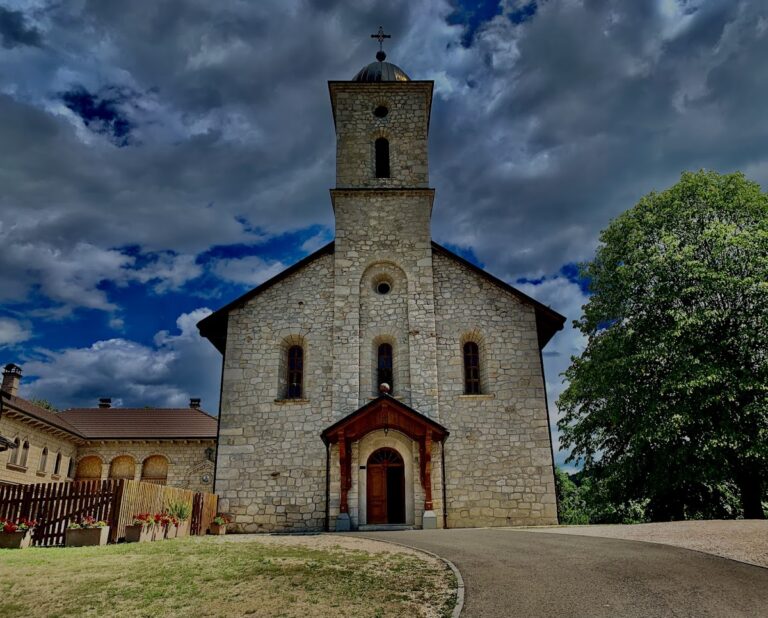
The present church is built from large, carefully dressed blocks of white stone quarried in the Kozara village of Vojskovi. Its walls are approximately one metre thick and more than six metres high. The massive construction is associated with the building’s survival through repeated burning and devastation. The church was reportedly roofless for 30 years, and its builders may have come from the Adriatic coastal region.
The naos and dome
The church has a cruciform ground plan divided into two sections. The principal section is the naos, the main worship space in an Eastern Christian church. It is rectangular and contains three apses, which are altar or choir recesses with polygonal or curved ends. The larger and deeper central apse serves as the altar area, while two smaller elliptical apses serve the choirs. Additional recesses in the altar apse give it a tripartite appearance, and the exterior conches are five-sided.
Four square stone piers stand at the centre of the naos. They are plain, without capitals or ornament, and are joined by semicircular arches. Above them rises a square base about one metre above the roof, carrying an octagonal dome tower with eight narrow windows. Each window is approximately two metres long, and the church reaches about 23 metres in height. The semicircular arches and dome construction have been described as Romanesque features, while the carved heart-shaped friezes have been associated with a Moorish style. The exterior has also been compared with the appearance of Visoki Dečani.
Porch and entrances
An exterior narthex, or entrance porch, is attached to the church. The southern entrance is unusually small and low, while the building has no northern or western entrance. A separate small doorway near the altar was intended for the monks and faces the monks’ hermitage farther from the church. Low doorways of this kind are characteristic of churches in the Bosnian Krajina, a historical region in northwestern Bosnia, and were intended to prevent mounted Ottoman soldiers from entering.
Women’s church
The second section is identified as the women’s church. It is narrower and lower than the naos and is separated from it by a thick wall with a doorway at the centre. Its vault rests on two octagonal piers, and it does not have a dome tower. The exterior walls are arranged in three horizontal levels. The middle level is recessed by about 10 to 15 centimetres, creating a belt-like band around the building. Southern entrance doors and a floor paved with rectangular stone slabs complete the surviving architectural description.
Decorative features and furnishings
Heart- or leaf-shaped carved friezes decorate the doors and windows. No original interior wall painting survives, and it is uncertain whether the church was fully frescoed. A former fresco of the Archangel Michael occupied a high recess on the western exterior wall. It was destroyed during the last war and replaced by the present fresco, painted in 1976.
An image of the Virgin and Child stands on the first pier to the left. Tradition says that it was brought from Russia about 120 years before its repair in 1902. The image bears three bullet holes attributed to Ottoman soldiers. The surviving furnishings and iconostasis are of more recent date.
Monastic buildings and associated objects
The complex includes a residence building constructed in 1972 and renovated and enlarged in 2005. A smaller chapel with a bell tower dedicated to Saint Basil of Ostrog was built in 2002. The monastery preserves wax and a stone associated with Christ’s tomb, together with a slipper associated with the relics of Saint Basil of Ostrog.
A monastery key dated 1711 is preserved in a museum in Belgrade. The monastery cross was lost during the destruction of 1941 and later found at Banja Monastery before being transferred to a museum. It was not returned to Moštanica.