Selimiye Mosque in Konya: A Sixteenth-Century Ottoman Mosque



Site at a Glance
- Rating
- 4.8
- Popularity
- Medium
- Country
- Turkey
- Primary era
- Early Modern
- External website
- Open
- Eras represented
- Early Modern
- Civilizations
- Ottoman
- Site type
- Religious
- Remains
- Mosque
On this page7 sections
History
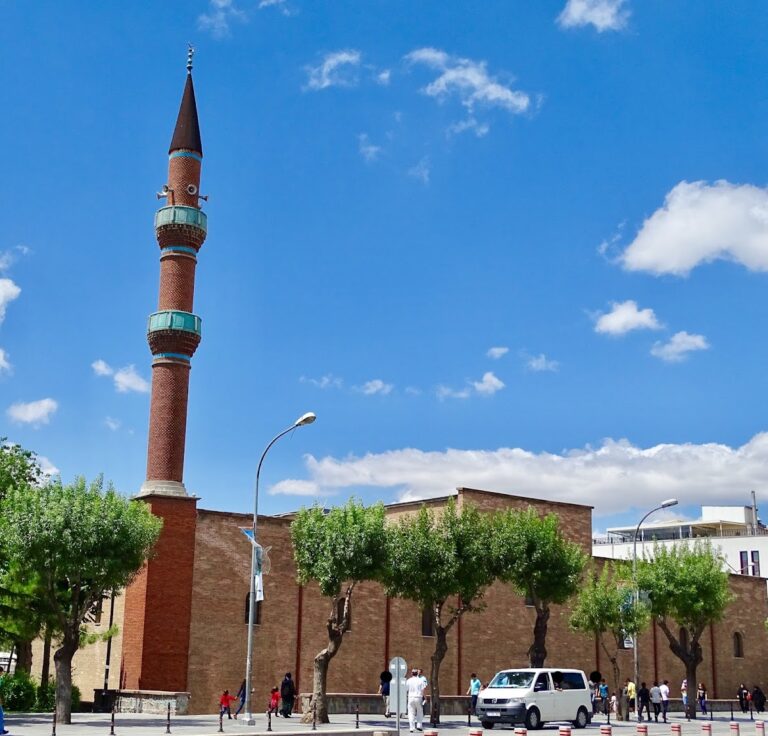
Selimiye Mosque, also known as the Selim II Mosque, is a sixteenth-century Ottoman Sunni mosque in Konya, Türkiye. Selim II commissioned it in 1558, when he was still a şehzade, an Ottoman prince, and governor of a sanjak, an Ottoman provincial district. Construction ended in 1570, after he had become sultan. The mosque is a local example of Ottoman Turkish architecture and stands in the Karatay district, within Konya’s commercial center.
Commission and completion
The mosque was built during the tenure of Mimar Sinan, the Ottoman Empire’s chief architect and most celebrated sixteenth-century architect. Sinan did not include the building in his autobiographies. When referring to Konya, he recorded the renovation of a hospice rather than the construction of Selimiye Mosque.
Repairs and setting
Major repairs took place in 1685, 1816, and 1914. Following these interventions, the mosque remained intact in its original form. It stands east of the Aziziye Mosque and beside the funerary shrine complex of Mevlana Celalüddin Rumi, the thirteenth-century Persian Sufi mystic and poet. That complex is now the Mevlana Museum.
Remains
Portico and minarets
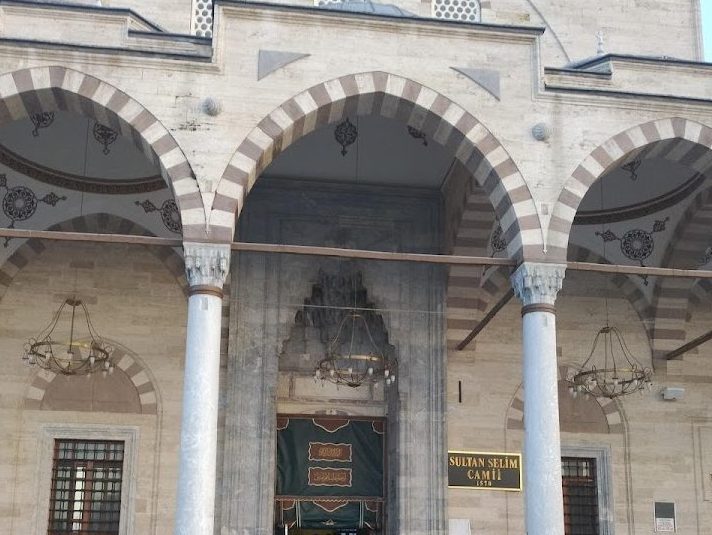
Selimiye Mosque is a double-minaret example of Classical Ottoman architecture. Its northern facade faces the square and carries a columned portico with seven domes, supported by six slender marble columns. A slender minaret with a single balcony rises at each end of the portico. The building has three entrances: one through the portico and two lateral doorways beside the minarets. Turkish inscriptions above the side entrances compare a believer in the mosque with a fish that lives and enjoys itself in water, while likening a hypocrite to a bird confined in a cage.
Prayer hall
The square prayer hall is organized around a central dome set on a square drum. Broad arches and richly decorated corner vaulting connect the hall to the dome, while three smaller domes on either side flank the central one. Two massive columns support the central dome. Inside, the blue marble mihrab, the prayer niche indicating the direction of Mecca, and the white marble minbar, the stepped pulpit used for the Friday sermon, are both finely carved.
Yusuf Aga Library
A domed building attached to the mosque’s southeastern corner houses the Yusuf Aga Library, constructed in 1795. It has two rows of windows. A green park extends in front of the mosque.