Mosque of Muderis Ali Efendi: An Ottoman-Era Mosque in Prizren


Site at a Glance
- Rating
- 4.9
- Popularity
- Very Low
- Country
- Serbia
- Primary era
- Early Modern
- Eras represented
- Early Modern
- Civilizations
- Ottoman
- Site type
- Religious
- Remains
- Mosque
On this page6 sections
History
The Mosque of Muderis Ali Efendi is an Ottoman-period Sunni Muslim mosque in Prizren, Kosovo, built between 1543 and 1581, with its foundation specifically dated to 1581. Also known as the Mosque of Ali Hoxha, it is considered one of the oldest mosques in Kosovo. Its Ottoman setting reflects a period when the empire ruled much of southeastern Europe and Islamic architectural traditions developed alongside regional building practices.
Foundation and religious role
Ali Efendi, the mosque’s founder, served as the muderis of Prizren. A muderis was a teacher or professor in an Islamic religious school, so the title identifies Ali Efendi’s scholarly and educational office. He was buried in the mosque’s garden. The mosque is affiliated with Sunni Islam, the largest major branch of Islam, and may have been established on the site of an earlier school, although that possibility remains uncertain.
The 1905 boycott
In 1905, the mosque became central to organizing a boycott of Catholic Albanian shops in Prizren. The action lasted three years and followed the alleged discovery of a pig’s head in the mosque before morning prayer. Because the mosque stood near the Catholic cathedral, the incident was interpreted as a deliberate provocation, and Muslim residents avoided economic dealings with the targeted Catholic businesses.
The incident was later attributed speculatively to the Serbian rector of an Orthodox theological school. This theory presented the act as an attempt to divide Albanians who were then pursuing independence from the Ottoman Empire. The alleged provocation and the resulting boycott form part of the mosque’s history as a place involved in Prizren’s religious and social tensions.
Damage, protection, and restoration
After the Second World War, the mosque was closed for a period and used as a Red Cross center. This non-religious use, together with alleged neglect, caused severe damage. A later fire caused further harm in 1963, although city records also give 1975 as the year of the fire. These events altered the building’s original character.
Several restoration campaigns have since addressed the mosque. Recent work focused on the walls, roof, and minaret, with the aim of preserving the historic building and preventing further deterioration. In 1989, the Municipality of Prizren declared the mosque a cultural monument. It is also listed as a protected cultural and historical monument in Kosovo’s cultural-heritage database. The mosque remains open for worship.
Remains
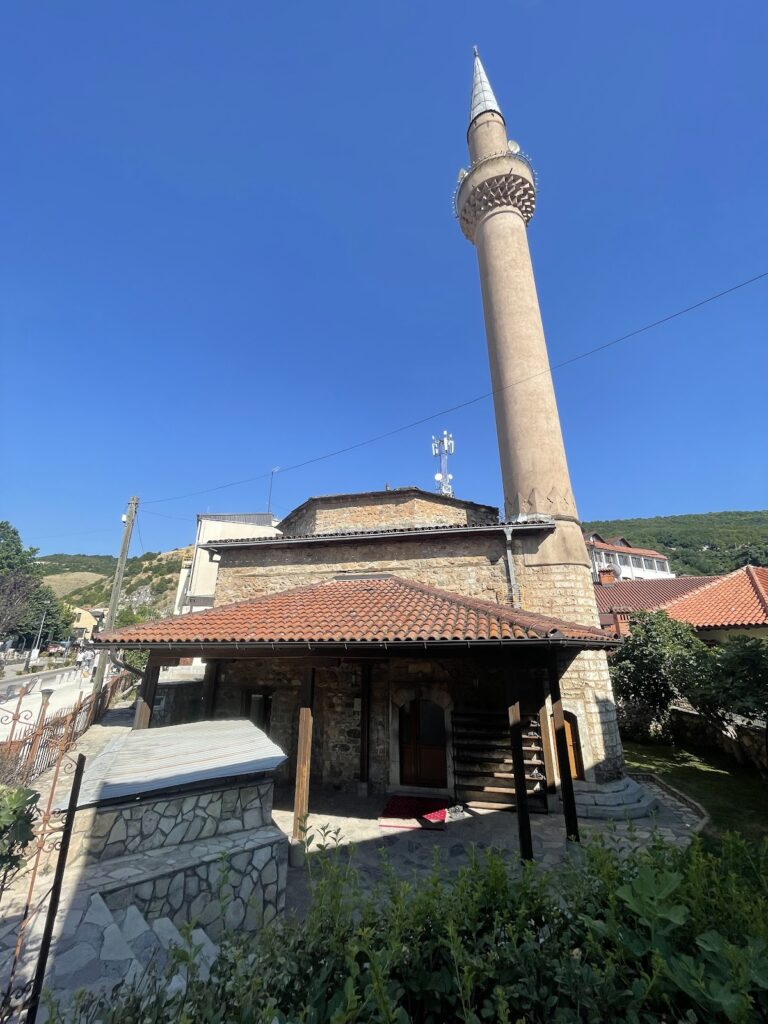
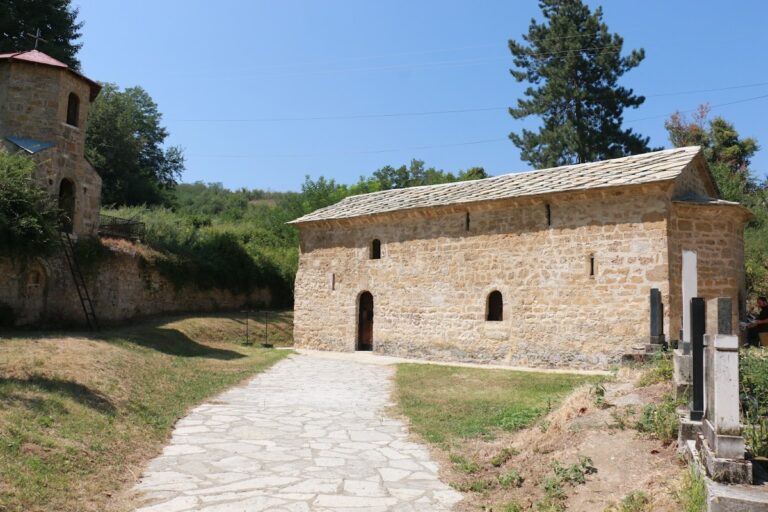
The mosque occupies a triangular property of 877 square metres on Papa Gjon Pali Street, in Prizren’s historic urban core below the city’s Catholic Cathedral. The site is also associated with the Muderis Ali Efendi quarter near the old commercial center. Within the wider triangular plot, the mosque itself has an approximately square plan. Its construction combines stone and brick, while a wooden roof covered with red tiles replaces the lead-covered domes characteristic of larger Ottoman mosques.
Minaret and cemetery
A single minaret stands on the right-hand side of the mosque. Built of finely cut stone, it is the tower traditionally associated with a mosque and used for the call to prayer. The outer courtyard contains a small cemetery with old Ottoman gravestones. Among them is the tomb of Ali Efendi, linking the surviving burial ground directly to the founder of the mosque. Conservation work has restored the walls, roof, and minaret after the damage caused by postwar misuse and fire.