Ibrahim Pasha Mosque: An Ottoman Mosque in Rhodes


Site at a Glance
- Rating
- 4.5
- Popularity
- Low
- Country
- Greece
- Primary era
- Early Modern
- Eras represented
- Early Modern, Modern
- Civilizations
- Italian, Ottoman
- Site type
- Religious
- Remains
- Mosque
On this page6 sections
History
Ibrahim Pasha Mosque is an Ottoman mosque in Rhodes, Greece, built after the Ottoman Empire captured the island from the Knights Hospitaller in 1522. Its construction took place under Sultan Suleiman the Magnificent, whose reign from 1520 to 1566 was marked by imperial expansion and extensive building. The mosque stands in what is now Platonos Square, within the medieval walled city.
Ottoman foundation
The Ottoman conquest brought Turkish-Muslim communities into the walled city. New mosques were established for Muslim worship, while some Christian churches were converted for the same purpose. Ibrahim Pasha Mosque formed part of this transformation. Its construction date remains uncertain, with dates of 1530–31 and 1540–41 both given. The later date corresponds to 947 AH.
An inscription identifies the building as the oldest mosque in Rhodes. It is also regarded as the oldest of the seven mosques within the old walled city and as the oldest mosque on the island.
Religious use and later administration
The mosque has continued to serve as a place of Muslim worship and serves Rhodes’s Turkish-Muslim community. During the period of Italian rule, when Rhodes was administered by Italy in the twentieth century, its minaret was rebuilt separately from the mosque in reinforced concrete in 1928. Restoration work on the minaret was commissioned again during the 1930s.
Although religious use continued, the mosque received an official operating license from the Greek Ministry of Education and Religion only in 2019. The same licensing action also covered the Defterdar and Gazi Hasan Pasha mosques on the neighboring island of Kos. Ibrahim Pasha Mosque is currently the only mosque in Rhodes open for worship.
Remains
Prayer hall and entrance
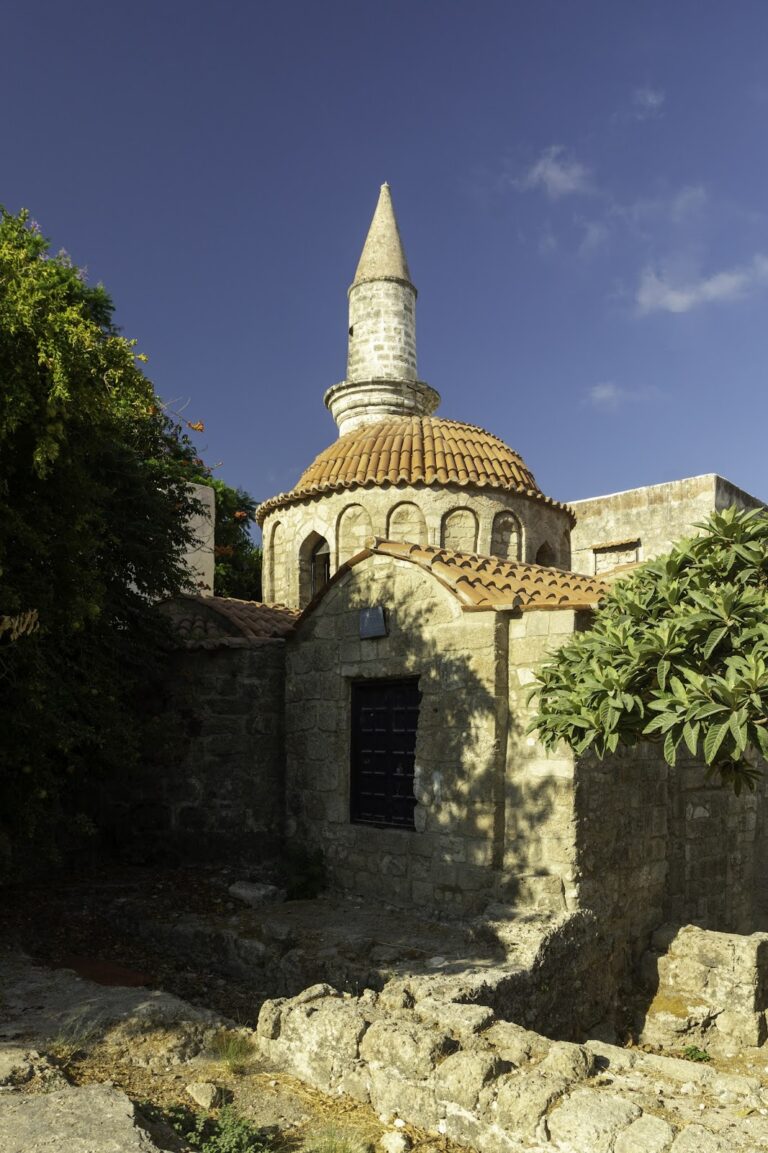
The mosque is built of stone and brick. Its principal prayer space is a large square hall covered by a single twelve-sided dome with an exterior diameter of approximately 11.5 meters. The interior is relatively plain, with a marble minbar, the raised pulpit used for the Friday sermon.
Two successive pediments extend along the north side. The entrance is also described as having two porticoes, roofed entrance or colonnaded passages, while the final congregation area adjoining the main hall is covered by three domes.
Minaret and courtyard
A single minaret rises from the northwestern corner of the roof. The tower traditionally associated with a mosque has a polygonal base, a cylindrical shaft, and one balcony. Its reinforced-concrete rebuilding in 1928 forms a separate later phase from the mosque itself.
An eight-sided fountain stands at the center of the external courtyard. Its roof is made of wood, providing a distinct feature within the mosque’s surrounding space.