Yeşil Mosque Iznik: An Early Ottoman Mosque in Türkiye


Site at a Glance
- Rating
- 4.8
- Popularity
- Low
- Country
- Turkey
- Primary era
- Medieval
- Eras represented
- Medieval, Early Modern
- Civilizations
- Ottoman
- Site type
- Religious
- Remains
- Mosque
On this page7 sections
History
Yeşil Mosque Iznik is a historic Ottoman mosque in Türkiye, built between 1378 and 1391 in the early Ottoman architectural tradition. It is among the earliest examples of this architectural tradition and remains in use for Sunni Muslim worship.
Construction under Murad I
Construction was ordered by Çandarlı Kara Halil Hayreddin Pasha, the grand vizier, or chief minister and highest-ranking official in the Ottoman administration, during the reign of Sultan Murad I. The mosque was completed by Çandarlı Ali Pasha, Kara Halil Hayreddin Pasha’s son and successor. An inscription gives the construction period as 1378–1391 and names Hacı bin Musa as the architect.
The mosque formed part of a larger religious and public complex that included an imaret, a charitable institution providing food for travelers, students, and poor people. A bathhouse was built southeast of the mosque in the seventeenth century. It ceased to function in the nineteenth century, when an oven was constructed on the former bathhouse site.
Damage and Restoration
Yeşil Mosque Iznik was damaged in 1922 by the Greek army during the Turkish War of Independence. Restoration took place between 1956 and 1969, followed by separate work on the minaret between 1961 and 1965. A further restoration was carried out in 2015.
Remains
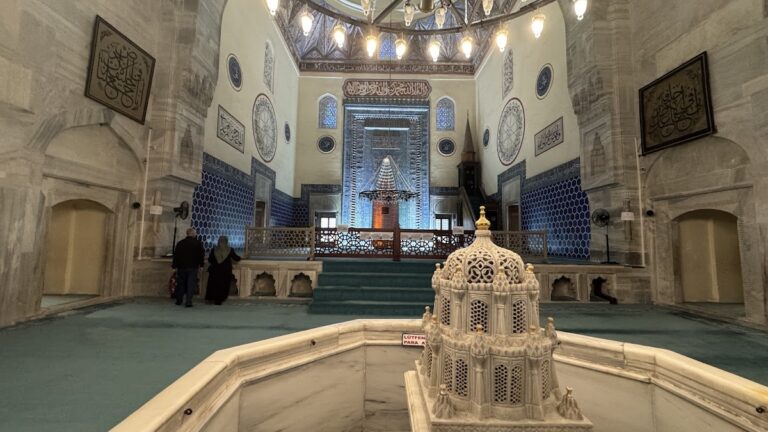
Yeşil Mosque Iznik stands within the walls of Iznik near Lefke Gate, at the eastern edge of the city. Its surviving structure is organized around a three-bay portico and a single prayer hall covered by one central dome. The dome is approximately 10.5 metres in diameter, rises 17.5 metres above the floor, and has four windows.
Prayer Hall and Mihrab
The lower interior walls are faced with gray marble panels. A marble mihrab, the prayer niche indicating the direction of Mecca, occupies the prayer hall and rises approximately 4 metres high. Its niche is enclosed by a richly decorated rectangular marble frame, flanked by rows of columns, and surrounded by an undecorated border.
Tiled Minaret
A single minaret rises from the mosque’s northwestern corner. Approximately 25 metres high, it is decorated with about 12,000 glazed terracotta tiles in green, yellow, turquoise, and dark purple. The multicolored tilework gives the mosque its name, Yeşil, the Turkish word for “green.”
Bathhouse Remains
Southeast of the mosque, the surviving remains include the ruins of the seventeenth-century bathhouse. The later oven built on the bathhouse site also forms part of the physical history of this area.