Church of St Peter, Windrush: A Medieval Anglican Church


Site at a Glance
- Rating
- 4.4
- Popularity
- Very Low
- Country
- United Kingdom
- Primary era
- Medieval
- Eras represented
- Medieval, Early Modern, Modern
- Civilizations
- English
- Site type
- Religious
- Remains
- Church
On this page7 sections
History
Church of St Peter is an Anglican church in Windrush, United Kingdom, built in the 12th century as a chapel of Great Barrington. It belonged to Llanthony Priory, a medieval Augustinian religious house, placing the church within a wider monastic institutional network.
Medieval origins and development
The church was established during the 12th century. Its south transept was added in the 14th century, extending the medieval building beyond its original arrangement and forming part of the structure seen today.
Victorian restoration and later care
Henry Woodyer, a 19th-century English architect known for ecclesiastical buildings and restorations, carried out a major restoration between 1874 and 1876. The work added an organ chamber and a vestry. In 2015, the south doorway was cleaned and treated to protect it from further decay.
Church of St Peter remains part of the Church of England and belongs to the Windrush benefice in the Diocese of Gloucester, within the Province of Canterbury. It has been protected as a Grade I listed building since 26 January 1961. In England, Grade I is the highest level of statutory protection for buildings of exceptional architectural or historical interest.
Remains
Plan and construction
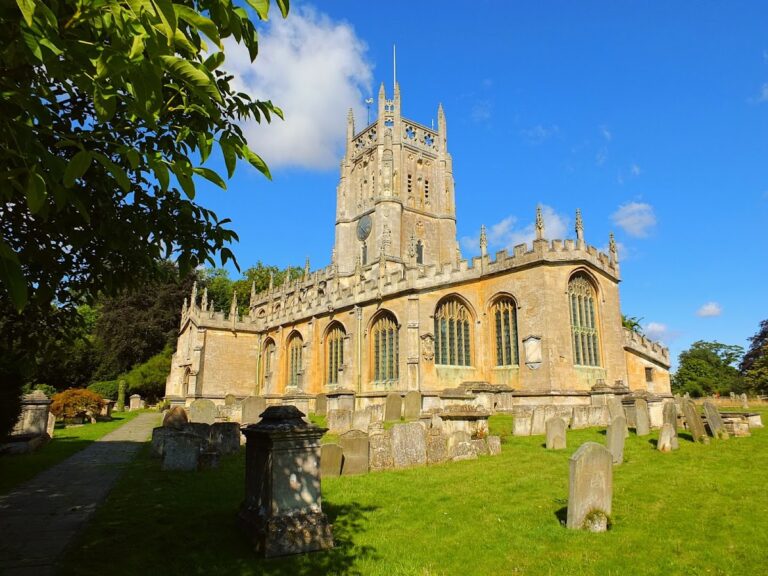
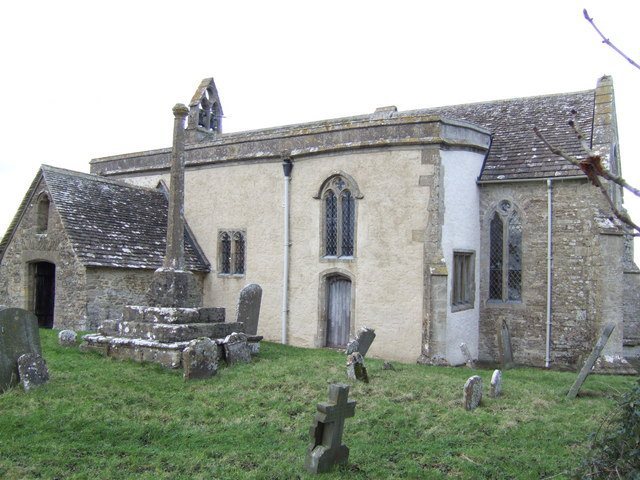
The church is built of limestone and covered by stone-slate roofs. Its plan consists of a three-bay nave, a south aisle, a south transept, and a chancel. The organ chamber and vestry added during the Victorian restoration form part of this arrangement, linking the medieval core with the building’s later development.
South doorway
The south doorway has a Norman surround, belonging to the Romanesque style introduced into England after the Norman Conquest. Its arch is framed by two rows of individually varied beakhead carvings, projecting heads with grotesque or animal-like forms that represent demons. An outer saw-tooth pattern completes the ornament. Two mass dials, medieval scratch-marked sundials used to indicate times associated with church services, are also set in the doorway. The entrance was cleaned and protected against further decay in 2015.
Tower, bells, and interior furnishings
A three-stage tower contains six bells. Five were cast in 1707 by Rudhall of Gloucester, a Gloucester bellfounding firm associated with church bells. Inside, the octagonal font was carved in the 15th century, while the pulpit is Jacobean, a style associated with the reign of James I of England from 1603 to 1625.