Saint Clement Church: A Medieval Parish Church in Brunssum, Netherlands


Site at a Glance
- Rating
- 4.7
- Popularity
- Low
- Country
- Netherlands
- Primary era
- Medieval
- External website
- Open
- Eras represented
- Medieval, Early Modern, Modern
- Civilizations
- Dutch, Holy Roman Empire
- Site type
- Religious
- Remains
- Church
On this page11 sections
History
Saint Clement Church is a medieval church in Brunssum, Netherlands, probably built around AD 1000 and dedicated to Saint Clement, a first-century Christian leader traditionally regarded as a pope. The dedication may indicate that an earlier church stood at the same site. The building occupies a rise above the Merkelbeek stream, where important Roman roads once crossed the valley.
Roman roads and the medieval parish
The church stands near the route of a Roman road running from Aachen through Heerlen and Tüddern to Xanten. At this location, the road crossed the Merkelbeek stream. A second Roman road probably joined Gangelt, Merkelbeek, and Maastricht, also crossing the stream in this area. These routes help explain the long-standing importance of the site within the local landscape.
A record from 1234 concerning a meeting of the Susteren deanery mentions a priest of Merkelbeek. By then, the Merkelbeek parish was already independent. Saint Clement Church continued as its parish church until 1879, when a larger Neo-Gothic church was built and dedicated in Merkelbeek, about 2 kilometres away. J. Kayser had designed the new church in 1875.
From parish church to monastic use
After the parish moved, the older church became a convent chapel for the Sisters of the Precious Blood from Sittard. Benedictines occupied the complex in the 1890s, followed by the Discalced Carmelites from 1921 to 1965. The Carmelites, a reformed branch of the Carmelite order known for its traditional practice of going barefoot or wearing simple sandals, operated a theological institution there. The monastery was renamed Our Lady of the Blessed Sacrament.
The Benedictine community had established itself near the Prussian border as a temporary base for German monks. Their settlement in Prussia had been hindered by the Kulturkampf, the nineteenth-century conflict between the German state and the Roman Catholic Church, when religious orders faced legal restrictions. The Merkelbeek priorate, a Benedictine house governed by a prior, was directed by Hermann Renzel. It became an abbey in 1896, and Renzel became its first abbot and the first abbot in the Netherlands since the Reformation.
In 1900 the Benedictines opened a large Neo-Gothic abbey church dedicated to Saint Benedict. Father Petrus Lambrecht designed it. The abbey subsequently used the name Saint Benedict and Saint Clement. In 1906, the monastery at Kornelimünster was founded from Merkelbeek. In 1922 and 1923, Abbot Romuald Wolters and the Benedictine community moved to the newly built monastery of Saint Benedictusberg at Vaals-Mamelis.
Later transformation and preservation
In 1967 Saint Clement Church became part of Huize Tieder, a residential home for older people. From 1968, the former monastery complex was converted for that use, and it later served for about ten years as an asylum-seeker centre. When the complex was demolished in June 2009, the church and several associated features were retained, including the churchyard wall, Lourdes grotto, and the tomb of Baron de Negri and his wife.
A major restoration took place in 2013 and 2014. Saint Clement Church is now deconsecrated and functions as a museum church and a venue for performances, concerts, civil marriages, and ceremonies. The church, churchyard wall, Lourdes grotto, and De Negri tomb are listed together as Dutch national monuments. Saint Clement Church received national-monument status on 10 May 1966, under monument number 42088.
Remains
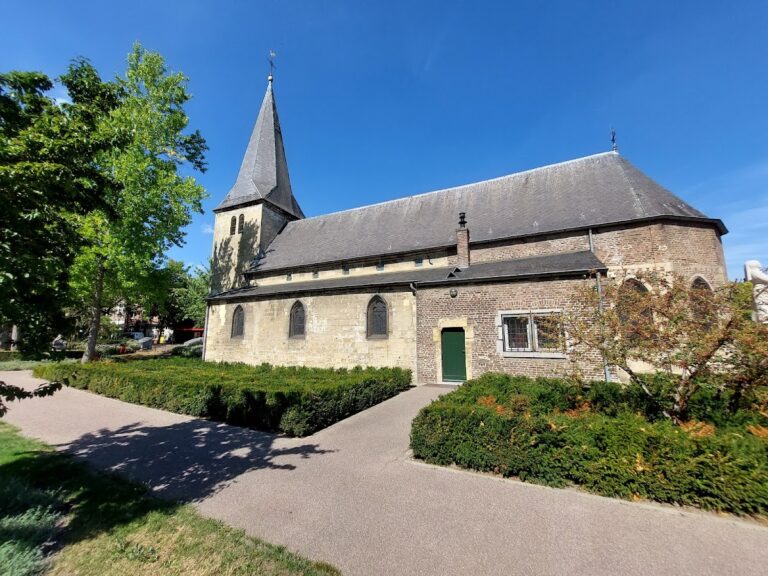
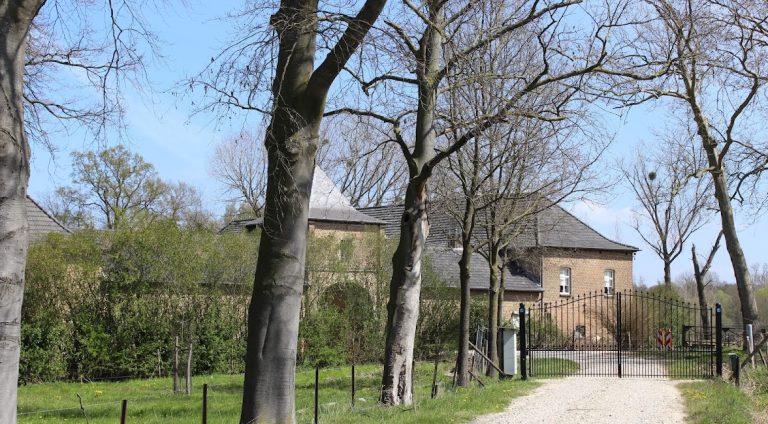
Saint Clement Church is a small building on the northern side of the Merkelbeek valley, raised above the stream. It began as a single-nave church, meaning that it had one principal nave without separate side aisles. Later alterations included a five-aisled extension, although the side aisles described in earlier accounts have since disappeared. The tower was rebuilt or substantially altered in 1746 or around 1750. Roman-period roof tiles are incorporated into the south wall.
Church structure and interior decoration
Building and tower
The surviving church combines its early single-nave form with later changes to the tower and the former multi-aisled extension. Its position above the Merkelbeek stream reflects the physical setting of the medieval church, while the Roman roof tiles in the south wall connect the building materially with the older occupation and road network of the area.
Wall paintings
A colour investigation carried out in 2008 by the Stichting Restauratie Atelier Limburg, commissioned by the municipality of Brunssum, revealed colourful wall paintings beneath whitewash and textured paint. Dom Romanus Jacobs, a church painter, created the paintings in 1901 over earlier work. The earlier paintings belonged to the renovation carried out around 1892 for Abbot Herman Renzel.
The restoration exposed and repaired Jacobs’s paintings and related decoration. The work included imitation draperies on the choir walls and painted surrounds around the windows. The decoration was restored to approximately its appearance in 1903, while some remnants of the older paintings were retained. The surviving programme includes an image of King David playing the harp and a painting of Saint Benedict in the church attic.
Churchyard features
Lourdes grotto
The Lourdes grotto stands in the former cemetery beside the church, within the convent garden. A Lourdes grotto is a devotional structure modeled on the Marian apparition site at Lourdes in France and used for prayer and pilgrimage. The grotto was created in the 1880s on the initiative of Pastor Kamps and blessed in 1887. Built from field bricks made in nearby ring kilns, it is approximately 5 metres high and 6.5 metres wide. A smaller Sacred Heart grotto was constructed close by. The site became an important local pilgrimage destination and remained popular until the mid-1960s.
De Negri tomb
The churchyard also contains the monumental tomb of Baron de Negri and his wife. The aristocratic couple spent their final years at the medieval Vossenhof, also known as the Lower Court of the À Campo family. Their tomb contains a small burial crypt with two coffins placed side by side. The family arms appear on the coffin lids, and the tomb has been completely restored.
The surrounding grounds are known as the Clemens Domain. Clemens Park was laid out there in 2022, forming part of the later landscape associated with the preserved church and its churchyard features.