St Andrew’s Church, Newcastle upon Tyne: A Medieval Parish Church


Site at a Glance
- Rating
- 4.8
- Popularity
- Very Low
- Country
- United Kingdom
- Primary era
- Medieval
- External website
- Open
- Eras represented
- Medieval, Early Modern
- Civilizations
- British, English
- Site type
- Religious
- Remains
- Church
On this page8 sections
History
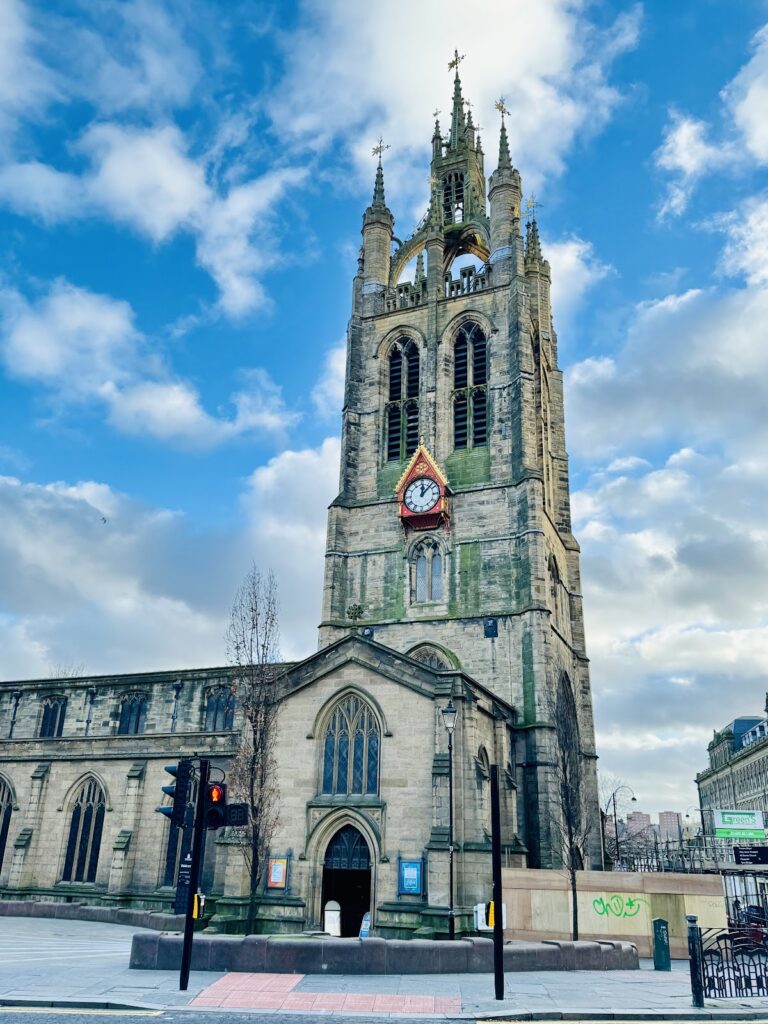
St Andrew’s Church is a parish church of the Church of England in Newcastle upon Tyne, United Kingdom, with a history extending back to the 12th century and a building formed mainly in the 13th and 14th centuries. It belongs to the Diocese of Newcastle, within the Archdeaconry of Northumberland and the Newcastle Central Deanery. The church is a Grade I listed building, the highest category of statutory heritage protection in England, reserved for structures of exceptional architectural or historic interest.
Medieval origins and later alteration
The church’s surviving fabric is predominantly medieval, although its origins reach back to the 12th century. Most of the construction took place during the 13th and 14th centuries, when Newcastle’s town wall was also an important part of the urban setting around the church.
The porch was given a new front in 1726. Further restoration followed in 1866 under Fowler, adding to the building’s record of alteration while retaining its medieval foundation and principal structure.
The church and Newcastle’s town wall
A substantial section of Newcastle’s medieval town wall survives immediately north of the church. The New Gate, a major entrance in the city wall, stood close to the church’s east side until it was demolished in 1823. Newgate Street, named after the gate, continues alongside the church’s east end.
Burials and musical history
The church is associated with two Newcastle-born figures. The portrait painter William Bell was buried there in June 1794, while the composer Charles Avison was buried beside the north porch in 1795.
The earliest recorded organ was installed by Donaldson in 1783. Later restoration work was carried out by Gray, Nicholson, Binns, and Harrison & Harrison. The recorded organists include Thomas Hawdon in 1783; George Barron from 1783 to 1787; George Carr from 1787 to 1790; Thomas Wright from 1790 to 1796; Henry Munro, also recorded as Monro, from 1796 to 1819; James Stimpson from 1836 to 1841; Samuel Reay from 1841 to 1845; J. S. Liddle around 1852; Mr Wish from 1864, with the end of his tenure unspecified; Thomas Albion Alderson from 1867 to 1902; and Harold Oswald around 1916.
Remains
Medieval church fabric
St Andrew’s is predominantly a medieval structure, with its principal construction belonging to the 13th and 14th centuries and an earlier history reaching into the 12th century. The porch retains the evidence of its later alteration through the re-fronting carried out in 1726, while the restoration of 1866 forms part of the building’s present architectural history.
Bell tower and organ
The church tower contains six bells cast by Mears and Stainbank in 1966. The largest weighs 16.5 hundredweight, equivalent here to 844 kilograms. The church also contains the organ first recorded in 1783, whose later restorations were undertaken by Gray, Nicholson, Binns, and Harrison & Harrison.
Town wall and former New Gate
Immediately north of the church stands a substantial surviving section of Newcastle’s medieval town wall. Near the church’s east side was the New Gate, a major gateway in the wall before its demolition in 1823. Newgate Street, which took its name from the gate, runs alongside the east end of the church.