Newcastle Cathedral: The Church of England Cathedral of Newcastle upon Tyne


Site at a Glance
- Rating
- 4.6
- Popularity
- Medium
- Country
- United Kingdom
- Primary era
- Medieval
- External website
- Open
- Eras represented
- Medieval, Modern
- Civilizations
- British, English
- Site type
- Religious
- Remains
- Cathedral
On this page22 sections
History
Newcastle Cathedral, formally the Cathedral Church of St Nicholas, is a Church of England cathedral in Newcastle upon Tyne, United Kingdom. Founded as a Norman parish church in 1091, it was rebuilt in the English Perpendicular Gothic style and completed around 1350. The building is the mother church and seat of the Bishop of Newcastle, serving the most northerly Anglican diocese in England, which extends from the River Tyne to Berwick-upon-Tweed and west to Alston in Cumbria.
Norman foundation and medieval rebuilding
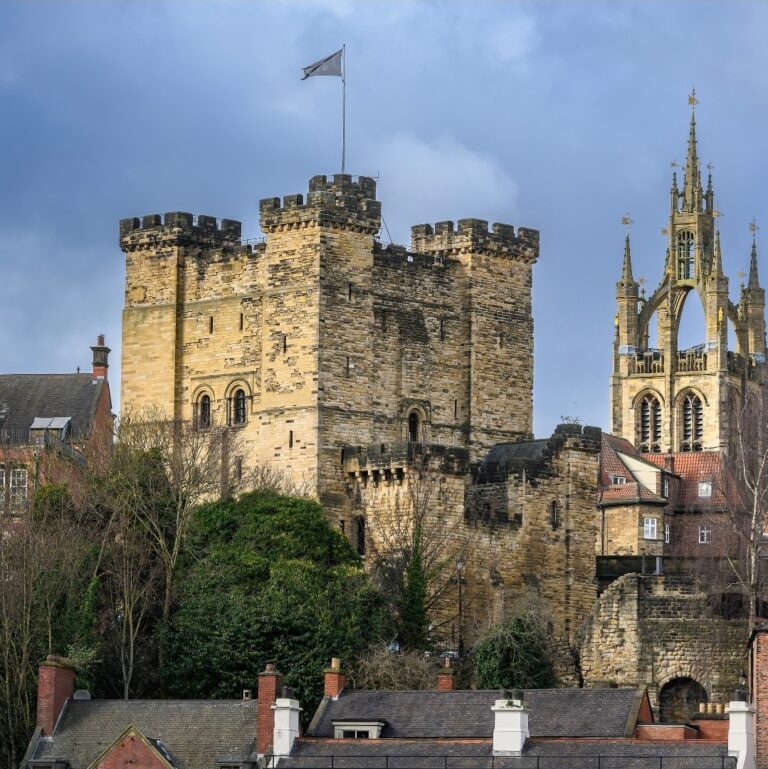
The first church was established during the same period as Newcastle Castle, which stands immediately to the south. The Norman building was destroyed by fire in 1216, leading to the construction of the church that survives in substantially later form. Its dedication to Saint Nicholas, the Christian patron of sailors and boats, may relate to its position on the northern heights above the River Tyne.
The church was built close to the line of Hadrian’s Wall, the Roman frontier fortification across northern Britain. The wall may have crossed or approached the churchyard to the south, although its exact route through Newcastle city centre is no longer known. Newcastle Castle occupies the site of Pons Aelius, the Roman fort and bridge settlement that guarded a crossing of the Tyne and gave the city its name.
A lantern spire was added in 1448. Combining a tower with an open or glazed lantern-like upper structure, it became a principal navigation landmark for ships using the River Tyne for centuries. The church also developed a long musical tradition. In 1503, Princess Margaret described seeing children in white surplices singing hymns and accompanying themselves with instruments as she passed through Newcastle.
Reformation and seventeenth-century conflict
John Knox, the sixteenth-century Scottish Protestant reformer and an important figure in the Scottish Reformation, served as the church’s minister from late 1550 until 2 February 1553. His tenure placed the church within the religious changes that reshaped worship in Britain during the Reformation.
The building suffered severe interior damage during the brief Scottish occupation of Newcastle in 1640. During the nine-week siege of 1644, Scottish forces threatened to bombard the lantern tower. Sir John Marley, Newcastle’s mayor, deterred the attack by placing Scottish prisoners inside the tower. Repairs followed in 1645, 1723, and 1761, while a lightning conductor was added in 1777.
Restoration and cathedral status
The church underwent extensive restoration in 1777. Its later institutional history changed more decisively in 1882, when the Diocese of Newcastle was created separately from the Diocese of Durham and St Nicholas’s became a cathedral. Newcastle also received city status in the same year. The city’s rapid population growth during the mid-nineteenth century had already led to the construction of more than 20 suburban churches, a development that contributed to the creation of the separate diocese.
The cathedral’s musical life continued through the work of Charles Avison, an English Baroque composer who served as organist and choirmaster. The choir later appeared on BBC Radio 3’s Choral Evensong. The building is designated Grade I listed, a classification recognizing its high-level national heritage importance.
Twentieth-century changes and conservation
During the COVID-19 lockdowns of 2020 and 2021, the cathedral closed to visitors while conservation work continued through the Common Ground in Sacred Space heritage project. The programme removed Victorian pews, installed underfloor heating, restored and relaid as many as 130 ledger stones, improved the churchyards, and created an east entrance. The cathedral reopened in August 2021. In October that year, it received support from the United Kingdom government’s Culture Recovery Fund as one of 142 sites across England.
Remains
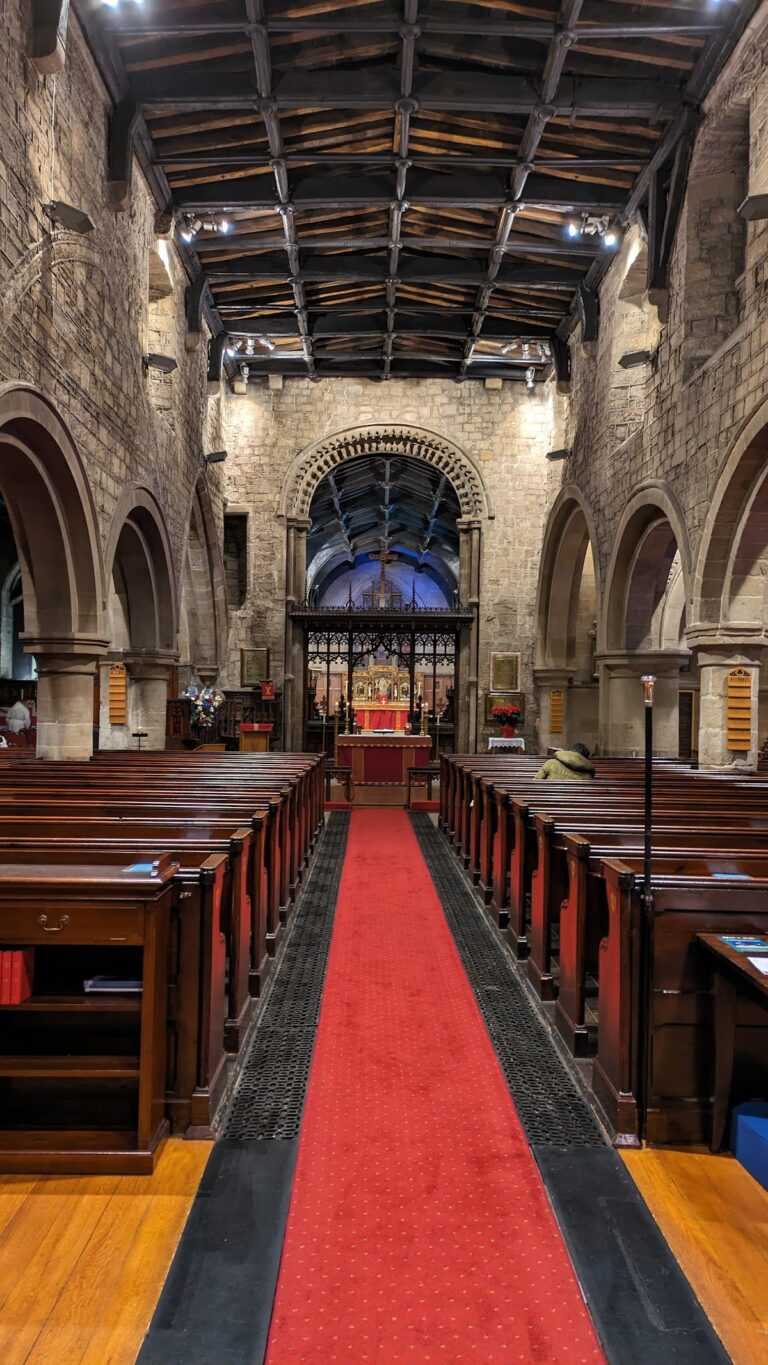
Newcastle Cathedral is predominantly an English Perpendicular Gothic building, a late medieval Gothic style characterized by strong vertical lines, large windows, and elaborate tracery. It accommodates approximately 1,000 people. Its principal visual feature is the fifteenth-century lantern spire, while the interior brings together medieval survivals, later memorials, stained glass, military objects, timber furnishings, bells, and a substantial organ.
Lantern tower and spire
The lantern spire
The lantern tower measures approximately 11.2 by 11.0 metres at its base and rises about 59 metres from the base to the top of the spire. Gilded statues occupy its four corners. They depict Adam eating the apple, Eve holding out the apple, Aaron dressed as a bishop, and David holding a harp.
Structural supports and bells
Street works in the 1860s revealed cracking and tilting in the tower. Two porch-like buttresses were added to support it, and the tower subsequently stabilized. The inclination remains visible in the wooden font cover suspended inside the church, which hangs out of alignment with the baptismal font.
The lantern tower contains a ring of fourteen bells. They include a tenor weighing almost two tons, one bell from the fourteenth century, and two from the fifteenth century. Michael, the oldest named bell, is rung for daily services. Gabriel, a second treble bell, was added in 1999, enabling a lighter peal of ten bells. A separate bourdon, or very large bell used for deep, prominent tones, is called “The Major” and is hung for swing chiming.
Nave, altar, and stained glass
Nave furnishings and high altar
The nave furnishings were redesigned in the early twentieth century by Ralph Hedley, a local artist, woodcarver, and craftsman. The high altar presents Christ in Majesty, a depiction of Christ as a glorified ruler holding an orb and sceptre. The Four Evangelists, Matthew, Mark, Luke, and John, flank the figure with their characteristic symbols.
St Margaret’s Chapel
Much of the cathedral’s original stained glass was broken during the English Civil War, and most of the surviving glass dates from the eighteenth century or later. St Margaret’s Chapel contains a medieval roundel, a small circular stained-glass panel, depicting the Madonna feeding the Christ Child.
St George’s Chapel
St George’s Chapel contains modern stained-glass windows commemorating two pioneering Tyneside industrialists who died in 1931. The Charles Parsons window depicts Turbinia, the first turbine-driven steam yacht, which astonished the Royal Navy at the Spithead naval review in 1897.
Chapel of the Ascension
The Chapel of the Ascension has a five-light east window designed by Leonard Evetts and installed in 1963. It was created in thanksgiving for the cathedral’s survival during the Second World War.
Memorials and commemorative objects
Medieval knight effigy
The cathedral’s oldest memorial is a thirteenth-century tomb effigy of a knight in armour. It is thought to represent Peter le Marechal, the sword-bearer of King Edward I, and is among the oldest objects preserved in the building.
Thornton Brass
The Thornton Brass is a monumental Flemish brass, an engraved or relief-decorated brass memorial, showing Roger Thornton with his wife, seven sons, and seven daughters. Dating from at least 1441 and possibly from before 1429, it is regarded as the largest brass in the United Kingdom. Thornton was a successful Newcastle merchant, three-time mayor, several-time Member of Parliament, and major benefactor. The brass originally covered his tomb in nearby All Saints’ Church. It is now fixed vertically on the far side of the High Altar, facing the east window, while a horizontal replica was formerly kept near the north door for brass rubbing.
Admiral Lord Collingwood’s monument
A finely carved marble monument commemorates Admiral Lord Collingwood, the British naval commander who assumed command at the Battle of Trafalgar after Admiral Lord Nelson’s death. Collingwood was baptized and married at St Nicholas’s, and a wreath is laid before the monument each year on 21 October.
Military standards
The Chapel of the Northumberland Fusiliers houses standards presented for safekeeping at the end of the First World War. They include two standards of the Royal Naval Division, the First World War formation of the Royal Navy that served as infantry, from the Hood and Hawke Battalions. Sixteen standards belonging to battalions of the Northumberland Fusiliers are also preserved, including those of the Newcastle Commercials, North Eastern Railway Pioneers, Tyneside Pioneers, Tyneside Scottish, Tyneside Irish, and the 51st, 52nd, 53rd, and 2nd Garrison battalions.
Organ and exterior monument
Grand Organ
The Grand Organ is a four-manual instrument built by T. C. Lewis and rebuilt several times. Harrison & Harrison carried out major reconstructions in 1911 and 1954, followed by work by Nicholson & Co. of Worcester in 1981. Its earlier history includes an organ made by Harris the elder in 1670, with 17 stops on two manuals. Schnetzler rebuilt it as a three-manual instrument in 1767, and later work by Wood, Small and Co., Bruce, and John Nicholson produced a 28-stop organ.
Around 1880, Lewis & Co. incorporated the earlier instrument into a new four-manual organ with 58 stops and pneumatic action, which uses air pressure to transmit the organist’s commands to the pipes. Harrison & Harrison rebuilt it in 1911 as a 76-stop Edwardian instrument. Later work produced a 96-stop organ with 61-key manuals and a 32-key pedalboard. Its cases are positioned on the north wall of the choir and in the north transept, with a movable console.
Queen Victoria statue
Immediately north of the cathedral stands a bronze statue of Queen Victoria. Alfred Gilbert, a British sculptor associated with major late-Victorian and early twentieth-century public monuments, created it. Unveiled in 1903, the statue commemorates 500 years of Newcastle’s shrievalty and was presented to the city by W. H. Stephenson, a company director and politician who served seven times as Newcastle’s mayor.