Kapan Han: An Ottoman Caravanserai in Skopje, North Macedonia


Site at a Glance
- Rating
- 3.9
- Popularity
- Very Low
- Country
- North Macedonia
- Primary era
- Medieval
- Eras represented
- Medieval
- Civilizations
- Ottoman
- Site type
- Economic
- Remains
- Caravanserai
On this page4 sections
History
Kapan Han is an Ottoman caravanserai in Skopje, North Macedonia, built in the second half of the fifteenth century as an inn and service complex for traveling merchants and their caravans. Isa-beg Ishaković, a Bosnian Ottoman military commander and the third Ottoman governor of the Skopje region, ordered its construction in the historic marketplace that became Skopje’s Old Bazaar.
Foundation and commercial purpose
The han was established to produce regular income for Isa-beg Ishaković’s waqf, a charitable or religious endowment whose revenues supported a specified institution or public purpose. Its position in the marketplace encouraged long-distance commerce by providing overnight accommodation for merchants arriving with their caravans. Kapan Han is first mentioned in the 1506 endowment deed of the Yaya Pasha Mosque.
The surrounding section of the bazaar became known as Kapan Bazaar. The name “kapan” comes from the Arabic term kabban, referring to large public scales used inside or near gates to weigh merchandise. A fountain called Kapan Fountain stood in front of the han.
Destruction and rebuilding
An earthquake destroyed Kapan Han in 1555. The building was later damaged again by the fire of 1689 and rebuilt in a considerably simpler form, using a wooden structure. Only the lower sections of the original appearance survived this transformation.
Kapan Han continued to operate as an inn until the Second World War. The 1963 earthquake almost completely destroyed the building. Repairs carried out between 1971 and 1973 led to its reopening in 1974, after which the restored complex returned to commercial use.
Remains
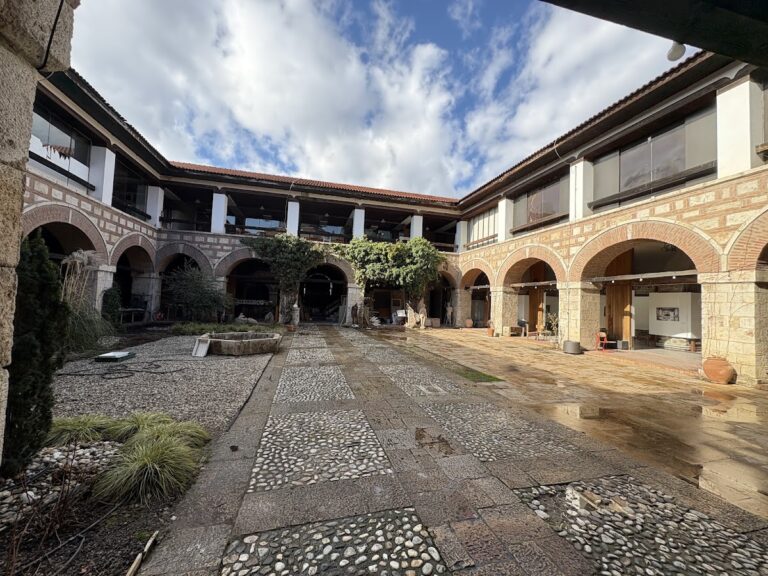
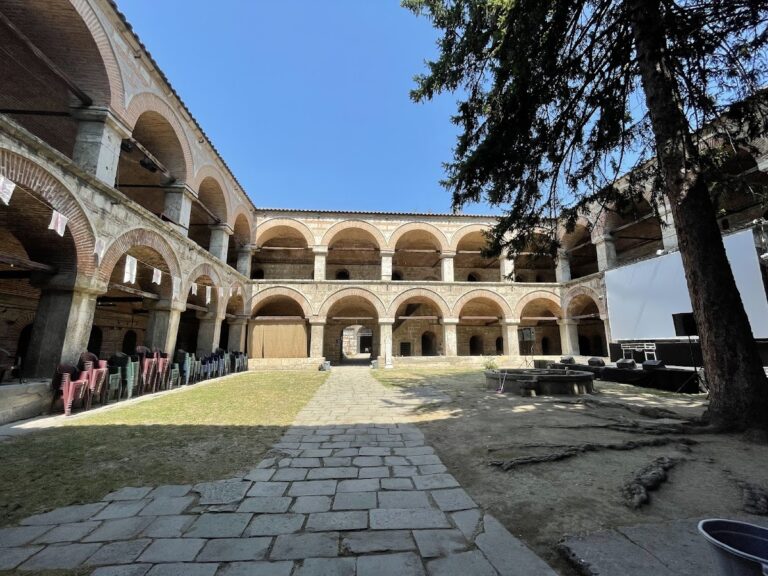
Kapan Han is a rectangular complex covering approximately 1,066 square metres. Its exterior is fully enclosed, while the interior is organized around a large square courtyard. Forty-four rooms occupy rows along all four sides on the ground and upper floors; these rooms formerly accommodated travelers and merchants with their caravans.
The upper storey has a wooden veranda running around all four sides of the courtyard. Wooden posts support the roof, and the han is entered through two wooden-doored gateways on its southern and northern sides. Since the restoration, the building has been used for shops, taverns, and business offices.