Agha Nur Mosque: A Safavid Mosque in Isfahan


Site at a Glance
- Rating
- 4.3
- Popularity
- Very Low
- Country
- Iran
- Primary era
- Early Modern
- Eras represented
- Early Modern, Modern
- Civilizations
- Qajar, Safavid
- Site type
- Religious
- Remains
- Mosque
On this page7 sections
History
Agha Nur Mosque is an active Shia mosque in Isfahan, Iran, built under Safavid rule between the reigns of Shah Abbas I and Shah Safi. Construction probably began around 1624–1625 and was completed in 1629–1630, during the Isfahani architectural style associated with Safavid Iran. The mosque is regarded as a major example of Safavid architecture in Isfahan and is described as one of the city’s architectural masterpieces.
Safavid construction
The mosque was built in the historic Dardasht neighbourhood under the patronage and supervision of Nur al-Din Mohammad Esfahani, remembered as one of Isfahan’s wealthiest and most righteous men. Its architectural attribution is associated with Mohammad Reza Emami, who composed the principal inscription over the portal. Nur al-Din Mohammad Esfahani is also identified as the architect. Work began during Shah Abbas I’s reign and concluded in the first year of Shah Safi’s rule, one year after Shah Abbas I died. An inscription above the entrance names both rulers.
The Safavid dynasty ruled Iran from the sixteenth to the eighteenth century and established Twelver Shia Islam as the state religion. Agha Nur Mosque therefore belongs to a period when mosque construction formed part of the religious and architectural landscape of Safavid Isfahan.
Qajar additions and later history
A covered prayer hall, or Shabestan, was added during the Qajar era, in the 13th century AH, at the expense of Haj Mohammad Ebrahim Ghazvini, a former imam of the mosque. The Qajar dynasty ruled Iran from the late eighteenth century until the early twentieth century. The mosque also contains the mausoleum of Zayn al-Abidin Shahshahani, a Qajar-era Iranian Twelver Shia cleric and author who lived from 1828 to 1900.
During the Iran–Iraq War, Iraqi airstrikes damaged the mosque’s southern upper window band, arches, tile decoration, mirrorwork, and minaret. These elements were later restored and renovated. The mosque was placed on Iran’s National Heritage List as a national monument on 5 April 1998, under registration number 1971. Its conservation is administered by Iran’s Cultural Heritage, Handicrafts and Tourism Organization.
Remains
Courtyard and iwans
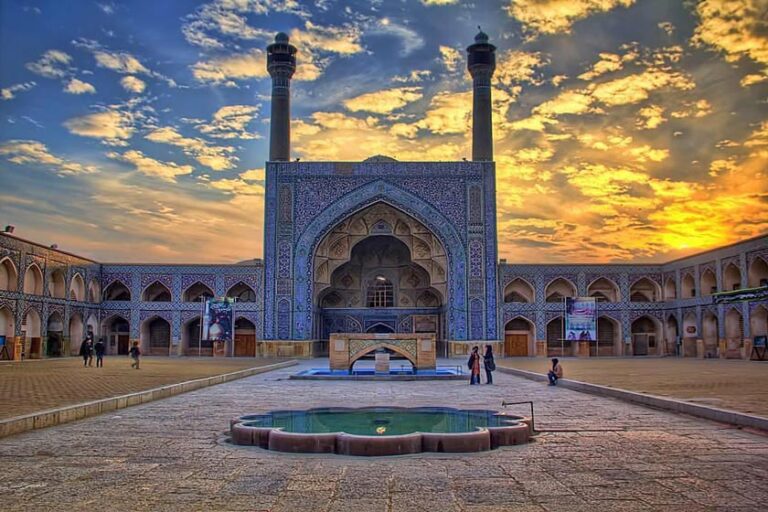
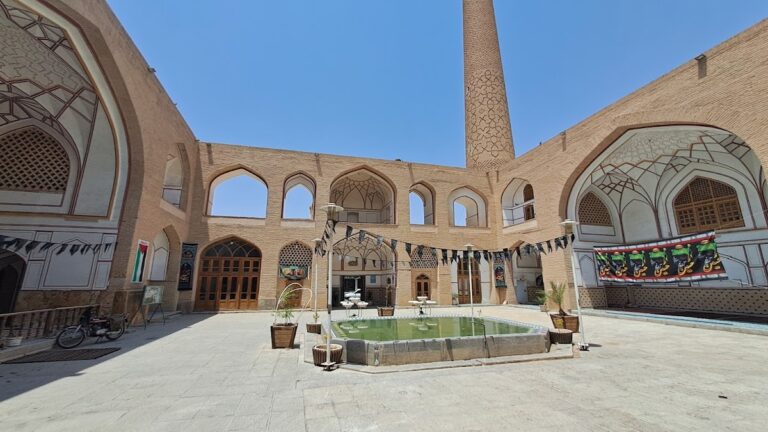
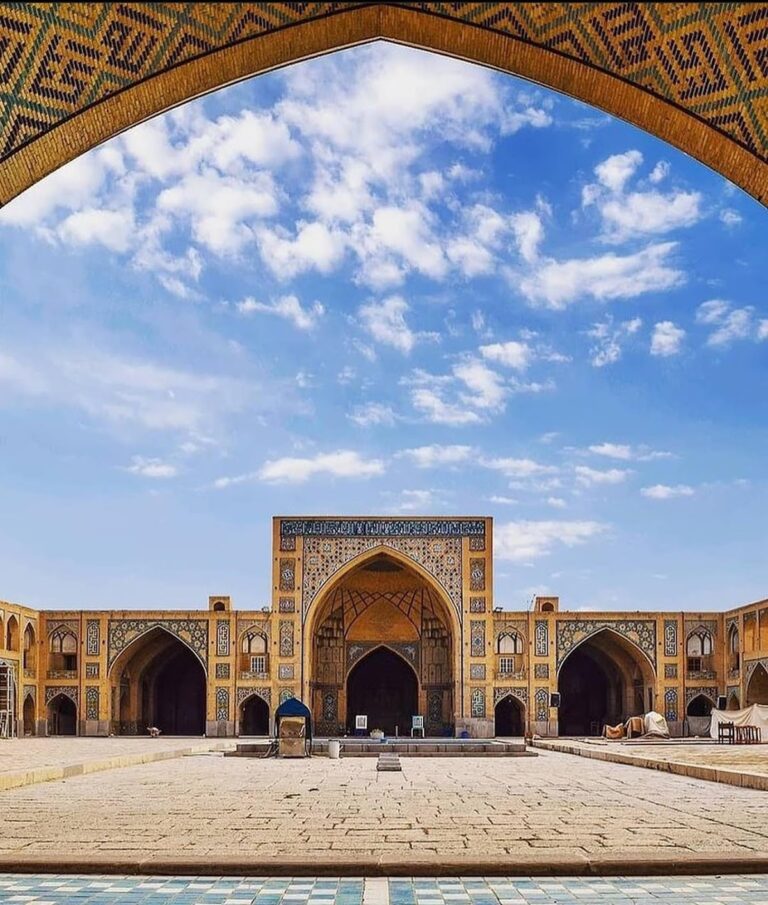
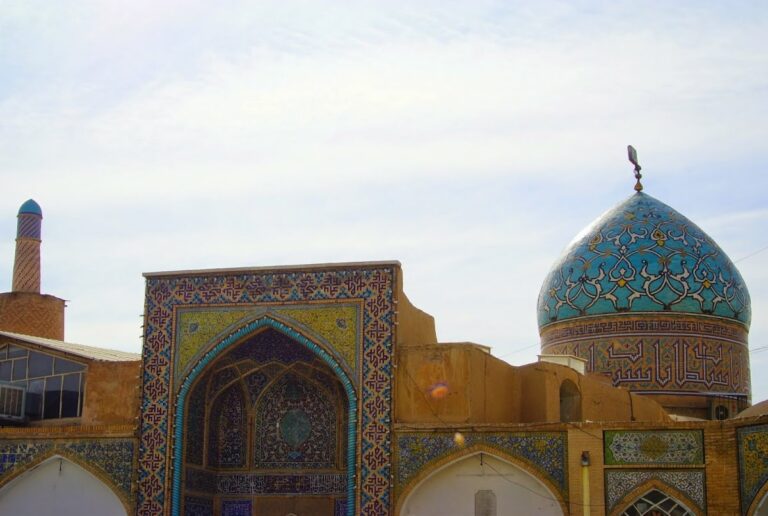
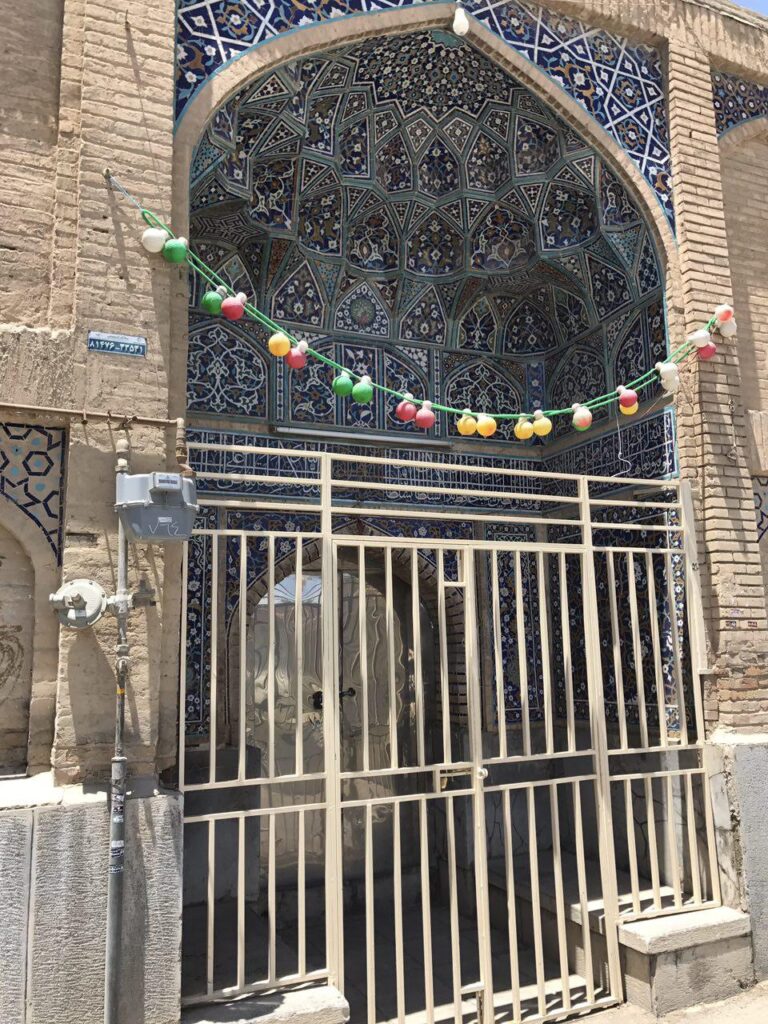
Agha Nur Mosque follows a four-iwan plan, known in Persian as Chahar Iwani. Four large vaulted halls or recesses, each open on one side, are arranged around a central courtyard. The complex includes an outer portal, the courtyard, four iwans, tile decoration, historical inscriptions, and one minaret. Stone and marble are the principal listed materials. The eastern iwan carries a verse inscription dated to 1624–1625, while another inscription on its portal is written in white Thuluth, a monumental Arabic calligraphic script, on azure glazed tile. Mohammad Reza Emami composed this inscription.
Shabestan
The Shabestan is a covered prayer hall supported by stone columns and marble arches. Transparent marble elements admit daylight into the chamber, which contains a small mihrab, the niche indicating the direction of prayer. Beside the northern portal, the outer entrance to the Shabestan has distinctive decoration. The chamber also includes a skylight regarded as among the most beautiful in Isfahan’s mosques.
Mausoleum
The mausoleum of Zayn al-Abidin Shahshahani lies within the mosque. Shahshahani was a Twelver Shia religious scholar and author associated with Iran’s Qajar period, and his burial place forms part of the mosque complex.