St. Victor Church: A Gothic Hall Church in Schwerte, Germany


Site at a Glance
- Rating
- 4.3
- Popularity
- Very Low
- Country
- Germany
- Primary era
- Medieval
- External website
- Open
- Eras represented
- Medieval, Early Modern
- Civilizations
- Holy Roman Empire
- Site type
- Religious
- Remains
- Church
On this page12 sections
History
St. Victor Church is a medieval Gothic hall church in Schwerte, Germany, whose oldest surviving building phase is the central nave constructed about a century after the church was established in 1050. Dedicated to Saint Viktor, a Christian martyr associated with the early Christian community at Xanten, it developed through several medieval phases and remains an architectural monument and landmark of Schwerte.
Foundation and medieval development
The church’s history reaches back to 1032, when Reinmod, a matron from Cappenberg, donated the Schwerte estate to the collegiate foundation of St. Viktor in Xanten. In 1050, St. Viktor was established as a daughter church of the Xanten collegiate church. About a century later, the central nave was built, providing the oldest surviving part of the structure.
During the thirteenth century, the church was expanded into a Romanesque basilica, a form with a long central nave usually flanked by lower side aisles. Schwerte’s prosperity as a Hanseatic town in the fifteenth century brought further enlargement. The Hanseatic League was a medieval and early-modern network of northern European towns and merchants whose commercial resources could support major civic and church building projects. The west tower was also constructed in front of the church during this period.
Reformation and later changes
After the Reformation, the sixteenth-century movement that divided Western Christianity and led many German churches to adopt Lutheran worship, St. Victor became a Lutheran church. The Antwerp Altarpiece was installed at Easter in 1523. Its predecessor, the Seven Sorrows Altarpiece of 1518, was not preserved as a complete work, but its predella, the low base of an altarpiece, was incorporated into the Antwerp carving.
A figure of the Christ Child from the Antwerp Altarpiece had been missing for more than a century before a sculptor made a replacement in 2015. The altar was restored in 2018. In 2025, the church’s former three-bell cast-iron peal, installed in 1920, was replaced after the bells reached the end of their service life.
Remains
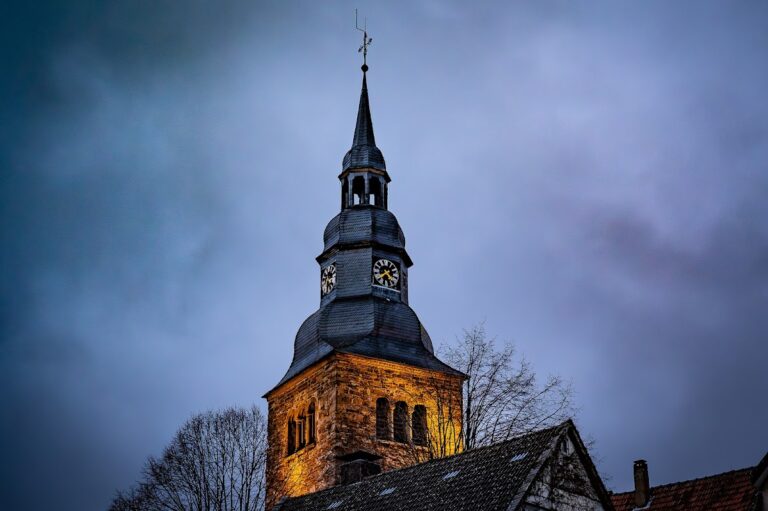
The surviving church is a three-aisled Gothic hall church, in which the nave and aisles are of approximately similar height, creating a unified interior space. Its fifteenth-century west tower stands in front of the church, and its visibly crooked spire has become a distinctive symbol of Schwerte. The tower carries a seven-bell peal assembled in 2025 from bells by different founders: four came from the demolished Paulushaus in Holzen, one from Gelsenkirchen, and two from the Bachert bell foundry.
Altarpieces and wall painting
Antwerp Altarpiece
The Antwerp Altarpiece, also called the Golden Altar, is an oak structure approximately 8.5 metres high. Painters and sculptors of the Antwerp Guild of Saint Luke created it. The guild was an association of artists in the Low Countries and neighboring regions, while Antwerp was a major artistic center in the early sixteenth century. Its central shrine contains 15 scenes concerning the childhood of Jesus, the Passion, the Mass of Saint Gregory, and the Mater Dolorosa. The paired wings carry 72 painted scenes, and a relic of Saint Viktor is set into the altar. The restored figure of the Christ Child completes a feature that had been missing for more than a century.
Seven Sorrows Altarpiece
The incomplete Seven Sorrows Altarpiece of 1518 was made by a Westphalian master. Its surviving predella, decorated with figures of the Apostles, was reused in the Antwerp carved altarpiece, linking the earlier work to the later structure.
Crucifixion fresco
A Crucifixion fresco by a Westphalian master dates from 1310. It depicts Jesus with Mary and the disciple John and remained enclosed within the masonry until 1943.
Interior furnishings and music
Baroque pulpit
The Baroque pulpit dates from 1666. Its body represents the four Evangelists, Matthew, Mark, Luke, and John, who are traditionally associated with the four canonical Gospels. Martin Luther holding a Bible appears at the entrance, while Paul is represented on the sounding board as a symbol of the Word of God.
Organ
Alfred Kern & Söhne of Strasbourg built the organ in 2014. It has 27 speaking stops, including three extended stops in the pedal, and is arranged over two manuals and a pedal. The action is mechanical and the stop action is electric. Its specification includes the couplers II/I, I/P, and II/P, octave couplers, two tremulants, a setter system, and a device for disabling wind stabilization.
Bells
The earlier 1920 cast-iron bells were tuned to C-sharp, E, and G and named Peace, Justice, and Joy. The tower also retains an external bronze hour-strike bell from 1523. The small bell called Joy formerly sounded the quarters and called for prayer three times daily. The large bell was silenced from September 2022 because of a crack.