Monastery of the Svetog Christophor (Prilep): A Seventeenth-Century Orthodox Monastery


Site at a Glance
- Rating
- 4.4
- Popularity
- Very Low
- Country
- North Macedonia
- Primary era
- Early Modern
- Eras represented
- Early Modern
- Civilizations
- Ottoman
- Site type
- Religious
- Remains
- Monastery
On this page9 sections
History
The Monastery of the Svetog Christophor (Prilep), also known as Slepche Monastery or the Monastery of St Nicholas, is a seventeenth-century Orthodox monastery in North Macedonia, near Slepche in Dolneni Municipality on the western slopes of Mount Babuna. Its church was built in 1673 by the hieromonk Michael, an Orthodox monk ordained as a priest, while an inscription inside the entrance dates its construction and fresco painting to 1674.
Foundation and fresco painting
The church’s founders included the abbot, Hieromonk Sergius, Hieromonk Nicephorus, the monk Cyril, the nun Janikia, and other lay people. The frescoes were probably painted by the founders themselves, particularly Hieromonk Sergius and his disciple, Hieromonk Michael. The church therefore preserves both the religious purpose of the monastery and the work of the community that established it.
Ecclesiastical affiliations and later history
The monastery formerly belonged to the Ohrid Archbishopric, an Orthodox ecclesiastical jurisdiction historically associated with the Ohrid region. It later came under the Bulgarian Exarchate, the Bulgarian Orthodox institution established in the nineteenth century, and is now part of the Prespa–Pelagonia Diocese of the Macedonian Orthodox Church–Ohrid Archbishopric.
A fourteenth-century manuscript containing the prologue for January through April was removed from the monastery by Bishop Joseph Cvijovic in the 1920s. It is now held by the Library of the University of Belgrade, and an inscription on the back of its cover gives the year 1754. In 1916, the Bulgarian archaeologist and politician Bogdan Filov recorded a description of the monastery church.
The church remains in use and the monastery is protected as a cultural monument. The complex continues to include religious, residential, agricultural, and auxiliary functions.
Remains
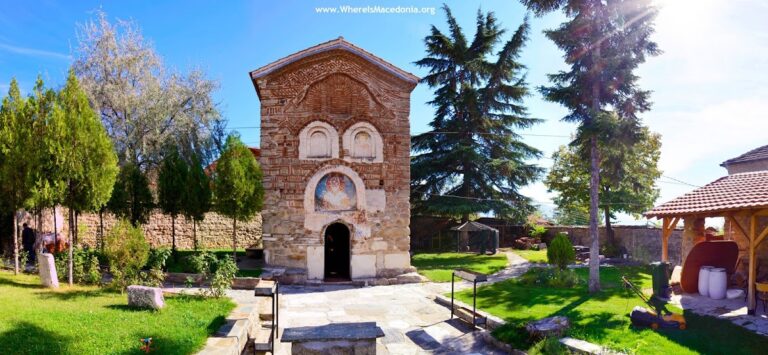
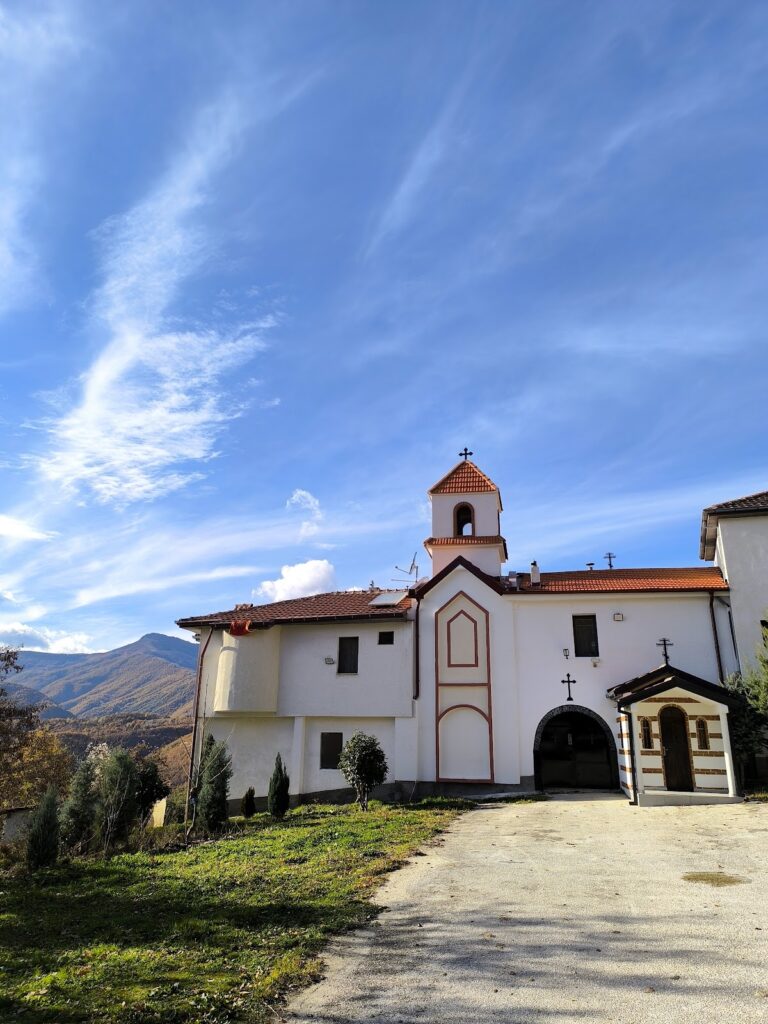
The monastery complex occupies a courtyard with the church in the central part of its eastern half. The surviving buildings include the small church, residential quarters, a fountain, agricultural facilities, and auxiliary structures. A stone gateway provides entry to the courtyard, while the agricultural section lies on both sides immediately before the entrance.
Monastery church
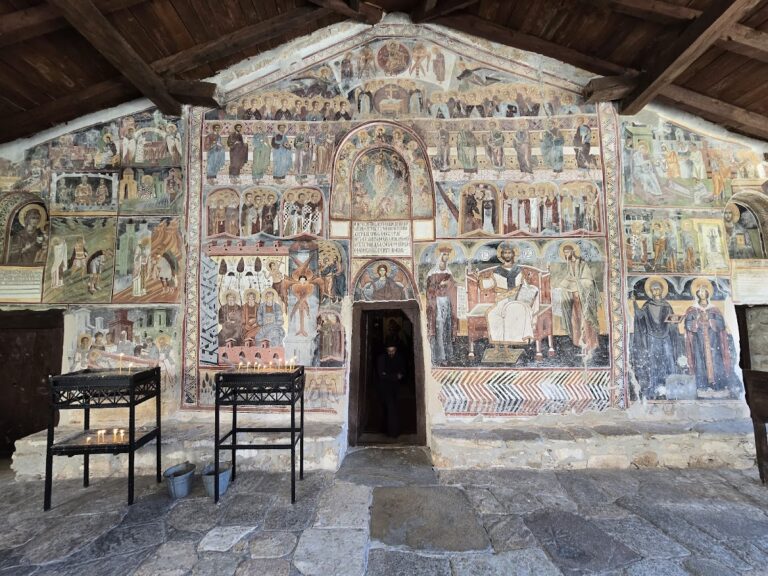
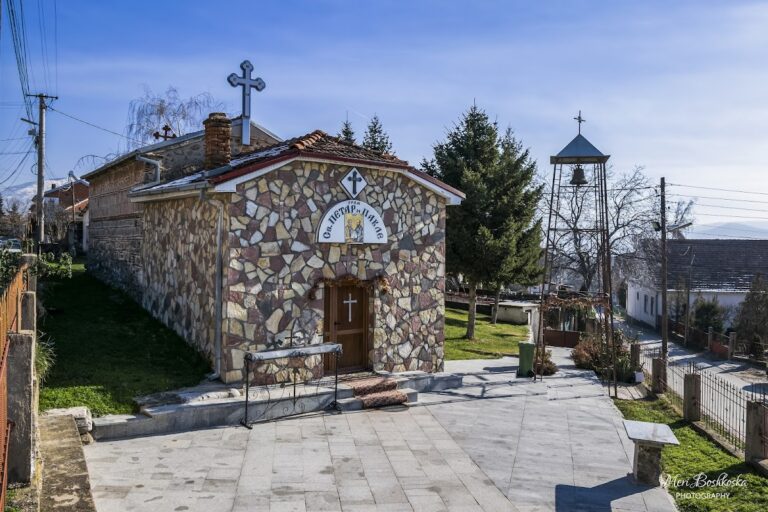
The church is a small, single-nave building without an apse. Its undecorated façades have small openings on the eastern and southern sides, and the only entrance is on the western side. A narthex, or entrance hall, was added later and has no fresco decoration. Inside, the walls are covered with frescoes dated to 1674. The furnishings include a gilded wooden circular chandelier and royal doors, the central doors of an Orthodox church’s iconostasis leading into the sanctuary.
Courtyard gateway and service buildings
Stone gateway
The stone gateway leading into the courtyard has recently been restored. Damage to the frescoes in its vaulted section indicates that the gateway is older than its present condition suggests. When the monastery was flourishing, the vault was fully painted, with Saint Nicholas shown at the centre of its semicircular surface.
Agricultural facilities
The agricultural section stands immediately before the entrance on both sides of the gateway. Its facilities are used for raising sheep and pigs, forming part of the monastery’s continuing working complex. A fountain and several auxiliary buildings also survive within the site.
Residential quarters
Old residential quarters occupy the northern side of the courtyard. The buildings have two storeys and a long front balcony, and they are constructed onto rocky ground. Together with the church, fountain, agricultural buildings, and auxiliary structures, they preserve the physical arrangement of the monastery as a religious and working community.