Barlingbo Church: A Medieval Church on Gotland


Site at a Glance
- Rating
- 4.7
- Popularity
- Very Low
- Country
- Sweden
- Primary era
- Medieval
- External website
- Open
- Eras represented
- Medieval, Early Modern, Modern
- Civilizations
- Swedish
- Site type
- Religious
- Remains
- Church
On this page13 sections
History
Barlingbo Church is a medieval church on Gotland, Sweden, whose present building was constructed between the early thirteenth century and about 1280. It belongs today to the Church of Sweden, Sweden’s Lutheran national church, and forms part of the Diocese of Visby, the Barlingbo parish, and the Roma pastorate.
An Earlier Church
The present church replaced an earlier limestone building. That church included a Romanesque chancel from the twelfth century, when Romanesque architecture, characterized by rounded arches and massive masonry, preceded the Gothic style. During the 1924 renovation, foundations and other remains of the early medieval church, including its tower, were found beneath the current floor.
Construction in the Thirteenth Century
The oldest surviving parts of Barlingbo Church are the eastern choir and apse, built in 1225. An apse is the eastern termination of a church, commonly semicircular or polygonal. A two-room sacristy was added on the north side during the early or middle thirteenth century, followed by the nave walls in the middle of the century.
Construction reached completion around 1280, when the western tower and the nave vaulting were added. The building’s plan has been understood as deliberately influenced by Cistercian architecture, the tradition associated with the Cistercian monastic order and its disciplined planning and restrained decoration. During the Catholic period, Saint Dionysius was believed to be the church’s patron saint. The bell cast around 1440 carries inscriptions invoking Christ, Mary, and Dionysius, traditionally regarded as an early Christian martyr and the first bishop of Paris.
Later Changes and Conservation
Barlingbo Church has experienced relatively few major alterations since its medieval construction. The original roof covering was replaced with ceramic tiles, and a low-pressure steam-heating system was installed in 1908, with its boiler placed in the sacristy.
Interior restoration was carried out in 1924 and again in 1947–1948 under the direction of the Swedish architect Carl-Otto Hallström. The earlier campaign included the laying of a stone floor, while the later work renewed the wall paintings. In 1989, surviving stained-glass windows were placed in new frames.
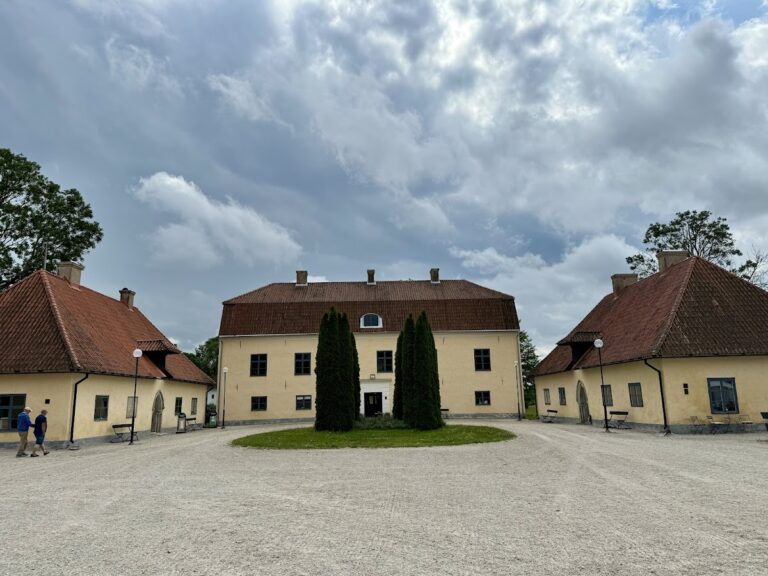
Jan Utas directed exterior restoration in 1997, including facade cleaning, repairs to the nave roof, and the installation of new lighting. Interior work under his direction in 2000 cleaned the walls, vaults, and floors and provided a new electrical system. The church still contains furnishings and artistic features from the medieval period, the seventeenth century, and the nineteenth century. Nearby, an old parsonage built in 1902 combines Gothic Revival and Renaissance Revival forms in an interpretation of medieval architecture described as unique on Gotland.
Remains
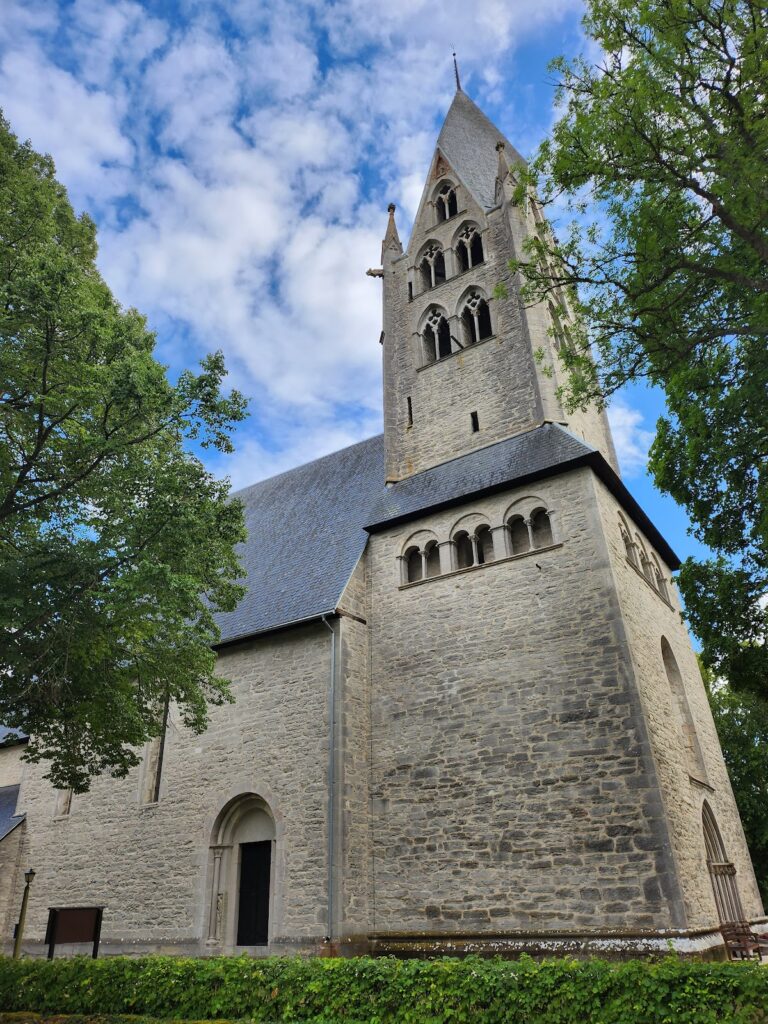
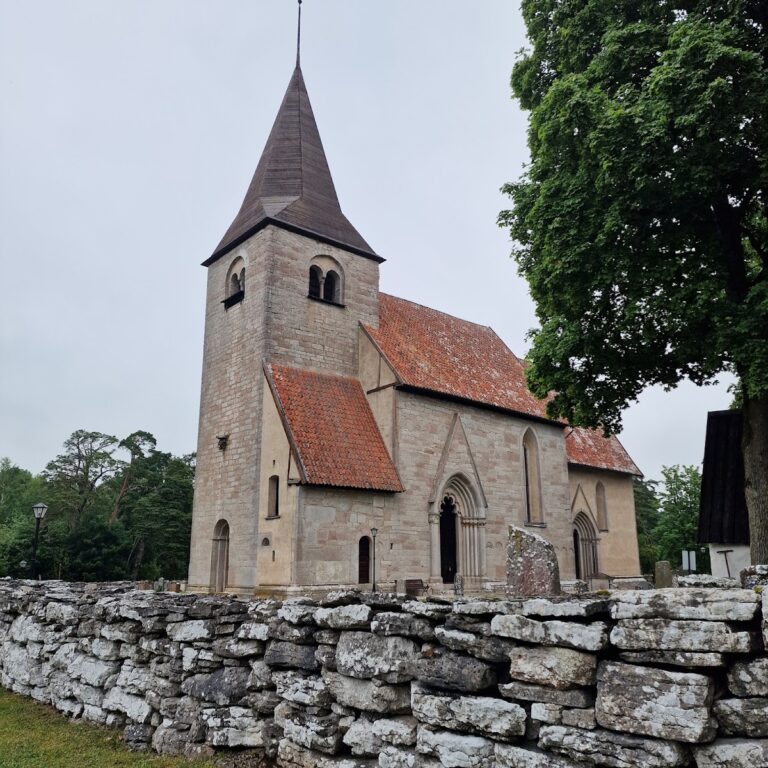
Barlingbo Church is a single-nave building arranged in a rising sequence of three parts. The eastern choir is relatively low, the nave is higher, and the massive western tower forms the tallest element of the silhouette. The tower was not completed to its intended full height; its bell chamber and sound openings occupy the lower part of its upper section. The choir ends in an apse and includes a square altar platform, while a two-room sacristy projects from its north side.
Exterior and Medieval Structure
Portals and Tower
Three portals mark the building’s medieval entrances. The large Gothic south portal of the nave, dating from about 1300, is the principal entrance. Its carved surround and perspectively arranged arches rise to a gabled field above the roof eaves. The portal appears to have been inserted after the nave walls were built, requiring the surrounding masonry to be thickened. A second Gothic portal on the north side of the tower has been walled up, while an older portal in the Romanesque tradition opens in the south wall of the choir.
Windows and Stained Glass
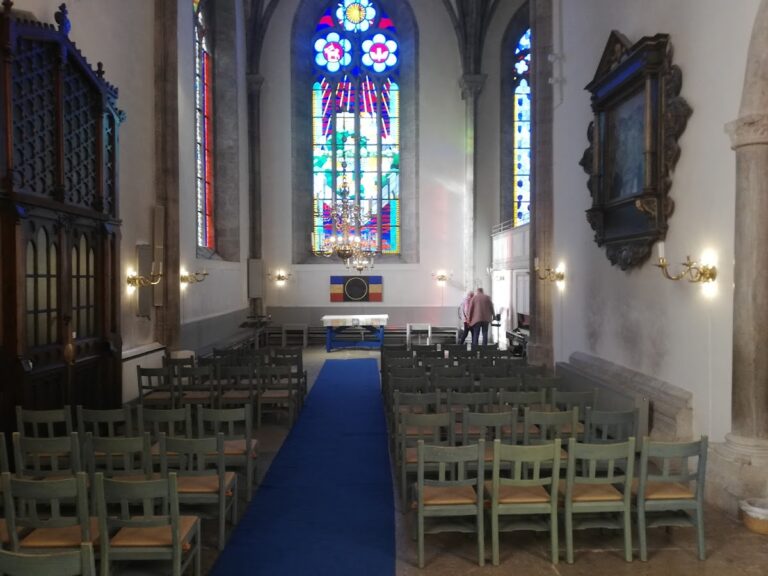
A rose window occupies the western facade of the tower. Gothic windows in the apse and south facade retain stained glass from about 1280, with both figural and ornamental designs. These windows are among the few examples of medieval stained glass preserved in situ in Sweden. The eastern wall also contains a pointed-arch window with tracery from the late thirteenth century.
Interior Painting and Vaulting
Inside, vaults divide the church lengthwise into three sections. Strong arches carry a prominent cross-vault extending from the eastern altar platform to the room within the western tower. This structure gives the nave and choir a unified vaulted interior while preserving the building’s sequence from east to west.
Medieval lime paintings survive on the side walls and vaults. The earliest decorations include gray triangles and crosses, probably dating from the first construction period. More monumental, though still mainly decorative, paintings in the nave and around the eastern window of the apse belong to about 1280. Fourteenth-century paintings in the apse show six apostles, whose appearance is described as unique on Gotland. Other murals are attributed to the so-called Union Master, the conventional name for an unidentified medieval painter associated with works from the period of the Kalmar Union.
Medieval Artworks and Tombstones
Baptismal Font
The baptismal font dates from the second half of the twelfth century, making it earlier than the present church. It was carved from a single block of limestone and bears figures from the Bible, the symbols of the four Gospel writers, and runic markings on some figures. Swedish art historian Johnny Roosval regarded the richly carved font as one of the finest works of medieval Swedish art, and its artistic treatment has also been connected with medieval English influences.
Triumphal Cross and Tombstones
A large triumphal cross with a crucified Christ dates from the 1240s and is attributed to the unidentified artist known as the Tingstäde Master. A triumphal cross is a large crucifix commonly placed at the boundary between the choir and nave. Symbols of the four evangelists appear at the ends of the cross. Thirteenth- and fourteenth-century tombstones remain visible in the choir.
Later Furnishings
The sandstone altar probably once held a relic. Its Baroque top, dated 1683, carries the monogram of King Charles XI of Sweden, who reigned from 1660 to 1697. The pulpit dates from 1673 and rests on a medieval side altar.
The pews and organ case date from the nineteenth century. The organ was made by Grönlunds Orgelbyggeri of Gammelstad. Together with the seventeenth-century pulpit and altar top, these later elements form part of the furnishings preserved alongside the church’s medieval fabric and artworks.