St. Blasius: A Late Gothic Church in Kaufbeuren, Germany


Site at a Glance
- Rating
- 4.6
- Popularity
- Very Low
- Country
- Germany
- Primary era
- Medieval
- External website
- Open
- Eras represented
- Medieval, Early Modern
- Civilizations
- Holy Roman Empire
- Site type
- Religious
- Remains
- Fortified Church
On this page15 sections
History
St. Blasius is a late Gothic church in Kaufbeuren, Germany, built by the medieval community of the town beside its northwestern fortifications. Rising above the old town in Swabia, it is regarded as one of the region’s most important medieval architectural monuments.
Early Chapel and Earlier Structures
The chapel is first mentioned in 1319, when it was known as the Blasius Chapel. An earlier parish church may have stood on the hill above the original settlement. Local tradition also places a former castle belonging to the nobles of Kaufbeuren on the same hill, although the surviving evidence concerns earlier ecclesiastical and defensive structures rather than a confirmed castle.
The lower masonry of the nave and the remains of an earlier tower point to activity before the present church. In 1931, masonry beneath the existing brick tower was first interpreted as a foundation slab. It was later recognized as the remains of a four-sided predecessor tower. Excavations in 1950 revealed two high-medieval wall lines made from tuff stone beneath the central nave. These may have belonged to the crypt of an influential patrician family, an interpretation supported by the discovery of a human fibula in the same area.
Late Gothic Construction
Work on the present choir began in 1436. In 1484 and 1485, the nave was enlarged into a three-aisled hall, establishing the principal form of the church. Most of the furnishings were added during the decades that followed. A fresco of the Resurrection was painted on the north wall in 1600, adding a later layer to the late Gothic interior.
The church probably began as a chapel used by the city’s guards. It stood directly against the town wall, and the covered fighting walkway, a passage along a fortified wall used by defenders to patrol and protect the town, passed through the building. Watchmen could therefore worship while remaining connected to their defensive post.
Patrons and Later Conservation
The saints represented on the high altar reflect occupations associated with the guards and townspeople. Kaufbeuren’s population was composed mainly of weavers and weaponsmiths. Saint Blasius, a Christian bishop and martyr traditionally associated with protection against throat ailments, and Saint Erasmus, another early Christian bishop and martyr, were patrons of wool combers and yarn winders. John the Baptist and Saint Sebastian were associated with weapons producers. Saint Ulrich, the tenth-century bishop of Augsburg, protected the city soldiers and was also patron of the Diocese of Augsburg. Saint Anthony, associated with the early monastic tradition, appears among the church’s painted saints.
The sculptures and paintings were restored under state supervision in the late nineteenth century. Efforts to dry the masonry followed in 1950 and 1968, and a major renovation was carried out in 1971. These interventions preserved an interior whose late Gothic architectural character and medieval furnishings remain substantially intact.
Remains
Layout and Construction
St. Blasius consists of a three-aisled hall attached to the town wall on the west, with a somewhat lower choir extending eastward. The covered fighting walkway passes through the church toward the adjoining defensive tower, physically connecting the building with the town’s fortifications. The church is built throughout of brick, while dressed stone forms the window tracery and other architectural elements. A whitewashed exterior is articulated by plain buttresses, and a continuous trefoil frieze runs beneath the choir cornice.
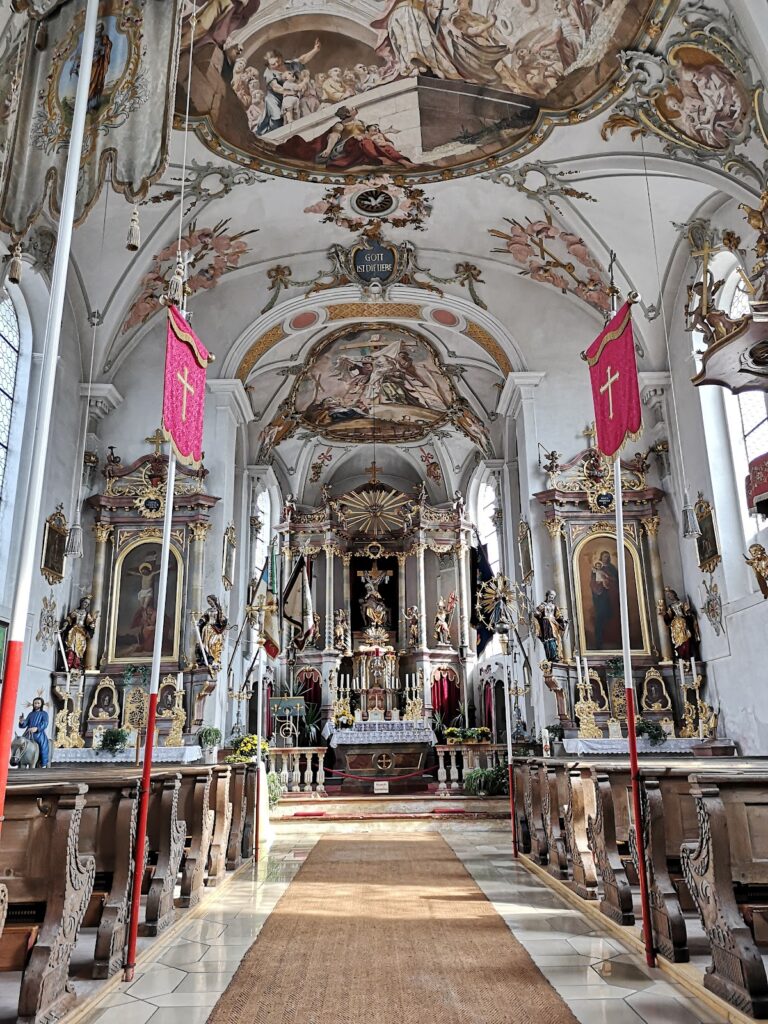
Four octagonal piers support the cross-rib vaults of the rectangular nave, which is divided into three bays. The choir has a star-rib vault and ends in five sides of an octagon. Its windows contain flame-like patterns, trefoils, and quatrefoils, forms created by the stone framework dividing Gothic windows. Some sections of the tracery have been renewed. The nave masonry contains tuff blocks reaching 2.75 metres in height. These blocks date at least to the thirteenth century and provide architectural evidence for an earlier building.
Defensive Tower
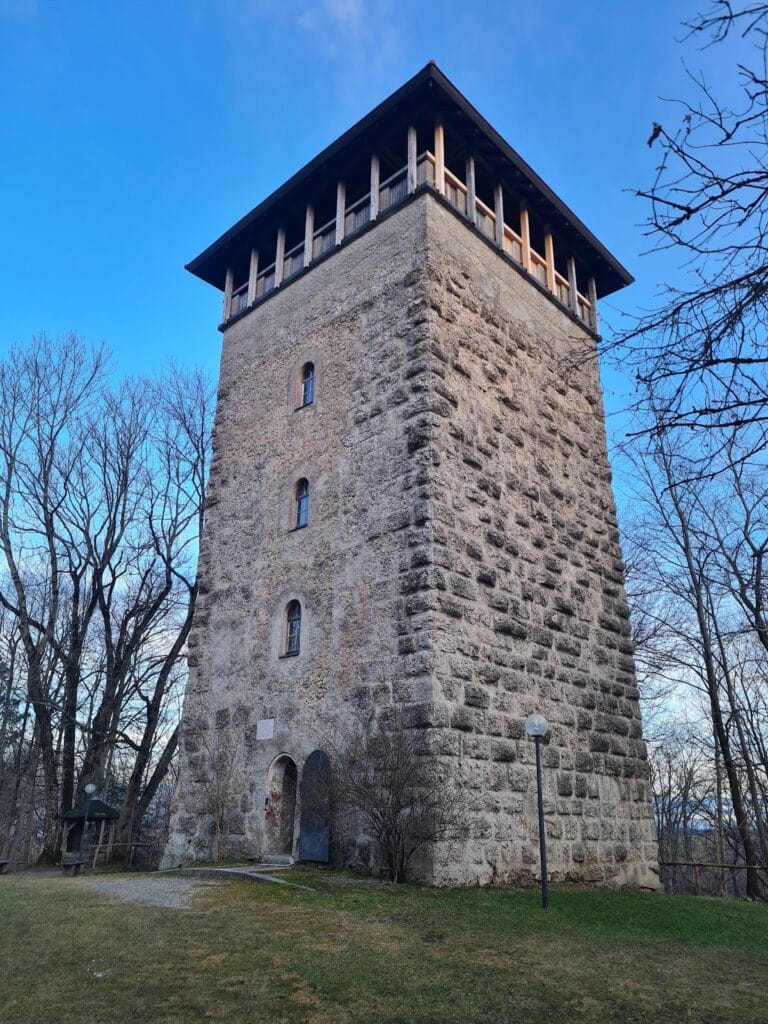
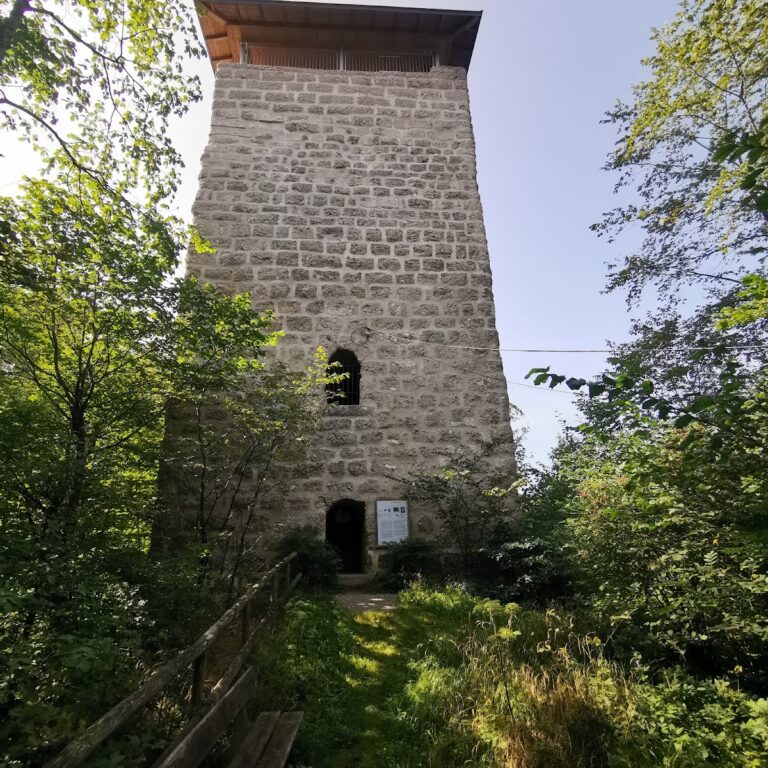
The tower adjoining the church is round and constructed of brick. It is covered by a conical, tile-covered roof and stands on the remains of the earlier four-sided tower. Its position beside the church preserves the close relationship between St. Blasius and the town’s medieval defensive system.
Choir Furnishings
High Altar
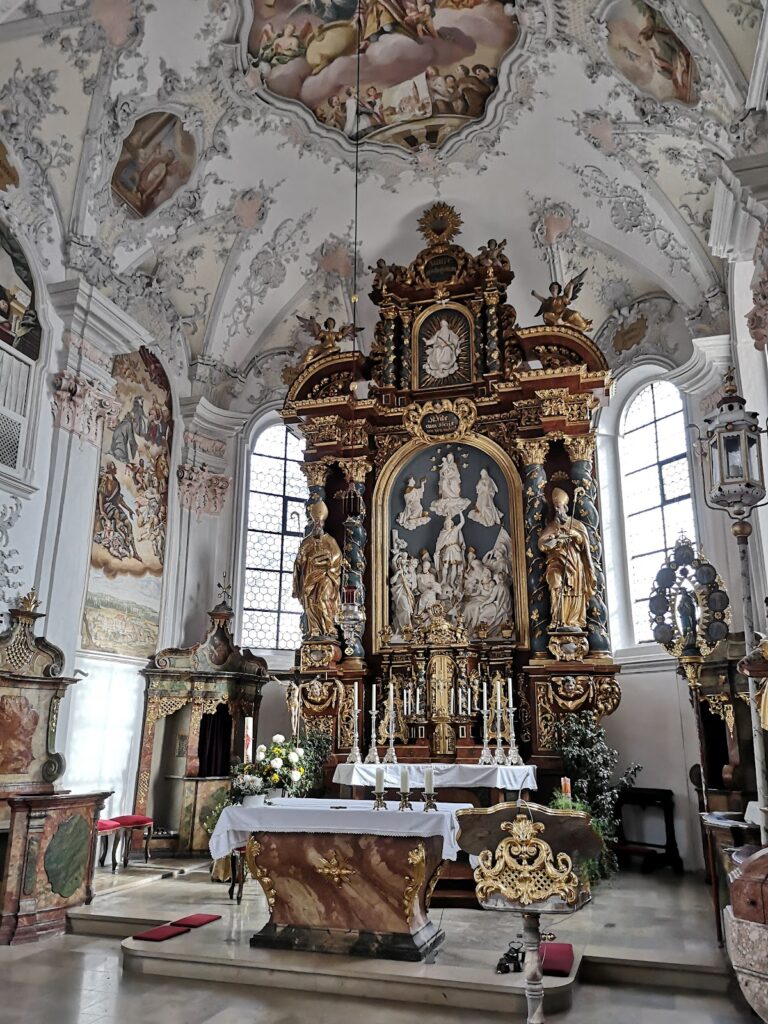
The high altar stands in the termination of the choir and dates to 1518. It is attributed to Jörg Lederer, a late Gothic sculptor and woodcarver active in the region. Three large wooden figures from an older altar, dating to around 1436, were incorporated into it. The predella, the horizontal section beneath the main body of an altarpiece, contains paintings by Jörg Mack. The altar wings are attributed to unidentified, probably local, masters and show saints, the Nativity, and the Adoration of the Magi.
Reliquary Altar
A small reliquary altar, an altar designed to contain or present a relic or sacred representation, stands on the right side of the choir entrance. Dating to around 1470, it has a central panel showing an angel holding the dead body of Christ. Mary and John mourn on the folding wings.
Choir Sculptures
At the east wall, a statue of Saint John stands before a fragment of a Gothic Crucifixion. The statue is attributed to Jörg Lederer. To the right of the choir arch is a sculpture of Saint Sebastian from the circle of that same regional master.
Nave Paintings and Sculptures
Panel Groups
Four large late Gothic groups of painted panels, dating to around 1485, cover the nave walls and present legends of saints. Twenty pictures arranged in two rows on the north wall show episodes from the life of Saint Blasius. Ten panels on the west wall depict scenes from the lives of Saints Ulrich, Erasmus, and Anthony. The south wall presents the martyrdom and separation of the Apostles. Some panels are crowned with carved keel-arch tracery.
Frescoes and Tapestry
The vaults retain restrained floral decoration, together with Gothic and Renaissance frescoes and fresco fragments. The north wall contains the Resurrection fresco dated 1600. A tapestry showing Saint Blasius with birds uses late Gothic forms but dates to around 1578.
Crucifix
A crucifix with an archaic-looking figure of Christ dates to approximately 1350. Together with the wall paintings, frescoes, sculpture, and altar furnishings, it forms part of an interior whose medieval elements remain substantially original and create a coherent late Gothic ensemble.