Church of Saint Michael: A Romanesque-Gothic Parish Church in Vielha, Spain


Site at a Glance
- Rating
- 4.4
- Popularity
- Low
- Country
- Spain
- Primary era
- Medieval
- External website
- Open
- Eras represented
- Medieval, Early Modern
- Civilizations
- Crown of Aragon, Spanish
- Site type
- Religious
- Remains
- Fortified Church
On this page10 sections
History
The Church of Saint Michael is a parish church in Vielha, Spain, built in several phases between the twelfth and thirteenth centuries in a transitional style combining Romanesque traditions with emerging Gothic forms. Dedicated to Saint Michael, the archangel associated in Christian tradition with defending the faith and defeating evil, it originally served as the chapel of the medieval castle of Viella.
Medieval origins
The church stood beside the castle and formed part of its military setting. Although the castle has disappeared, the fortified character of the church’s bell tower preserves a visible connection with that earlier arrangement. The building’s present entrance portal was added to the earlier Romanesque church in the late thirteenth or early fourteenth century, introducing pointed Gothic forms while retaining Romanesque themes and religious symbolism.
Later alterations
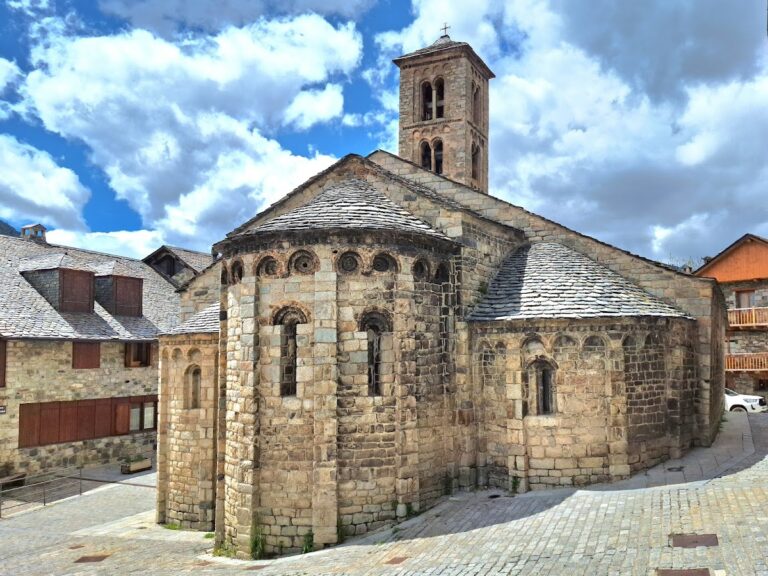
The church underwent substantial changes after its initial construction. The bay before the presbytery, the area around the main altar reserved for the clergy, belongs to the fifteenth century. The transept, the crosswise part of a church that intersects the nave, and the apse, the usually semicircular eastern end, were built in 1730.
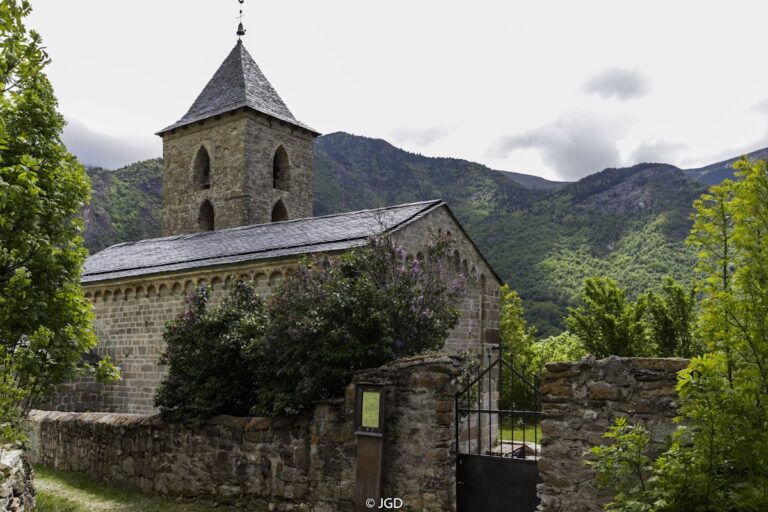
The bell tower has an uncertain date. It is described as a fourteenth-century work and is also associated with construction in the sixteenth century under a privilege granted by Fernando II in 1510. Fernando II was the late-medieval king of Aragon and Sicily who ruled much of the Iberian Peninsula with Isabella I of Castile. The tower served both defensive and ecclesiastical functions, combining protection with the housing of bells.
The Church of Saint Michael is included in Catalonia’s Inventory of Architectural Heritage, reflecting its recognized place within the region’s historic buildings.
Remains
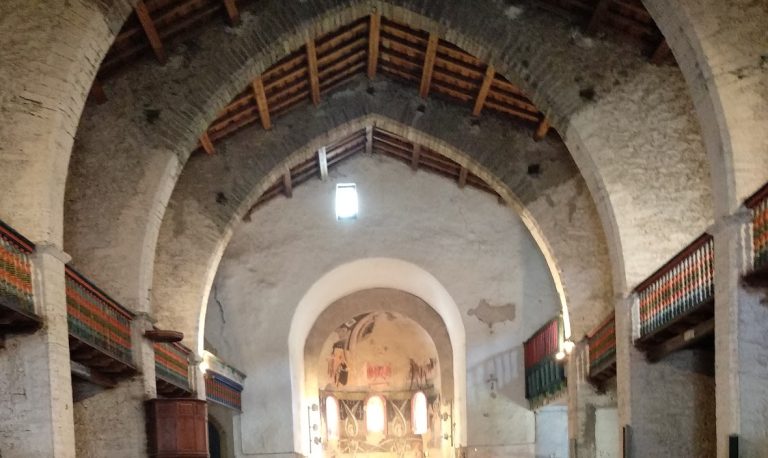
Built of stone, the church has a single nave with four lateral chapels on each side. The nave is covered by a barrel vault, a continuous semicircular vault, supported by transverse arches. The two chapels nearest the transept have groin vaults, formed by the intersection of two vaults, dating from 1535. At the west end, the entrance portal and bell tower are combined in a single architectural composition.
Portal and bell tower
Carved entrance portal
The late-medieval portal combines pointed Gothic shapes with Romanesque imagery and resembles the portal of Saint Stephen of Betrén. It is formed by five pointed archivolts, decorated bands that follow the curves of the arches, set in progressively recessed tiers. The archivolts carry 59 carved figures. Those in the lower part refer to the Resurrection, while the upper figures represent Eternal Life. Angels, saints, musicians, and apostles appear among figures emerging from their tombs. An atrium protects the entrance and also forms the first level of the bell tower.
Fortified bell tower
The tower rises directly over the portal, with a semicircular arch creating a porch-like space on the interior. Its square base measures 6 by 7 metres before the plan changes to an octagonal form higher up. A barbican, a projecting defensive structure associated with a fortified building, supports a sharply pointed pyramidal roof covered in slate. Arrow slits pierce the walls, and two rows of windows occupy the upper section beneath a projecting cornice supported by brackets. The tower ends in a pointed spire and reaches 40 metres in total, including the 13.5-metre spire.
Interior furnishings
Romanesque baptismal font
The Romanesque baptismal font consists of a conical basin, a cylindrical stem, and a circular base. The stem and base do not belong to the basin and have no decoration. Three horizontal bands divide the basin into two zones. The upper zone carries a vegetal design, while the lower zone contains a sequence of engraved arches. Semicircular bosses border the lower angle of the basin, and the decoration combines vegetal and geometric motifs influenced by Mozarabic art, a group of medieval Iberian artistic traditions associated with Christians living under Muslim rule and with related visual influences.
Gothic high-altar retable
The fifteenth-century Gothic high-altar retable, an altarpiece placed behind or above an altar, presents scenes from the lives of the Virgin Mary and Saint Michael. Saint Michael appears in the central panel and in the three panels at the upper left. The central group also includes the apostles Saint Peter and Saint Paul. The work is attributed to the anonymous artist known as the Master of Vielha, who appears to have been a disciple of Pere Garcia de Benavarri, a fifteenth-century painter active in the Crown of Aragon, particularly in Catalonia and Aragon.