Portumna Friary: A Cistercian and Dominican Religious House


Site at a Glance
- Rating
- 4.7
- Popularity
- Very Low
- Country
- Ireland
- Primary era
- Medieval
- Eras represented
- Medieval
- Civilizations
- Irish
- Site type
- Religious
- Remains
- Monastery
On this page8 sections
History
Portumna Friary is a historic religious complex in Ireland, at Portumna, whose history began in 1254 and whose surviving buildings are in the Late Gothic style. Also called Portumna Abbey, Portomna, or Portompria, it passed through Cistercian and Dominican phases and is now an inactive National Monument.
The Cistercian foundation
The site began as a Cistercian chapel dedicated to Saints Peter and Paul in 1254. The Cistercians were a Catholic religious order, and the chapel depended on Dunbrody Abbey in County Wexford, its mother house. It belonged to the Diocese of Clonfert. This foundation later declined, bringing the first phase of the site’s religious history to an end.
The Dominican friary
In 1426, the Cistercian institution was replaced by a Dominican friary dedicated to the Assumption of the Virgin Mary and to Saints Peter and Paul. The Dominicans, another Catholic religious order served by friars, were established there by Murchad Ó Madáin of the O’Madden lords of Síol Anmchadha.
The friary was dissolved around 1582 and granted to Ulick Burke, 3rd Earl of Clanricarde. Part of the monastery was later used as a Church of Ireland church in 1631. The Dominican community returned in 1640, when Ambrose Ó Madadhan became its first prior.
War, expulsion, and later use
Richard Ó Madadhan was prior in 1691, when the friars fled after the Battle of Aughrim. This battle was a major engagement in the War of the Two Kings, the late seventeenth-century conflict associated with the struggle between William III and James II in Ireland and Britain. Anthony McHugo was prior when the Dominicans were formally expelled on 1 May 1698, although some friars remained and had reoccupied the priory by the early eighteenth century. McHugo died there on 24 July 1711.
The friars continued to live in the surrounding area, including Boula and Gortanumera, until the nineteenth century. The choir served as the local Church of Ireland place of worship from 1762 to 1810. On 9 January 1689, Patrick Sarsfield, 1st Earl of Lucan, married Honora Burke at the friary during the War of the Two Kings.
Remains
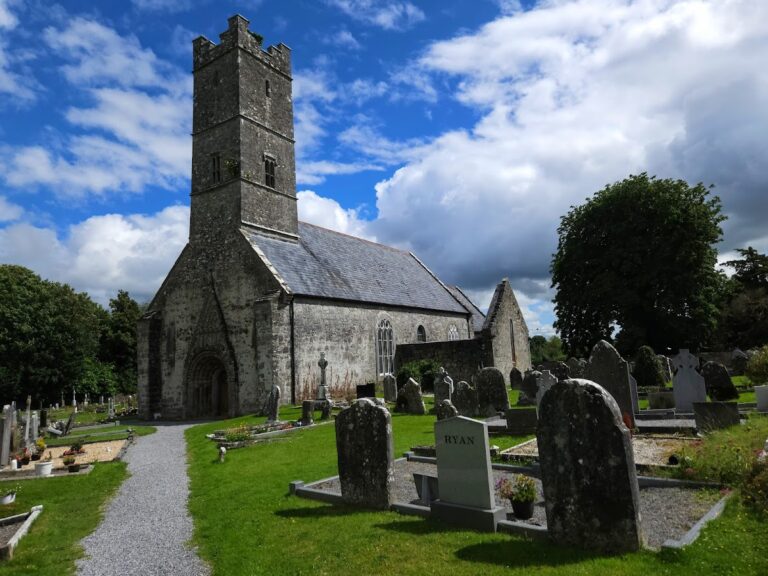
The ruins stand in Portumna Demesne, about 500 metres south of Portumna town centre, immediately east of Portumna Castle and on the northern edge of Lough Derg. The surviving Late Gothic complex consists of an abbey church with a cloister and sacristy to its north. A cloister is a covered walkway around an open court, while a sacristy is a room for storing sacred vessels and vestments.
Church and monastic buildings
Abbey church
The church is approximately 35 metres long and is formed by a nave and chancel separated by a tower. The nave is the main body used by the congregation, while the chancel is the area around the main altar, traditionally reserved for clergy. Inside are medieval grave slabs, memorial plaques, and a piscina, a shallow basin set into a church wall for washing sacred vessels.
Cloister and sacristy
The cloister and sacristy lie on the northern side of the church. Part of the cloister arcade has been reconstructed, preserving a portion of the walkway’s architectural form beside the surviving church.