San Beneto: A Former Roman Catholic Church in Venice
Site at a Glance
- Rating
- 4.3
- Popularity
- Very Low
- Country
- Italy
- Primary era
- Early Modern
- Eras represented
- Early Modern
- Civilizations
- Venetian
- Site type
- Religious
- Remains
- Church
On this page14 sections
History
San Beneto, also known as San Benedetto, is a former Roman Catholic church in Venice, Italy, in the San Marco district. Its foundation is generally placed around 1000 or in the eleventh century, and tradition attributes it to the Caloprini, Burcali, and Falier families, possibly in 1007. The present building belongs chiefly to a seventeenth-century rebuilding in a classical exterior and Baroque interior style.
Foundation and Medieval Development
In 1013, Giovanni and Domenico Falier transferred San Beneto, along with numerous ornaments and books, to the Benedictine monastery of Santissima Trinità e San Michele Arcangelo at Brondolo near Chioggia. Benedictines followed the monastic tradition based on the Rule of Saint Benedict. During the twelfth century, a shipyard stood toward the Grand Canal, where Romano Mairano had a ship built for his long-distance trading voyages.
A fire destroyed the first church in 1167. Its replacement was built with three naves, the main lengthwise spaces of the church, and three chapels. In 1229, Pope Gregory IX, head of the Catholic Church from 1227 to 1241, ordered the church’s transfer to the Cistercians, a reform branch of Western Christian monasticism that developed from the Benedictine tradition. The order neglected the building.
Parish Church and Rebuilding
In 1435, Lorenzo Giustiniani, then Bishop of Castello and later Venice’s first patriarch, converted San Beneto into a parish church, serving a defined local Christian community. The church is also described as having received collegiate status at this time.
The original free-standing campanile, or bell tower, stood west of the campo beside the facade. It collapsed on 26 November 1540, seriously damaging the church and leaving the building increasingly unsafe. Under Patriarch Giovanni Tiepolo, a third church was constructed between 1619 and 1629 under an unidentified architect. Rebuilding work, including the replacement campanile, continued until 1695, while 1685 is given as a completion or rebuilding date for the church.
The new church was turned 90 degrees from the earlier eastward alignment, leaving its apse, the end of the church around the high altar, facing north. Jacopo Tintoretto had produced several works for the second church, including a high-altarpiece, a Nativity for the Contarini Chapel, organ-shutter paintings, and two works for the organ gallery. The two altar paintings disappeared during the early seventeenth-century rebuilding. Four organ canvases survived, though they were cut down and later moved elsewhere; the paintings remained at San Beneto until their sale in 1730, which helped pay for restoration of the organ.
Later Status
San Beneto was closed during the early twentieth century. In 1810, its parish was placed under the neighboring church of San Luca Evangelista, and San Beneto became a subsidiary church of that parish. It remains Roman Catholic and belongs to the Patriarchate of Venice, although regular services are no longer held. In September 1927, Contessina Marina Volpi di Misurata, daughter of the Venetian politician Giuseppe Volpi, married Carlo, Prince Ruspoli di Poggio Suasa, at the church.
San Beneto is now a profaned church that has been rebuilt several times. Its surviving decoration includes paintings by Carlo Maratta, Jacopo Guarana, Sebastiano Mazzoni, Antonio Fumiani, Gaspare Diziani, Giambattista Tiepolo, and Bernardo Strozzi. Maratta’s high-altarpiece is described as his only work in Venice.
Remains
Building and Facade
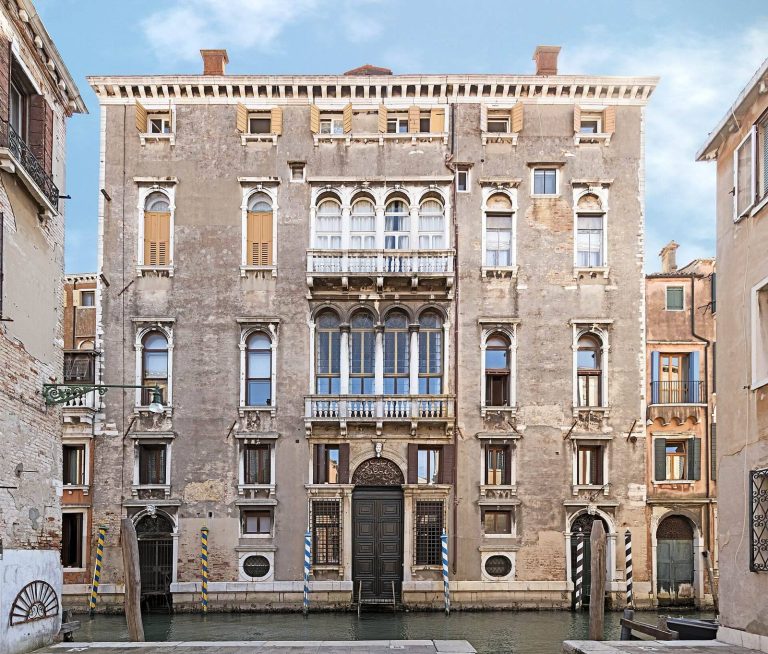
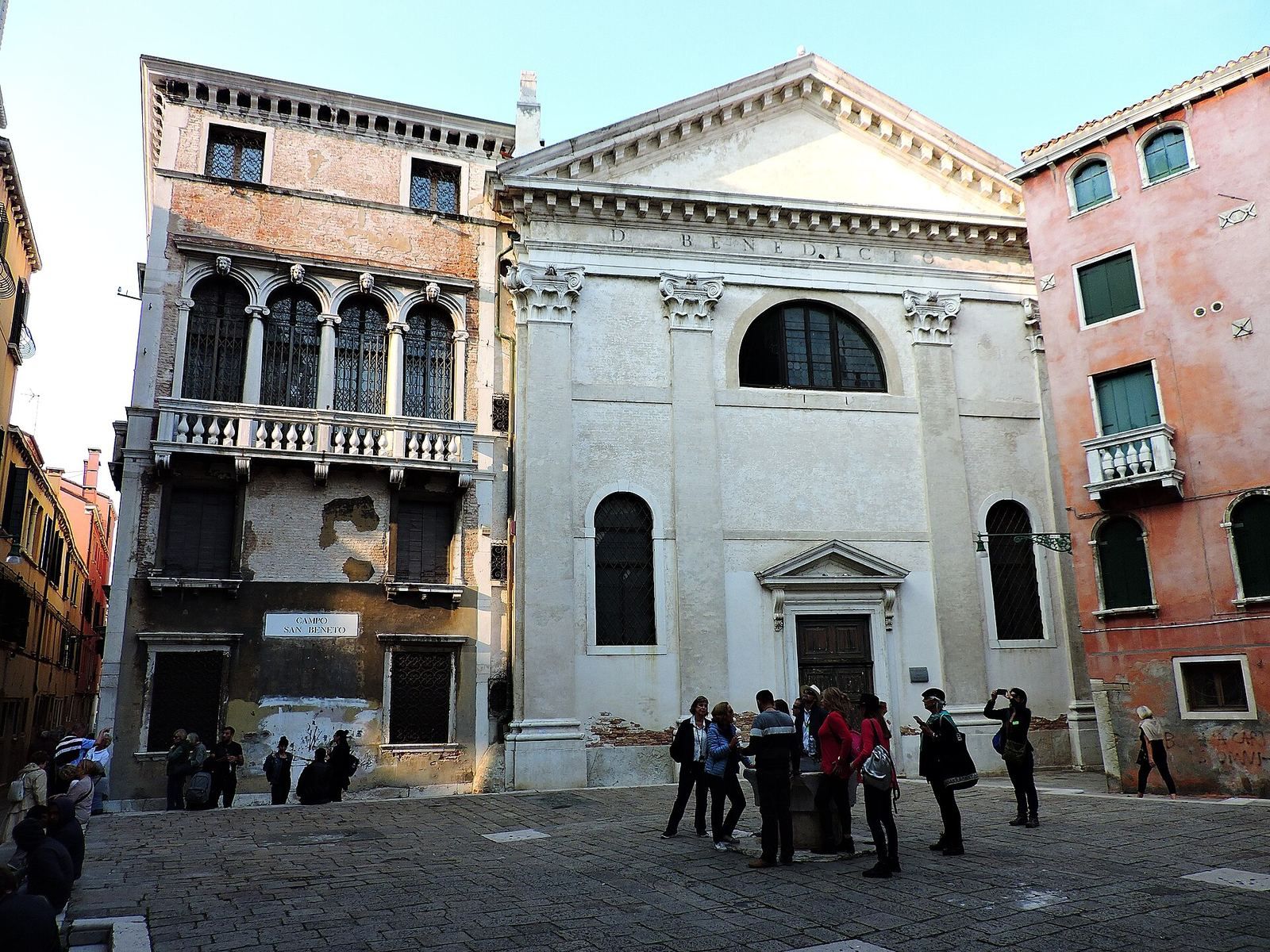
San Beneto is a small rectangular church with a single nave and a restrained classical-style exterior. It stands on the northern edge of Campo San Beneto, beside the building now known as the Fortuny Museum, also called Palazzo Pesaro degli Orfei or Palazzo Fortuny. The church’s side and apse are associated with neighboring palazzi, while its left side and attached campanile face the Corte Tron.
Facade
Four pilasters divide the facade into three sections. They rise from simple bases and carry Composite capitals, which combine principal forms of the Ionic and Corinthian orders. Above them is an entablature, the horizontal architectural assembly over the supports, with a frieze bearing the inscription “D. BENEDICTO.” A triangular pediment framed by dentils crowns the facade. The dentils are small tooth-like blocks arranged in a repeating cornice pattern.
A window immediately below the cornice is cut across at its base by a horizontal band running through the wall. Two narrower arched windows flank the portal below the facade’s midpoint. The portal has its own pediment, supported by elements resembling battlements.
Bell Towers
Earlier Campanile
The earlier campanile was separate from the church and stood west of the campo beside the facade. It was comparatively tall, with a conical, sugarloaf-shaped roof and four corner pinnacles or crenellations. Its collapse on 26 November 1540 caused serious damage to the church and contributed to the later rebuilding.
Present Campanile
The replacement campanile stands to the northwest beside the Corte Tron. Smaller than its predecessor, it is approximately 20 metres high and has an octagonal drum, an onion dome, and a belfry opened by mullioned windows, which are divided into separate openings by slender vertical supports.
Interior Decoration
High Altar and Presbytery
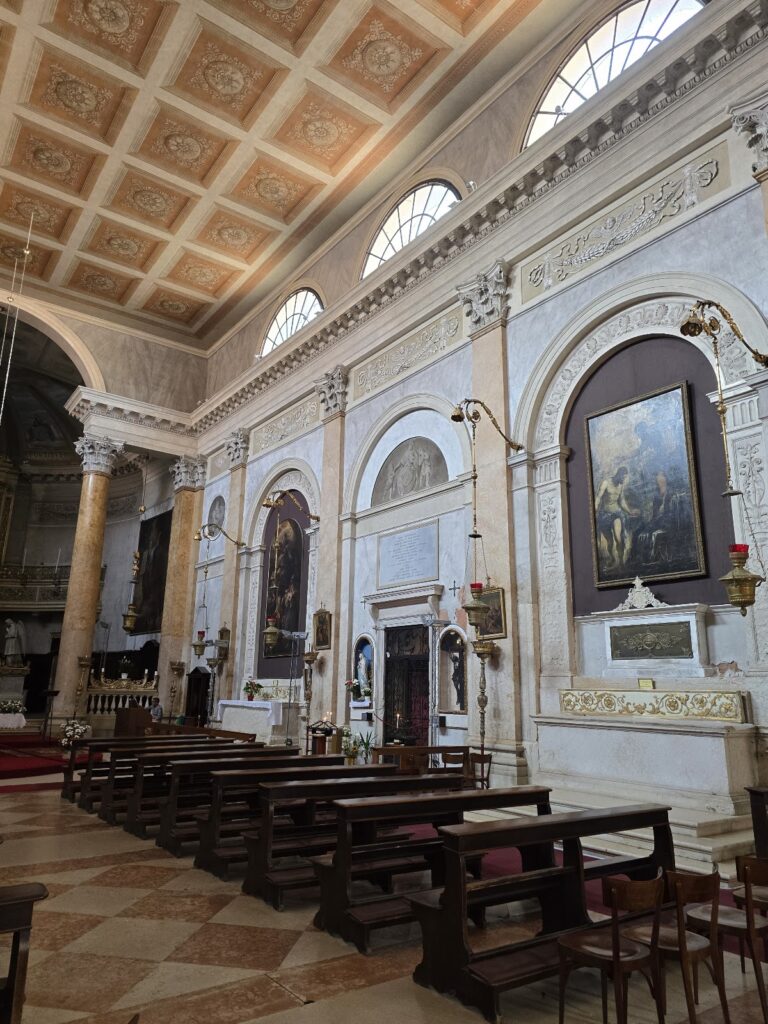
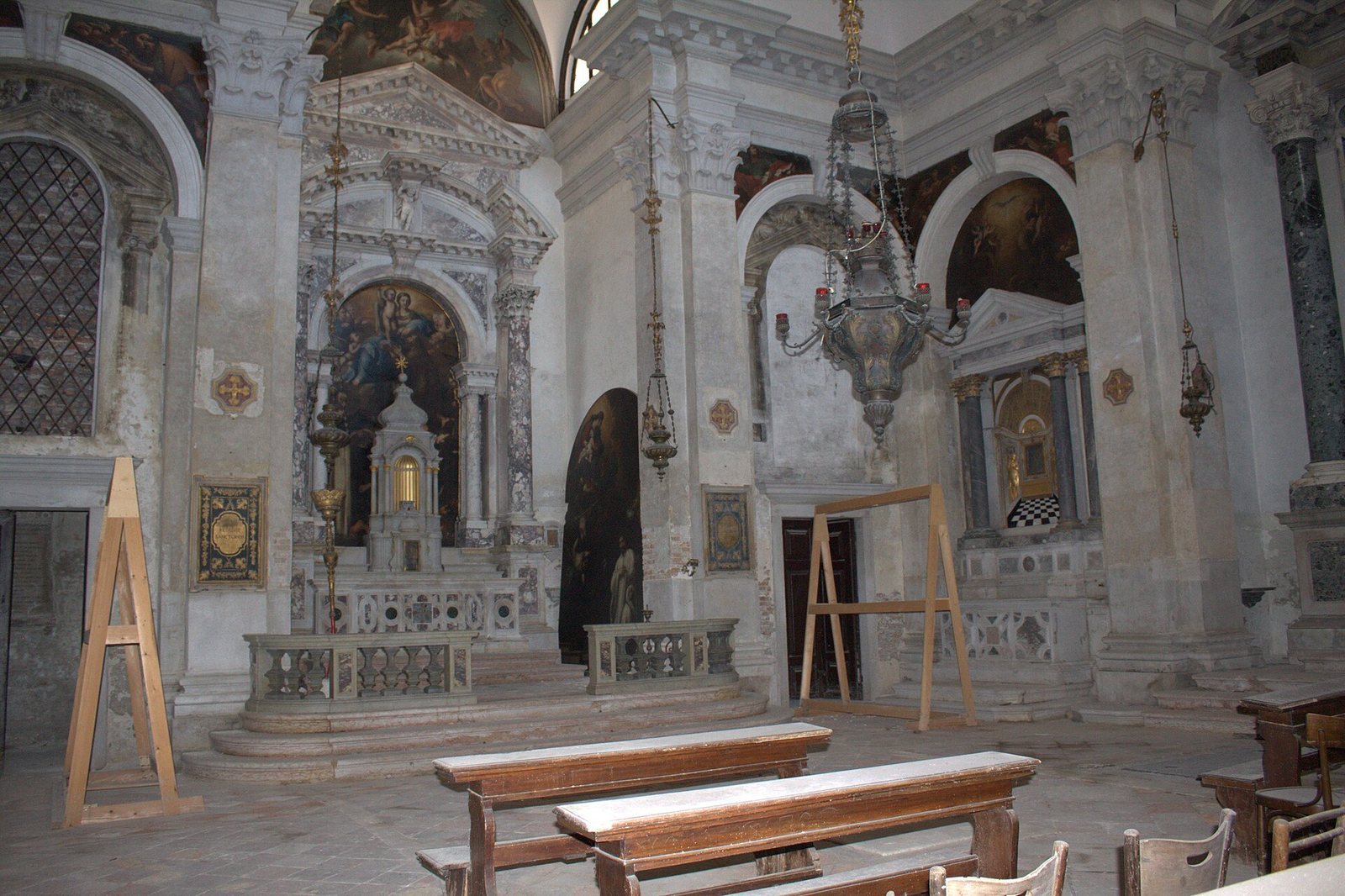
The interior is more ceremonious than the exterior and uses marble of various colors extensively. The presbytery, the area around the high altar traditionally reserved for clergy, contains works by Sebastiano Mazzoni. Two paintings hang on either side of the presbytery, with further paintings placed over the doors beside the high altar. One of Mazzoni’s works, Saint Benedict Presents Pasqualino Daneli to the Virgin, dates to 1648.
Side Altars
Bernardo Strozzi’s The Two Women Tending Saint Sebastian is on the second side altar on the right, also described as being on the south wall. On the first altar to the left, or on the north wall, is Giambattista Tiepolo’s Saint Francis of Paola in Ecstasy, painted in 1738–1740 and restored in 1994. Other paintings associated with the church are by Jacopo Guarana, Antonio Fumiani, Gaspare Diziani, Carlo Maratta, and Sebastiano Mazzoni.
Organ Paintings
Tintoretto’s Annunciation, originally painted on the inside of the organ doors, is now in the Rijksmuseum in Amsterdam. The other surviving organ canvases were cut down and are located elsewhere. The church’s interior retains religious paintings and frescoes, while the external campanile occupies the side alley known as the Corte Tron.