Logtun Church: A Medieval Parish Church in Norway
Site at a Glance
- Rating
- 4.7
- Popularity
- Very Low
- Country
- Norway
- Primary era
- Medieval
- External website
- Open
- Eras represented
- Medieval, Early Modern
- Civilizations
- Norwegian
- Site type
- Religious
- Remains
- Church
On this page7 sections
History
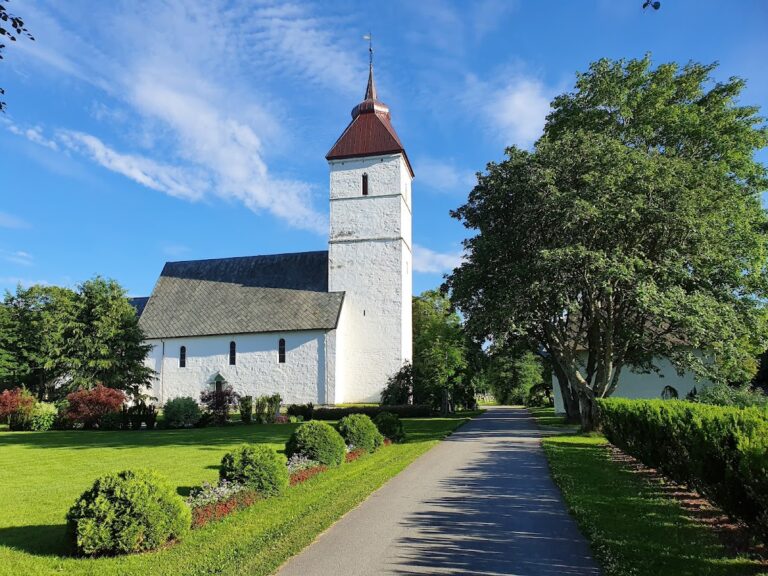
Logtun Church is a medieval parish church in Norway, standing in the village of Logtun on the Frosta Peninsula in Frosta Municipality. Probably built around 1150–1160, it belongs to the medieval period and served as the main church of Frosta Parish until a new church replaced it in 1866.
Medieval origins and parish use
A church already stood at Logtun during the tenure of Archbishop Eystein Erlendsson, the medieval archbishop of Nidaros, who served from 1157 to 1180. The date of the present building remains uncertain, although its construction is generally placed around 1150–1160. Its architect is unknown. Logtun lies near Tinghaugen, identified with the early meeting place of the Frostating, an early Norwegian regional assembly and court.
The church was completely rebuilt around 1500. Extensive interior repairs followed in 1640. A wooden sacristy, veranda tower, and porches were probably added after the Reformation of 1537, the religious transformation that ended Norway’s Catholic ecclesiastical order and established Lutheran Christianity. Logtun Church was formerly Catholic and is now Evangelical Lutheran within the Church of Norway.
The 1814 election and changing role
In 1814, Logtun Church served as an election church and polling station during Norway’s constitutional elections. Each parish elected electors, who then helped choose representatives for the Constituent Assembly at Eidsvoll Manor, where the Constitution of Norway was drafted.
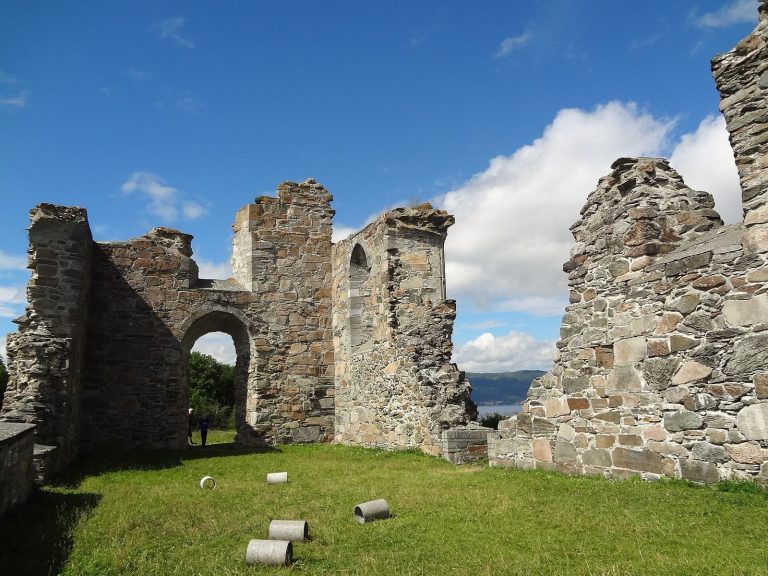
Frosta Municipality purchased the church in 1857, when it was considered too small for the parish. After Frosta Church was built in 1866, Logtun Church ceased regular use. It was partly dismantled in 1868, but its stone walls remained standing, while the roof timbers were sold at auction.
Preservation and present status
The parish transferred the building to the Society for the Preservation of Ancient Norwegian Monuments in 1903. This Norwegian organization conserves historic buildings and monuments. The stone walls were extensively repaired in 1903–1904, the roof was rebuilt in 1932, and the interior was restored between 1935 and 1950. The restored church was first used for an Olsok service in 1950, an observance associated with Saint Olav, Norway’s medieval patron saint.
Logtun Church is preserved as a museum and historic cultural site, while it continues to be used occasionally for baptisms, weddings, worship services, and concerts. It remains a parish church of the Church of Norway and is an automatically protected Norwegian cultural heritage site.
Remains
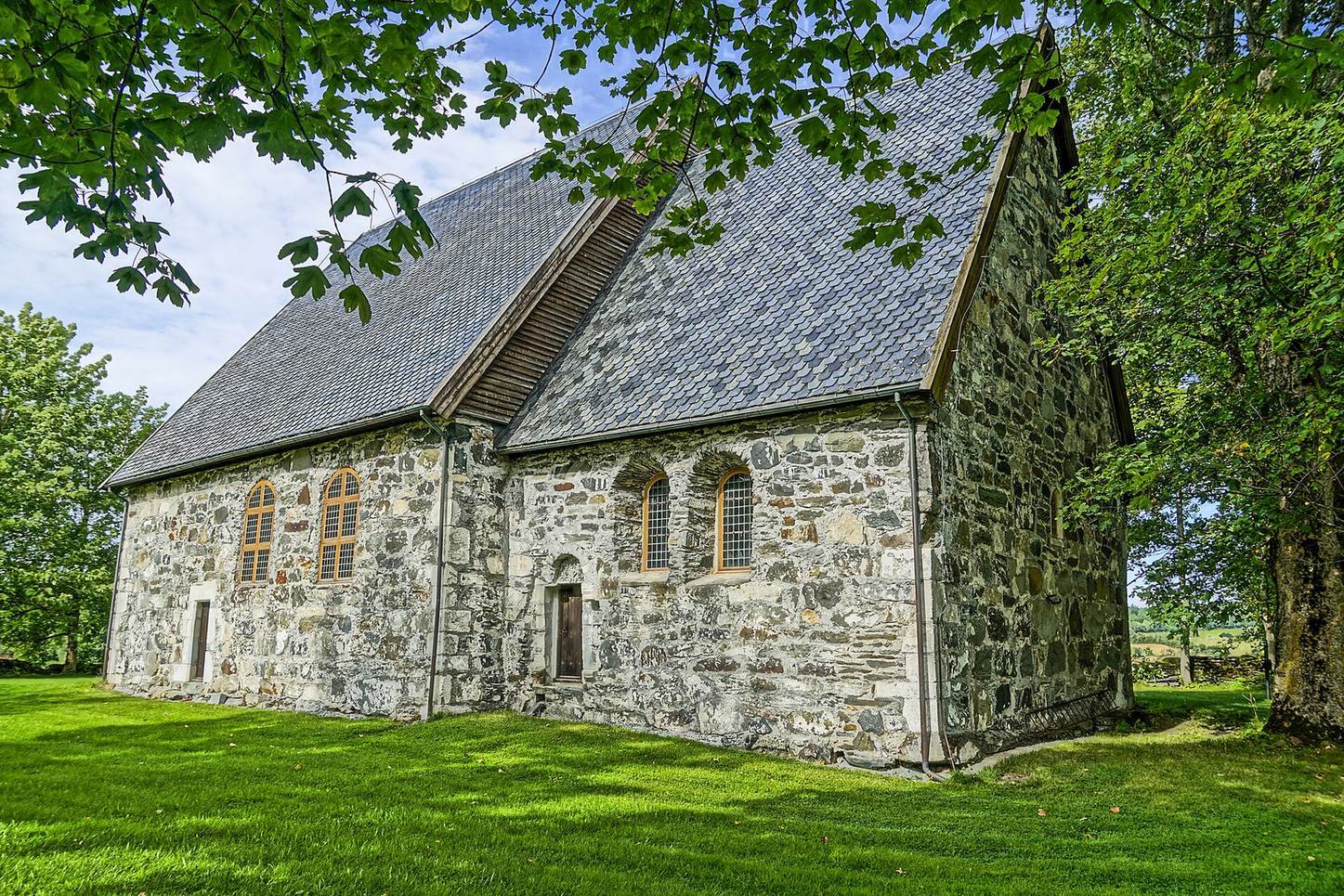
Logtun Church is a stone-built medieval long church with walls formed as double masonry. Stone and brick were bonded with lime and sand, creating the surviving structural shell that remained after the partial dismantling of 1868. The roof was reconstructed in 1932, and the interior was restored from 1935 to 1950.
Stone church
The main building preserves the form of a medieval long church. Its repaired stone walls stand close to Tinghaugen on the Frosta Peninsula and express the building’s medieval origin. The roof and interior now reflect the twentieth-century restoration carried out after the church’s period of reduced use.
Wooden additions and interior furnishings
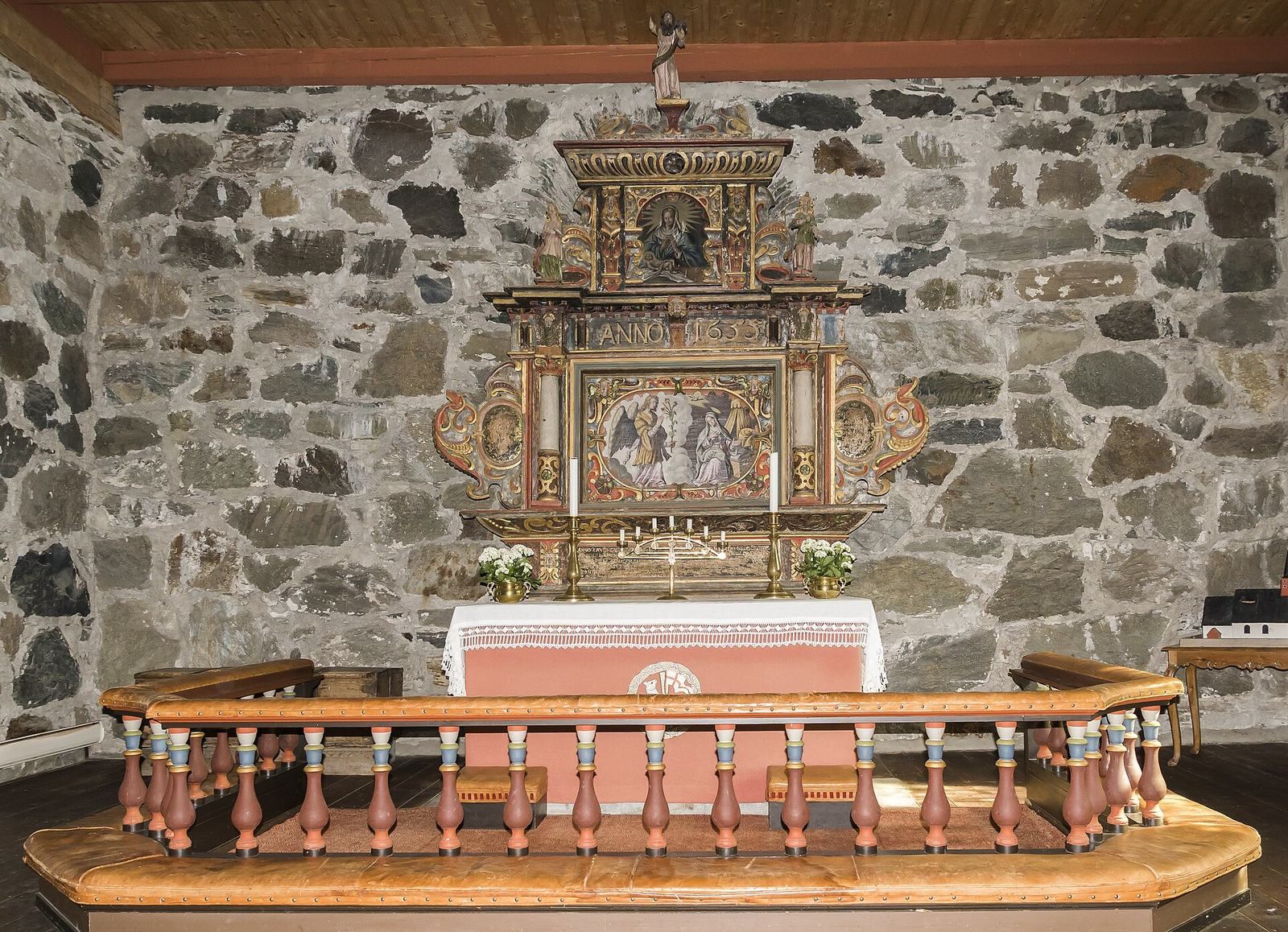
The church also contains later wooden elements, including a sacristy, a veranda tower, and porches probably added after 1537. Inside is an altarpiece carved in 1652 and painted in 1655. Johan Bildthugger carried out its carpentry and wood carving, while Johan Hansen Kontrafeier painted it.