Saint George Church in Ziębice: A Roman Catholic Parish Church and Passion Sanctuary
Site at a Glance
- Rating
- 4.8
- Popularity
- Very Low
- Country
- Poland
- Primary era
- Medieval
- External website
- Open
- Eras represented
- Medieval, Early Modern, Modern
- Civilizations
- Holy Roman Empire
- Site type
- Religious
- Remains
- Church
On this page16 sections
History
Saint George Church in Ziębice is a Roman Catholic parish church in Poland, dedicated to Saint George and serving as a sanctuary of the Passion. The present medieval building was constructed between 1265 and 1275, with its western body completed around 1270. Saint George, a Christian martyr traditionally associated with the defeat of a dragon, is widely venerated as a military patron and as the dedicatee of churches.
Thirteenth-century foundations
The present church replaced a slightly earlier predecessor. During restoration in 1898–1900, fragments of a Romanesque building dating from the second quarter of the thirteenth century were found beneath the area of the present presbytery. The presbytery is the part of a church surrounding the main altar and traditionally reserved for the clergy.
The western body belongs to the original construction campaign around 1270. The church was subsequently enlarged and altered over several centuries, so its present form reflects both its medieval origins and later changes in religious use, architecture, and decoration.
Medieval enlargement
A sacristy was added on the south side in the fourteenth century. It was later converted into the Chapel of Saint George. The choir was also added during a later phase, although its construction date is uncertain.
The Marian Chapel was built on the north side between 1420 and 1423 under the patronage of John I of Münsterberg, a member of the Poděbrad dynasty who ruled the Duchy of Münsterberg. A free-standing bell tower was added during a later Gothic phase in the second half of the fifteenth century.
Early modern transformations
The church underwent further alterations in the early eighteenth century. In 1715, it received a Baroque high altar made by A. Joerg of Kamieniec Ząbkowicki in 1703 for Bardo. Paintings by Michael Willmann, a prominent Baroque painter active in Silesia, were transferred from Bardo with the altar.
Its historic furnishings represent several periods, including the late Gothic, Renaissance, Baroque, Rococo, and Neo-Gothic eras. Among the early modern memorials is a painted Renaissance wooden epitaph for Charles I of Münsterberg, a Silesian prince of the Poděbrad family.
Restoration and present status
From 1898 to 1900, the church underwent a Neo-Gothic restoration. The work altered parts of the building and brought renewed attention to its medieval fabric, including the Romanesque remains found beneath the presbytery. Alexander Linnemann of Frankfurt am Main created the stained-glass windows during this remodeling, while August Oetken carried out the interior painting.
On 28 May 2008, Pope Benedict XVI granted the church the title of minor basilica. This papal title recognizes a church’s particular religious and historical importance without making it the seat of a bishop. In 2024, the church was recognized as a Monument of History and remains protected as a historic monument.
Remains
Plan and exterior
Two-nave church and choir
The church is built of brick and has two naves. The two-nave hall opens into a three-nave choir, which is accompanied by a roof turret and two tall side chapels arranged like the arms of a transept. The south-side Chapel of Saint George occupies the former fourteenth-century sacristy, while the Marian Chapel stands on the north side.
Portals and bell tower
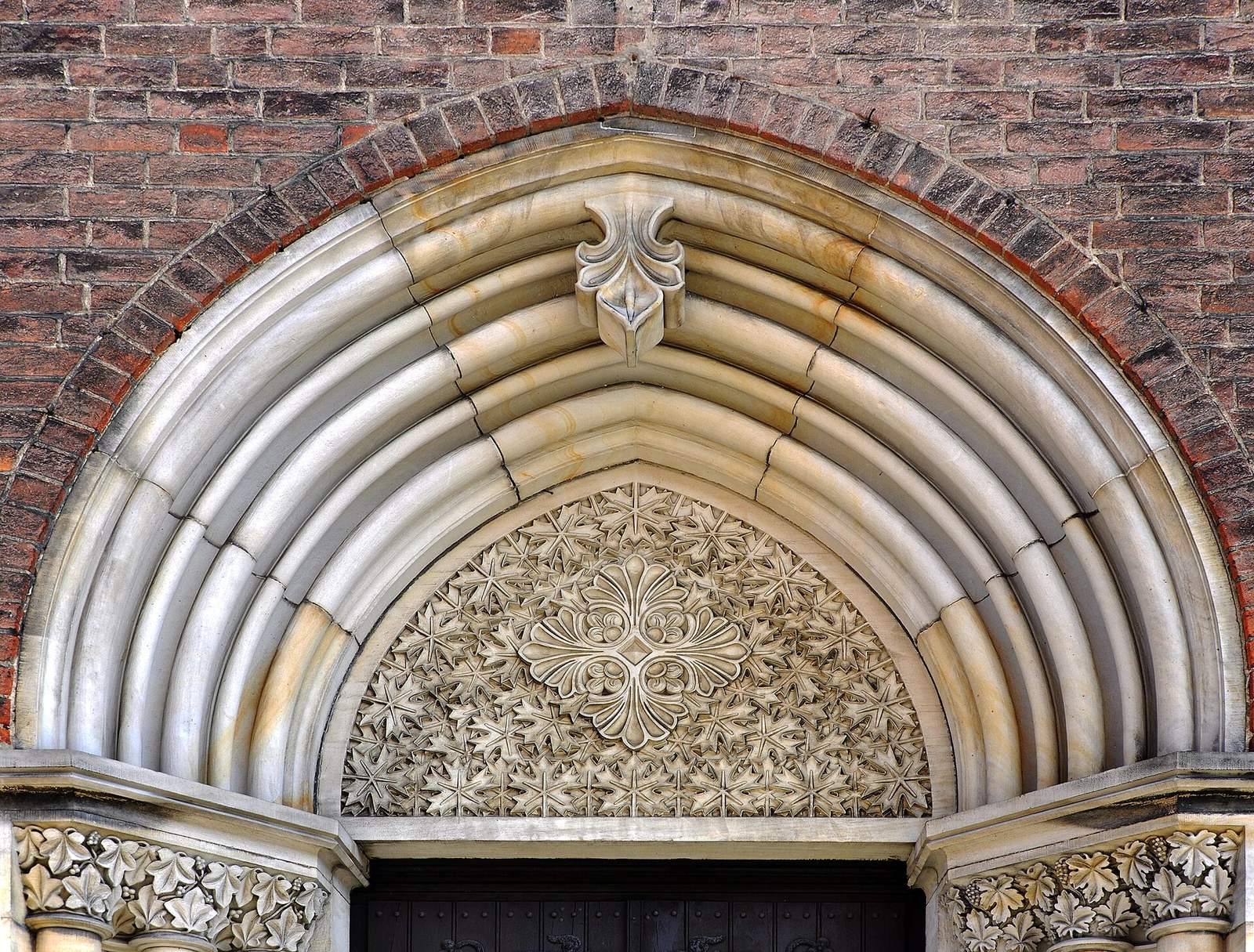
The principal northern entrance has a thirteenth-century pointed-arch portal combining Romanesque and Gothic features. Its richly sculpted portal includes a tympanum containing a flat cross. A similar portal on the south side was made during the Neo-Gothic restoration around 1900.
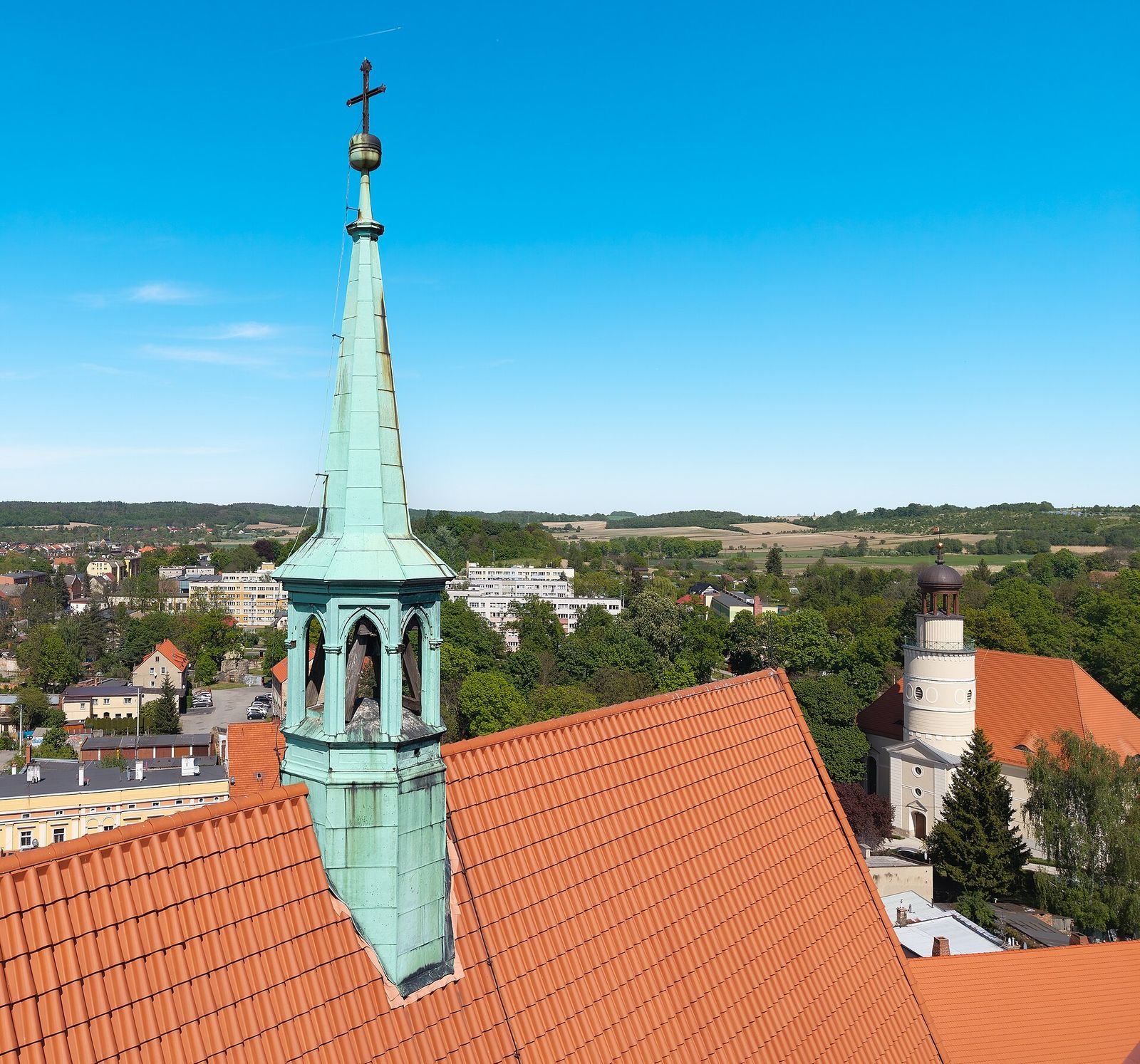
North of the nave stands the square, free-standing bell tower. Its upper form is finished with a round roof or cupola, giving the tower a distinct relationship to the main brick body of the church.
Medieval paintings and sculpture
Chapel and choir features
A fifteenth-century wooden crucifix hangs on a pillar in the choir. The Marian Chapel contains a polychrome fifteenth-century sculpture of the Virgin and Child, transferred from a former Franciscan church. Beside the altar in the presbytery is a Gothic sacrament house from the second half of the fifteenth century. A sacrament house is a structure or architectural cabinet used to reserve the Eucharist.
Frescoes and polychrome decoration
Fifteenth-century frescoes survive on the presbytery walls and elsewhere in the church. They are associated with the Biblia Pauperum, or “Bible of the Poor,” a medieval devotional tradition that presents scenes from Christ’s life alongside related biblical images and inscriptions, often in visual form. The frescoes were restored in 1900, and the original sections behind the high altar depict scenes from the Passion.
Polychrome decoration dated 1530 remains on the eastern side of the main nave. Its scenes from the Passion of Christ include the washing of the feet of the poor, the Last Supper, Christ’s imprisonment, and the trial before Pilate.
Altars, memorials, and pulpit
Gothic and Renaissance works
The north nave preserves fragments of an early-sixteenth-century Gothic altar formerly located in the Marian Chapel. Its reliefs show the Annunciation, the Nativity, the Adoration of the Magi, and the Assumption.
At the end of the south nave is a late-Gothic altar dated 1615, with polychrome scenes from the Passion. The same area contains the painted wooden epitaph for Charles I of Münsterberg, dated 1542. Six relief tombstones of nobles from the mid-sixteenth century are located beneath the choir, while further tombstones are set into the south wall, the northern porch, and the stairwell.
Baroque and Rococo furnishings
The Baroque high altar made in 1703 represents Christ on the Mount of Olives. It is richly decorated with sculptures of saints and angels and was moved from Bardo to Ziębice in 1715, together with paintings by Michael Willmann.
The side naves contain early Rococo altars dedicated to the Holy Trinity and the Crucifixion, both dated 1740. The Crucifixion altar incorporates a Gothic sculpture of the Madonna with Angels from the second half of the fifteenth century. Numerous Baroque and Rococo sculptures also stand in the main and side naves, including a Baroque Virgin and Child from the first half of the eighteenth century.
Mannerist pulpit and later decoration
A Mannerist stone pulpit from around 1595 is supported by figures of Moses and angels. Its relief decoration represents the Evangelists and Apostles. The stained-glass windows by Alexander Linnemann and the interior painting by August Oetken belong to the Neo-Gothic remodeling around 1900, completing the church’s layered interior of medieval, early modern, and nineteenth-century elements.