Mezquita de las Tornerías: A Former Mosque in Toledo, Spain


Site at a Glance
- Rating
- 4.6
- Popularity
- Low
- Country
- Spain
- Primary era
- Medieval
- External website
- Open
- Eras represented
- Classical, Medieval
- Civilizations
- Roman, Taifa Kingdoms, Taifa of Toledo
- Site type
- Religious
- Remains
- Mosque
On this page7 sections
History
Mezquita de las Tornerías is a former mosque in Toledo, Spain, associated with Moorish Islamic architecture and the Taifa period, the era of independent Muslim kingdoms that followed the breakup of the Caliphate of Córdoba. Its construction date is uncertain. Located in Toledo’s old Muslim quarter, the Arrabal de Francos, it remained a place of communal Muslim prayer after the Christian conquest of Toledo by Alfonso VI of León and Castile in 1085.
Use during the Taifa and Christian periods
Following the conquest, the mosque continued to serve Muslim worshippers. For nearly four centuries, it was the only place in Toledo permitted for communal Muslim prayer. Its religious use ended during the desacralization carried out between 1498 and 1505 under Isabella I of Castile and Ferdinand II of Aragon, known together as the Catholic Monarchs.
Secular use and rediscovery
After its conversion to secular use, the building became an inn in 1505. It later accommodated various businesses, small factories, and a private residence. Over time, its original identity was forgotten, although local memory retained the idea that an old mosque stood within a house on Tornerías Street. During the late nineteenth century, historians investigated whether the building had originally been a synagogue or a mosque.
On 15 March 1905, the discovery of an Arab mosque on Tornerías Street was formally communicated to the Royal Academy of History, Spain’s institution for historical research and documentation. The rediscovery followed archival and field research associated with the Marquis of Torrecilla. Since the twentieth century, the building has been reused as a museum and gallery. It now houses the Regional Crafts Centre of Castilla-La Mancha and hosts temporary exhibitions. The property is catalogued as a Property of Cultural Interest and forms part of the Historic City of Toledo.
Remains
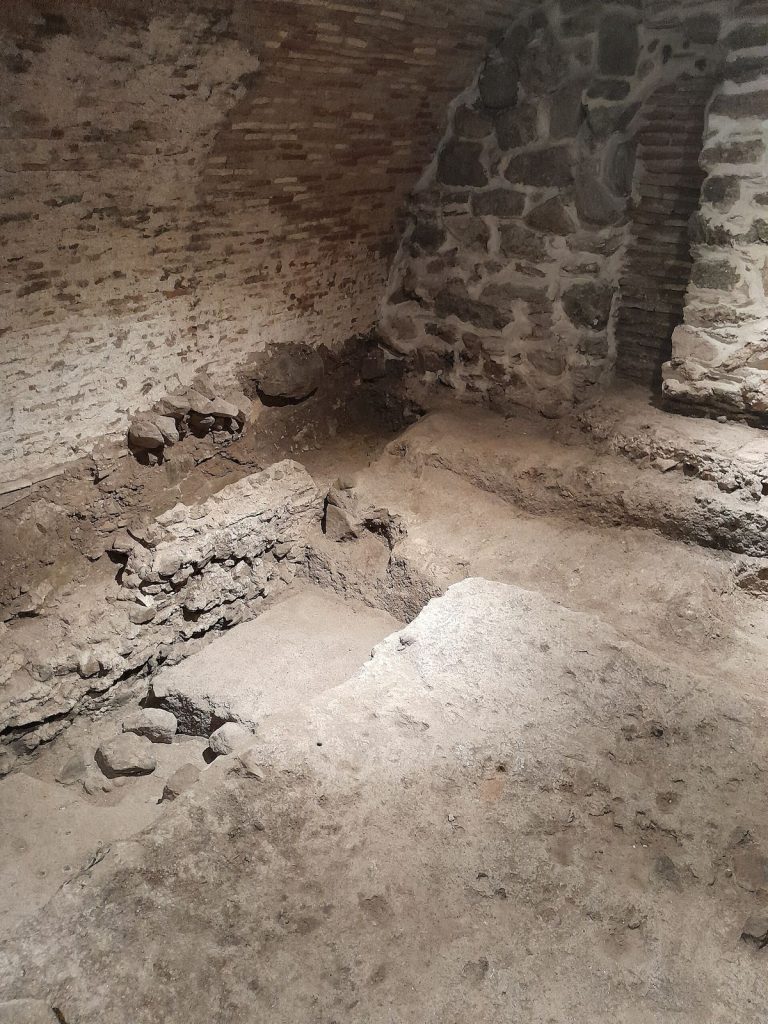
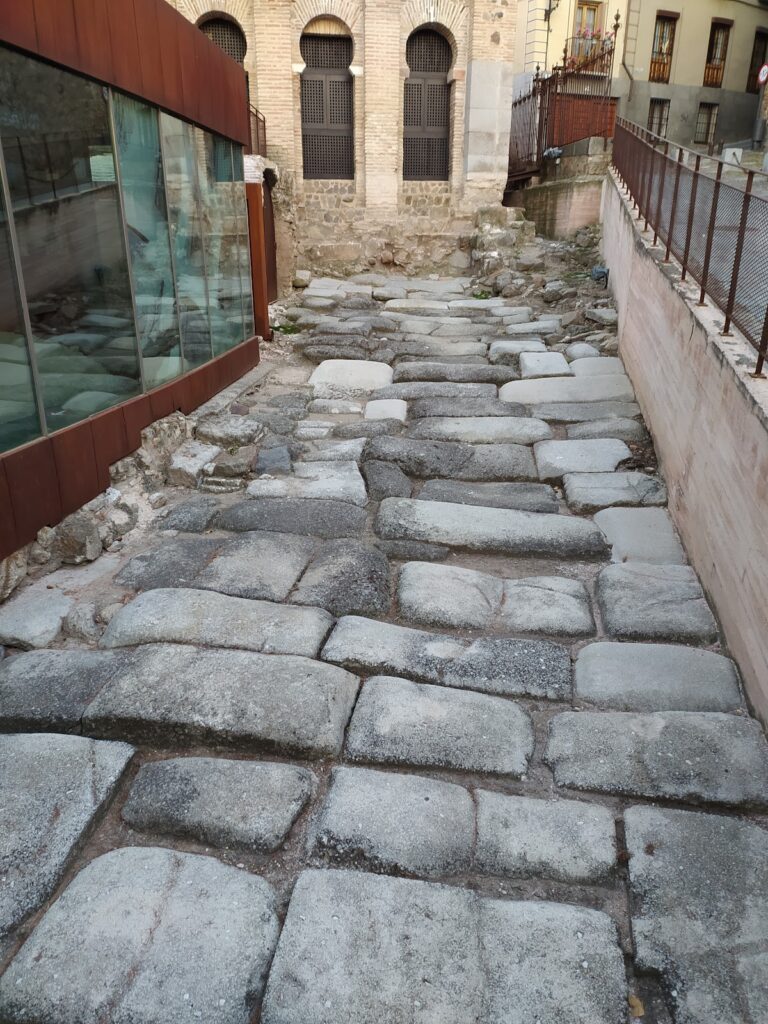
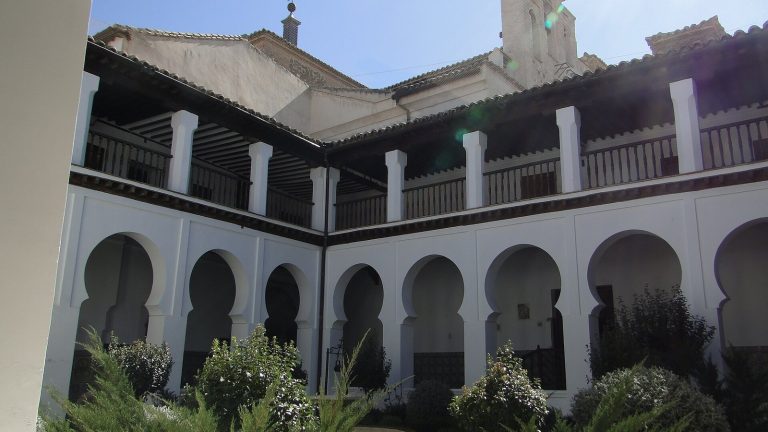
The mosque occupies an irregularly planned building on Tornerías Street, arranged over two levels because of the pronounced unevenness of the terrain. Its lower structures incorporate earlier Roman water-distribution remains, while the upper level preserves the former prayer hall. Together, these elements reveal how the building was fitted into an already established urban and architectural setting.
Two-level structure and prayer hall
Lower level
The ground floor is entered from Tornerías Street and contains granite horseshoe arches associated with the earlier substructure. This level opens onto the Roman water-distribution remains beneath the mosque, linking the building’s later Islamic construction with older infrastructure.
Upper prayer hall
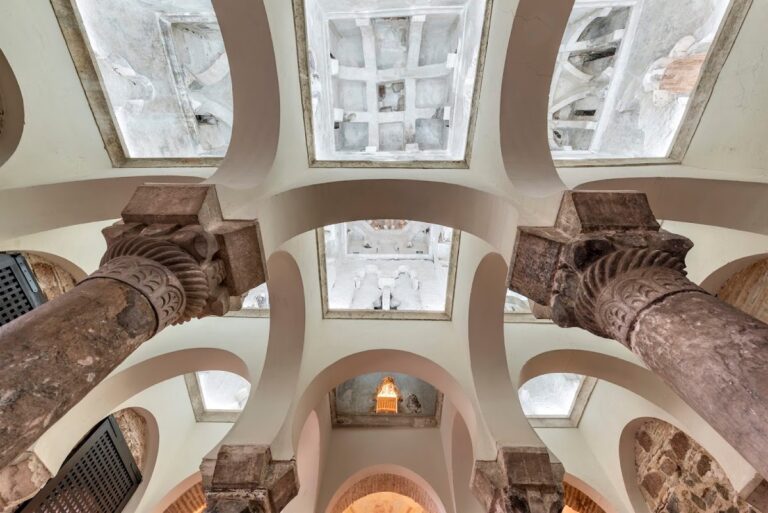
The upper floor contains the former prayer hall, including surviving remains of the mihrab, the niche indicating the direction of Mecca, and the qibla wall, which faces that direction. The interior is divided into nine square compartments, an arrangement modeled on the Mosque of Cristo de la Luz, also known as Bab al-Mardum. Each compartment is covered by a brick sail vault, a vault shaped like part of a sphere rising between its supports. The central compartment has a prominently ribbed dome with geometric ornament. Horseshoe arches rest on low columns with large, solid capitals.
The mosque’s small dimensions, the position of the prayer hall, and the lack of a courtyard for ablutions have led to the interpretation that it may have served as a private prayer space for a prominent resident of Toledo.