St. Laurentius: An Evangelical Fortified Church in Krostitz
Site at a Glance
- Rating
- 4.8
- Popularity
- Very Low
- Country
- Germany
- Primary era
- Medieval
- External website
- Open
- Eras represented
- Medieval, Early Modern, Modern
- Civilizations
- German, Holy Roman Empire
- Site type
- Religious
- Remains
- Fortified Church
On this page11 sections
History
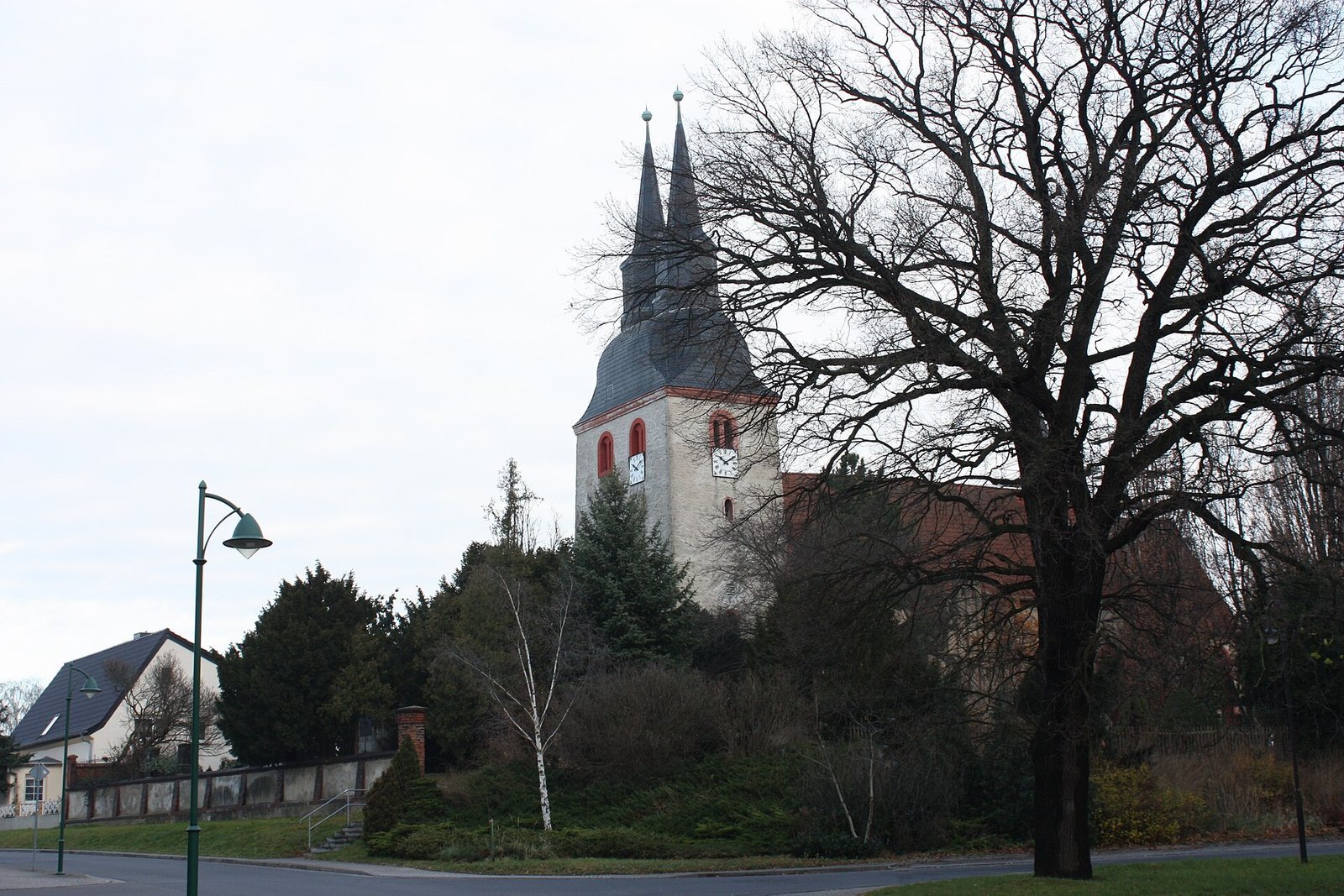
St. Laurentius is an evangelical church in Krostitz, Germany, dedicated to Saint Lawrence of Rome, a third-century Christian deacon and martyr. Built between 1206 and 1208 in the late Romanesque style, it served as a fortified church and may originally have belonged to a monastic brotherhood, a religious community organized around shared worship and communal life. That possible connection may explain its unusually large scale for a village church.
Romanesque Origins and Gothic Changes
The church’s early form belonged to the Romanesque period, known here for massive construction and round-arched elements. Around 1500, extensive alterations reshaped the building. Its tower had collapsed and was rebuilt in the form that survives today, while the altar area was added in 1504. The earlier Romanesque altar area had been decorated with the Twelve Apostles.
The remodeling also introduced Gothic features, a style associated with pointed forms, larger windows, vaulting, and tracery. These changes included a net vault, enlarged windows on the south side, and a stone gallery. A wooden gallery begun in 1583 was later enlarged in 1666 and again in 1823 as the congregation grew.
War, Renewal, and Later Preservation
In 1638, during the Thirty Years’ War, a major European conflict fought from 1618 to 1648, Swedish troops stood at the oak door in the gable and threatened the village’s remaining inhabitants. By the end of the war, Krostitz had been completely destroyed and depopulated, while the church remained standing. A document preserved in the tower finial records the names of citizens who helped restore life to the village after 1649.
Leaded-glass windows and the tower clock were installed in the eighteenth century. Conrad Geißler built the organ between 1875 and 1876. During the First and Second World Wars, bells were surrendered as metal donations and melted down for war material; one bell was replaced in 1928 through a donation campaign.
An interior renovation carried out from 1984 to 1992 repainted the church in the style associated with its 1504 building phase, while services continued during the work. The leaded-glass windows made in 1891 were restored in 1994, and Emil Hammer Orgelbau restored the organ in 2006. A memorial plaque on the opposite parsonage commemorates Zachäus Faber, an elder and pastor in Krostitz who wrote the hymn Fröhlich wir nun all fangen an in 1601.
Remains
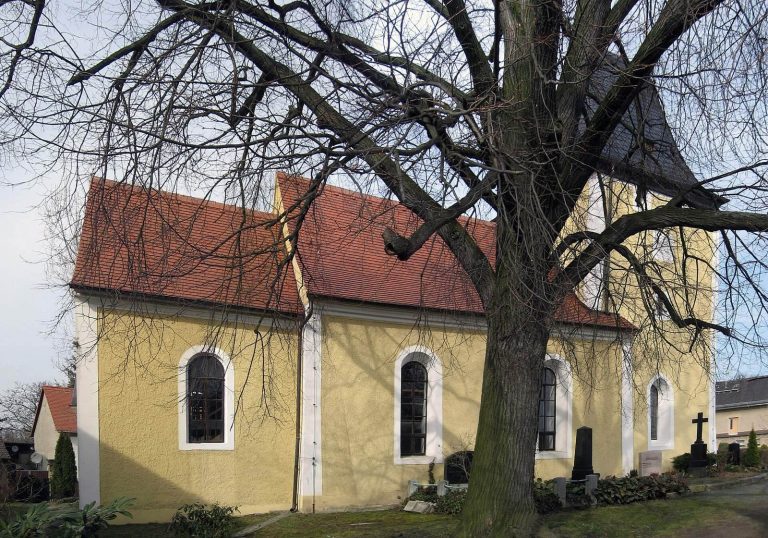
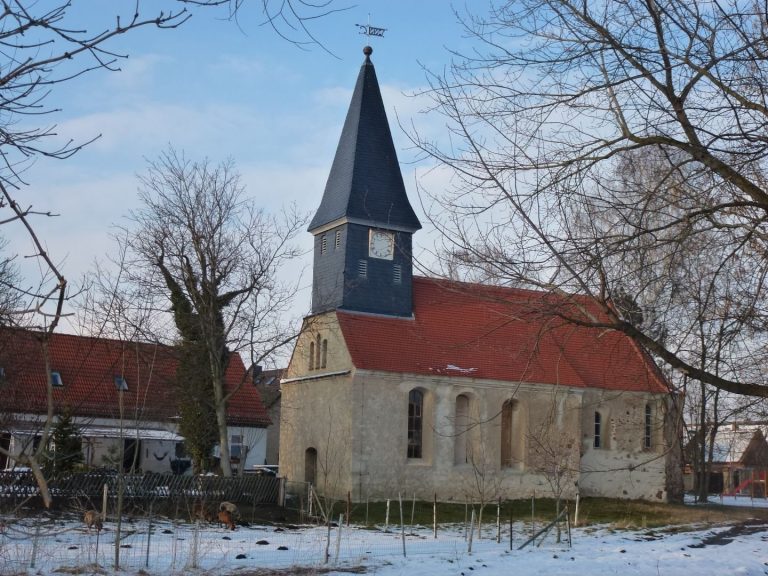
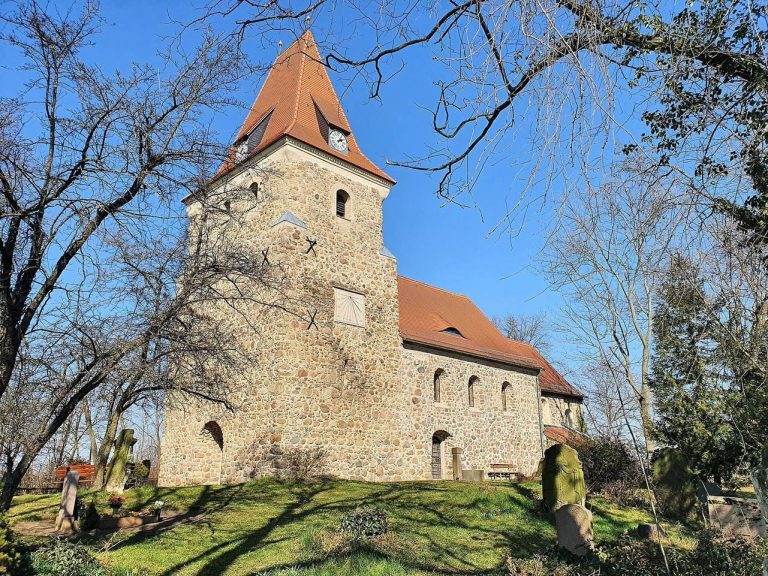
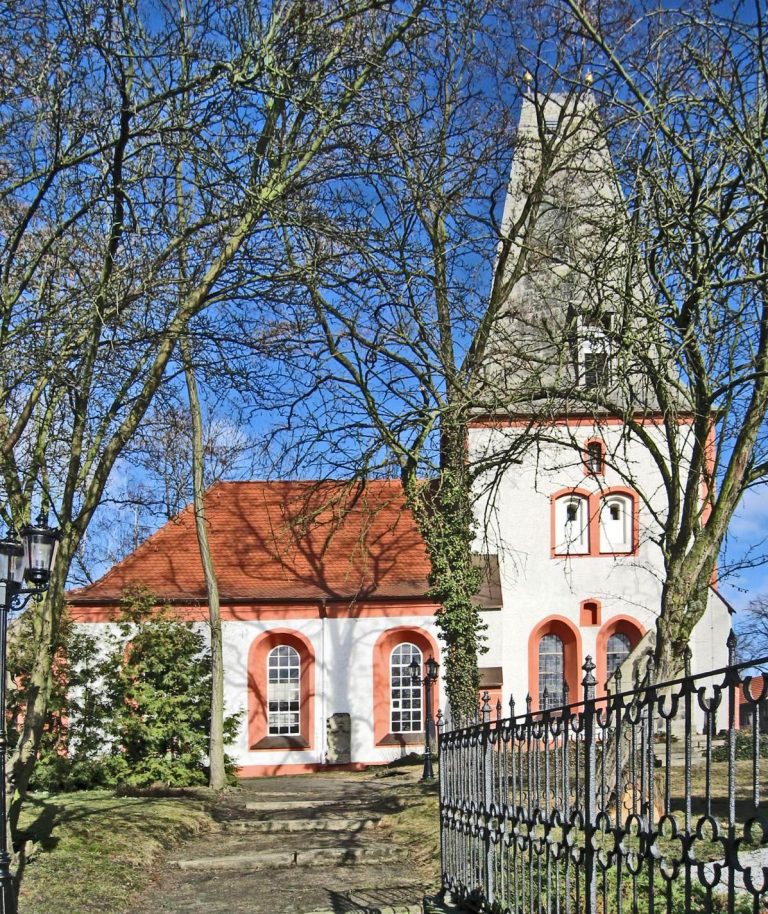
St. Laurentius is a plastered fieldstone building with a slightly narrower choir, a roof rider, and an unplastered tower. Its surviving fabric brings together late Romanesque elements, Gothic alterations, and Baroque furnishings. The choir closes on three sides and is reinforced by buttresses. Its windows contain tracery with trefoil, or three-lobed, forms.
Exterior and Medieval Fabric
Choir and Romanesque Elements
The north windows, triumphal arch, baptismal font, and altar table retain late Romanesque features. Remains of frescoes survive on the north wall and beside the pulpit. A half-figure of a saint can still be seen along the demolition edge of the former Romanesque altar area, whose earlier painted decoration presented the Twelve Apostles.
Tower and Roof Structures
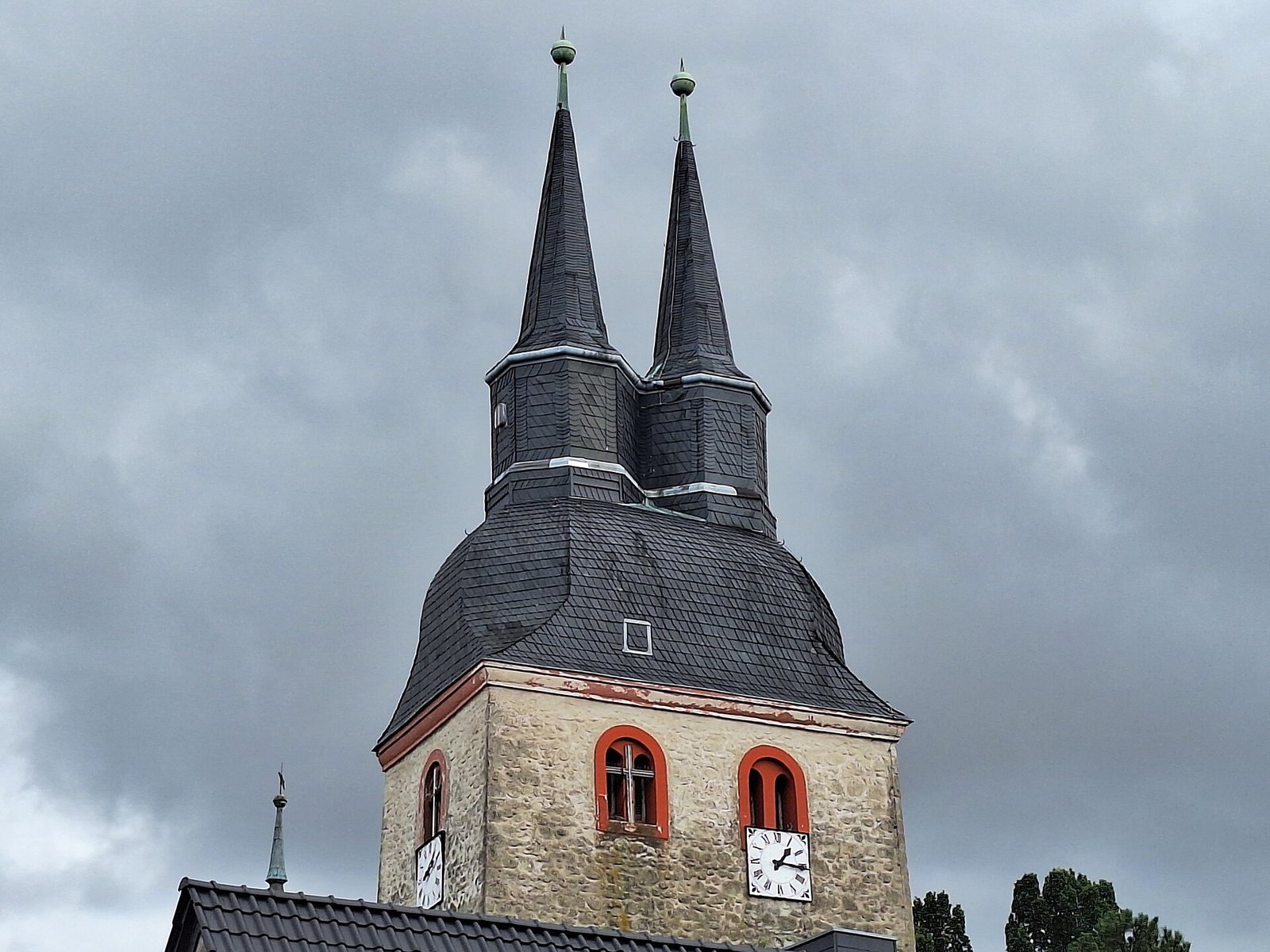
The tower carries an unusual Baroque roof cap, also described as a curved Welsche hood, with a double pinnacle. The roof rider contains the smallest bell, a baptismal bell cast in 1495 and inscribed with the words “Come with peace!” The tower also contains two bells from the sixteenth century and a third bell financed through donations.
Interior Architecture and Furnishings
Vault, Galleries, and Painted Panels
The Gothic remodeling is expressed in the net vault, whose intersecting ribs form a network-like pattern, the enlarged south-side windows, and the stone gallery. Four older panels on the north side are painted with images. The restored interior scheme uses white walls and ceiling panels with reddish-brown vault ribs, a treatment resembling that at St. Thomas’s Church in Leipzig and the church at Podelwitz.
Altar and Pulpit
The columned altar is a Baroque work carved in 1705 by a master from Eilenburg. Its wood incorporates the biblical message from 1 Corinthians 13:13, expressed as “believe rightly, love fervently, hope steadfastly,” with a painted addition reading “suffer patiently.” The central scene depicts the Crucified Christ, with Mary Magdalene kneeling to his left and a broken but budding tree to his right. A Last Supper scene appears below. A master from Taucha made the Baroque pulpit in 1726.
Organ and Memorial Objects
The organ has 19 stops arranged across two manuals, the hand-played keyboards, and a pedal keyboard operated by the feet. Its key and stop actions are mechanical. A wrought-iron chandelier dating from the Protestant Peace Decade around 1985 represents the transformation of a sword into a ploughshare. Above the baptismal font, a candle wheel commemorates the suffering caused by war in all directions.