Sant Miquel del Fai: A Former Benedictine Monastery in Catalonia


Site at a Glance
- Rating
- 4.4
- Popularity
- Medium
- Country
- Spain
- Primary era
- Medieval
- External website
- Open
- Eras represented
- Medieval
- Civilizations
- Crown of Aragon
- Site type
- Religious
- Remains
- Monastery
On this page9 sections
History
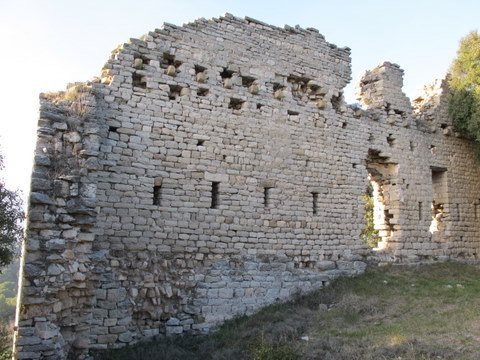
Sant Miquel del Fai is a former Benedictine monastery in Spain, located in Bigues i Riells above the Sant Miquel Valley in Catalonia. It was established as a medieval communal monastery in a natural rock setting within the Cingles de Bertí, between Vallès Oriental and Moianès.
Foundation and Benedictine rule
Gombau de Besora, lord of the lands that included Montbui Castle, acquired the territory from Ramon Borrell in 997. The exact foundation date of Sant Miquel del Fai is unknown, but a community of monks was living there by 1006 under its first abbot, Guillemund. The counts of Barcelona and Gombau de Besora provided the monastery with extensive property.
In 1042, Gombau affiliated the monastery as a priory with Saint Victor of Marseille. A priory was a monastic house governed by a prior or dependent on a larger monastery. This arrangement was intended to help secure Sant Miquel’s continuation after Gombau’s death.
Decline and later religious use
The resident community remained small, generally numbering five or six monks. From the fourteenth century it declined further, reaching three members. Monastic life ended in 1567, when Sant Miquel became dependent on the Diocese of Girona and beneficiary priests continued to maintain worship at the site.
After 1567, the former monastery developed into a sanctuary visited by people from nearby communities. Following the disentailment of ecclesiastical property, it passed into private ownership, although religious activities continued until 1936. Despite its small community, the monastery received important donations. A distinctive Romanesque silver cross made using the repoussé technique, in which designs are raised by hammering the reverse of a metal sheet, is preserved in the Barcelona Diocesan Museum, along with tomb slabs, sarcophagi, and household objects from Sant Miquel.
Heritage protection
Sant Miquel del Fai was declared a monument of Spanish Cultural Heritage on November 8, 1988, under reference RI-51-0005209.
Remains
Sant Miquel del Fai occupies a rocky landscape beside the Rossinyol stream, where limestone formations, escarpments, waterfalls, and caves have been shaped by water. The stream runs along the western side of the priory buildings. A smaller waterfall and a pond enlarged by a small dam lie above the monastery, while below it the water forms a major waterfall and opens the Sant Miquel caves, a large rock shelter formed over centuries.
Church and monastic buildings
Rock-cut church
The church was built within a natural cave, using the rock itself as its roof. It is described as the largest troglodytic church in Spain, meaning that it was built partly or wholly inside a natural rock cavity. Its Romanesque entrance has a semicircular arch with an archivolt, a molded band following the curve of an arch, supported by two columns. Their capitals carry vegetal decoration.
Only a few remains of the high altar survive. A small crypt, a partly underground space associated with a church, is reached by a staircase near the entrance. Tomb slabs of former abbots remain visible in the floor. Two further tombs survive in the largely disappeared side chapels. One thirteenth-century tomb is traditionally attributed to Guillem, Count of Osona and brother of Ramon Berenguer I, who became a monk at Sant Miquel after renouncing his rights. The other may belong to Andreu Arbizu, a monk from Navarre who contributed numerous goods to the monastery.
Priory house
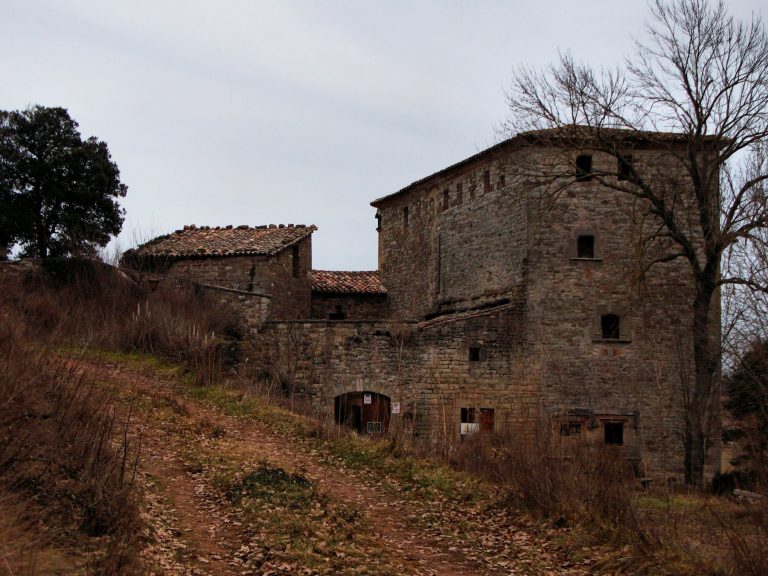
The former priory house is a fifteenth-century Gothic building. Gothic architecture was a later medieval style, and the house retains its original layout. For many years it functioned as a hostel.
Watercourses and caves
The site’s physical setting is formed by rocky escarpments and limestone structures shaped by the Tenes River, a tributary of the Besòs. The river created the Tenes Valley, while the principal waterfall and several caves remain prominent features around the monastery. The Rossinyol stream contributes its own sequence of water features, including the upper waterfall, pond, lower waterfall, and the caves below the buildings.