Santa Fosca: A Venetian-Byzantine Church on Torcello


Site at a Glance
- Rating
- 4.4
- Popularity
- Low
- Country
- Italy
- Primary era
- Medieval
- Eras represented
- Medieval
- Civilizations
- Venetian
- Site type
- Religious
- Remains
- Church
On this page7 sections
History
Santa Fosca is a Roman Catholic church on the island of Torcello in Italy, built within the Venetian-Byzantine tradition and taking its present form through rebuilding around the twelfth century. It belongs to the Patriarchate of Venice and forms part of the oldest and largest sacred complex in the Venetian Lagoon, together with the Basilica of Santa Maria Assunta and the remains of a baptistery.
Early Church and Cathedral Complex
A church dedicated to Santa Fosca already stood on the site during the first half of the ninth century. Emperor Louis the Pious, the Carolingian ruler of the Frankish Empire from 814 to 840, is recorded as having granted it among the benefices of the Basilica of San Zeno in Verona. This connection indicates that the church possessed a degree of autonomy and importance alongside the cathedral church of the Torcello diocese.
Around the year 1000, the church may have formed part of a building campaign commissioned by Orso Orseolo, bishop of Torcello, for the reconstruction of the cathedral complex. Its role was closely related to the neighboring cathedral and to the early Christian arrangement of a baptistery, cathedral, martyrion, and bell tower. A martyrion was a shrine or church associated with the relics of a martyr.
Rebuilding for the Relics
The rebuilding around the twelfth century gave Santa Fosca the form associated with the church today. The work was connected with the housing of relics belonging to the martyrs Fosca and Maura, which had arrived from Sabratha in Africa. Sabratha was a formerly Phoenician and later Roman city near Tripoli. The relics of Saint Fosca and the medieval trade routes that brought them to Torcello helped connect the church with the wider movement of people and sacred objects across the Mediterranean.
Saint Fosca is traditionally identified as a Christian virgin martyr associated with Ravenna, while Saint Maura is presented as her fellow martyr. Santa Fosca remains an active place of worship within the parish of San Martino di Burano, and its liturgical dedication is celebrated on 13 February.
Remains
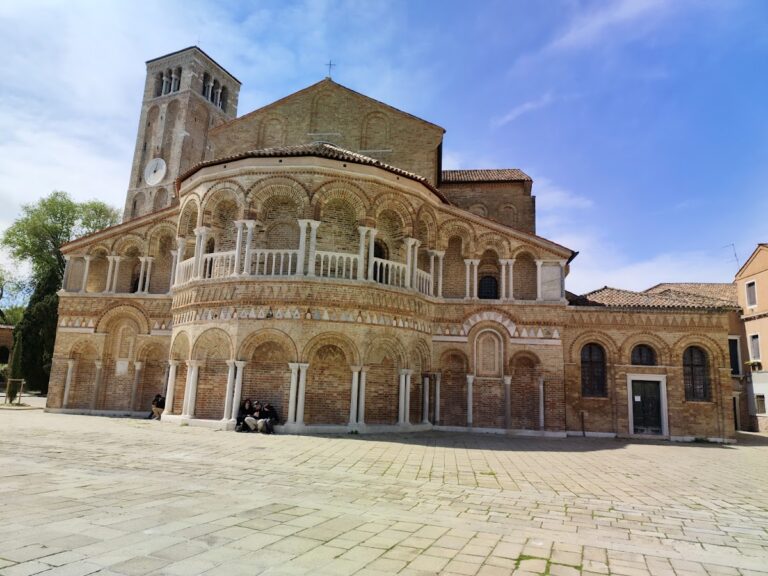
Santa Fosca stands beside the Basilica of Santa Maria Assunta, near the remains of the ancient city square and the old baptistery. Its exterior forms a balanced geometric composition centered on an octagonal appearance, while the interior is arranged around a Greek-cross plan. Another interpretation understands the layout as a square inscribed within an octagon, reflecting continuing debate over the building’s original arrangement.
Exterior and Portico
A portico surrounds five sides of the church. Its raised arches rest on columns with Byzantine ornamental capitals, and marble slabs survive between the columns on the side facing the cathedral. The main apse ends externally in five sides and carries blind arcades in two tiers. Smaller apses on either side have semicircular terminations. The church is built of stone and marble, and its decoration includes motifs influenced by Byzantine art of the Comnenian period, the era of Byzantine rule associated chiefly with the eleventh and twelfth centuries.
Interior Structure
The main nave is square in plan and is separated from the rest of the building by eight marble columns with Corinthian capitals. Together with the apses, these supports organize an interior of three aisles. Above the crossing, a substantial circular drum rises beneath the roof. Its solid construction suggests that a dome was intended, although the planned dome may not have been completed.
Altars, Sculpture, and Reliefs
The high altar contains a fifteenth-century sculpture of the Madonna and Child. Beneath it stands an illuminated sarcophagus holding the remains of Saint Fosca. A fifteenth-century wooden figure of the saint is positioned at the rear of the apse. On the exterior wall, a relief dated 1407 depicts monks venerating the Madonna, adding a later layer of devotional imagery to the medieval church.