Krk Cathedral: An Early Christian and Romanesque Cathedral in Croatia
Site at a Glance
- Rating
- 4.6
- Popularity
- Very Low
- Country
- Croatia
- Primary era
- Medieval
- External website
- Open
- Eras represented
- Classical, Medieval, Early Modern
- Civilizations
- Roman
- Site type
- Religious
- Remains
- Cathedral
On this page9 sections
History
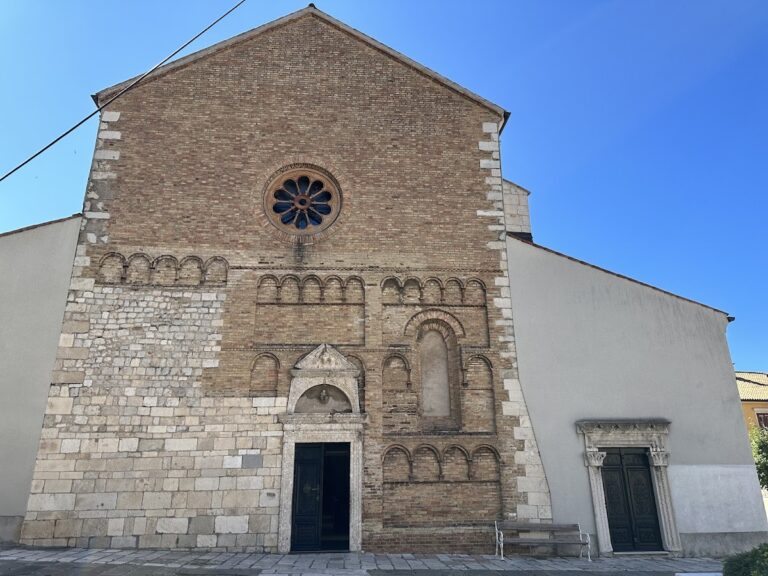
Krk Cathedral, formally the Cathedral of the Assumption of the Blessed Virgin Mary, is a Roman Catholic cathedral in Krk, Croatia. It grew from an early Christian basilica constructed in the latter half of the fifth century or at the beginning of the sixth, and its present Romanesque design, a medieval style known for massive masonry and rounded arches, took shape during the eleventh and twelfth centuries. The cathedral is the seat of the Roman Catholic Diocese of Krk and is administered within the Archdiocese of Rijeka.
Early Christian origins
Christian worship may have taken place on the site as early as the fourth century. Archaeological work later connected this early activity with a Roman bath complex dating from the first century. Worn mosaic fragments indicate that the area may have been used for Christian masses during the fourth century. The church itself followed in the fifth or sixth century, with architectural analysis placing the original basilica more precisely in the latter half of the fifth century or the beginning of the sixth.
The first written mention of the church dates from 1186. Historical records also describe a Chapel of Saint John the Baptist beside the former bath complex’s warm room, or tepidarium. It contained a baptismal font and remained in place until 1565. The arrangement indicates that one of the Roman bath pools may have been adapted as a baptistry, linking the earlier Roman complex with the Christian use of the site.
Romanesque cathedral and later additions
The cathedral’s Romanesque form was created during the eleventh and twelfth centuries. Several side chapels and altars were added over subsequent centuries. Around 1450, John VII Frankopan ordered the construction of the Chapel of Saint Barbara. The chapel preserves the heraldic arms of the House of Frankopan, a Croatian noble family, on its ceiling.
Two Renaissance ambons, raised platforms used for reading scripture or making liturgical proclamations, were installed in 1500. The apse was enlarged in 1538 and expanded again in 1700, when space was provided for an organ and choir. The present Chapel of the Holy Heart of Jesus incorporates an earlier baptismal installation beneath its floor.
Bell tower and cathedral complex
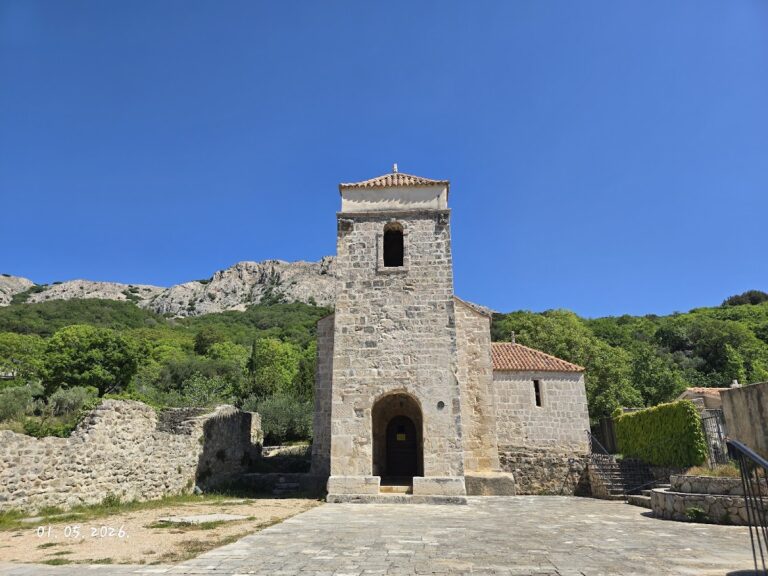
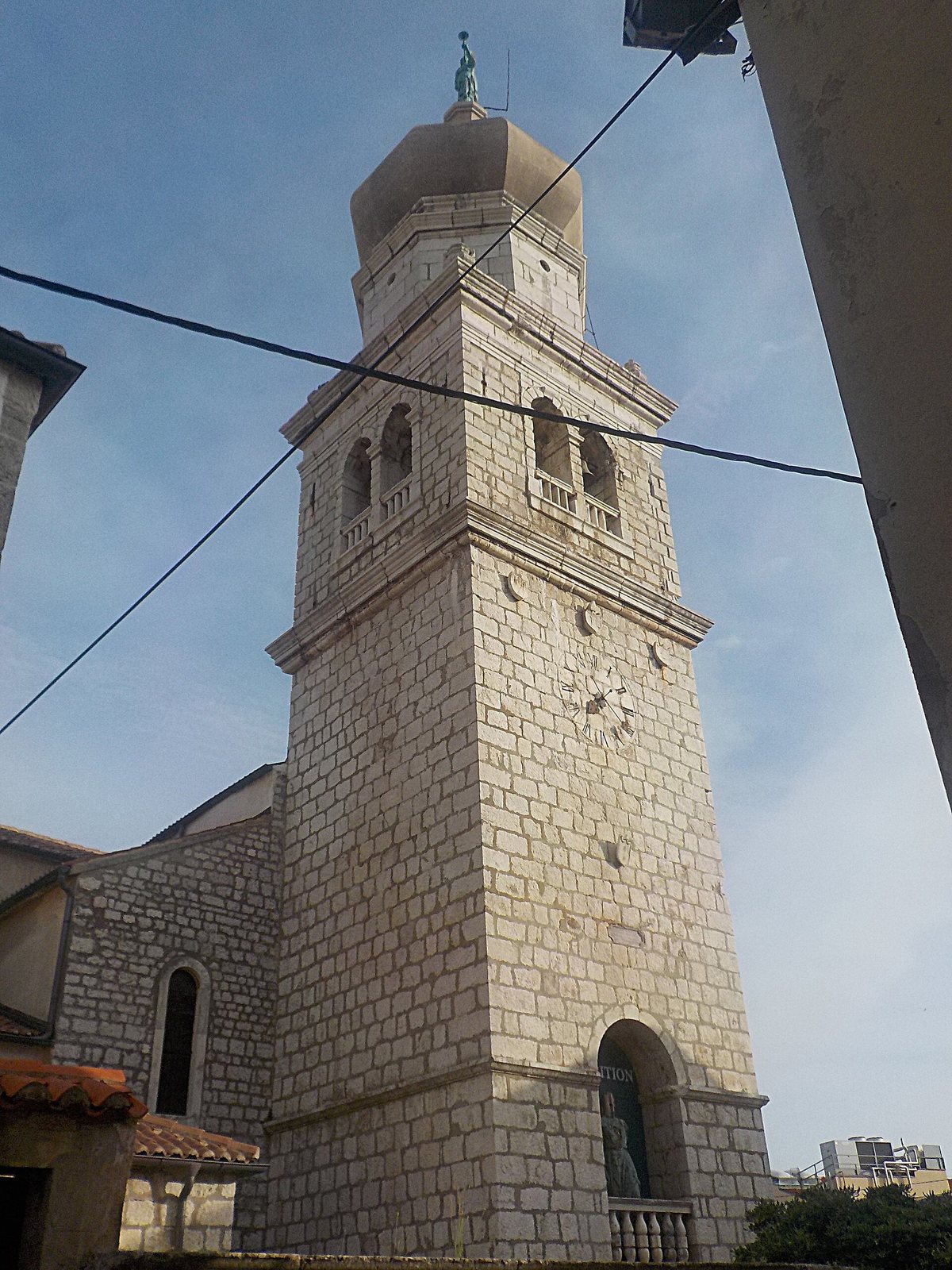
The complex developed around the cathedral and includes the Romanesque Church of Saint Quirinus, the Church of Saint Margaret, an early Christian baptistry, an apse, and a bell tower. Early Christian churches generally did not have bell towers, so a wooden tower was added later behind the sacristy. Restricted building space led to its relocation directly in front of the Church of Saint Quirinus in 1515.
The bell tower was thoroughly restored in 1765, when its upper section was redesigned and a Venetian-made angel sculpture was installed. Further renovations followed, most recently in 1973, when the present plastic angel replaced the original copper-coated wooden sculpture. Excavations conducted between 1956 and 1963 under the direction of Andro Mohorovičić, a Croatian architect and architectural historian, clarified the relationship between the cathedral and the earlier Roman and Christian remains.
Remains
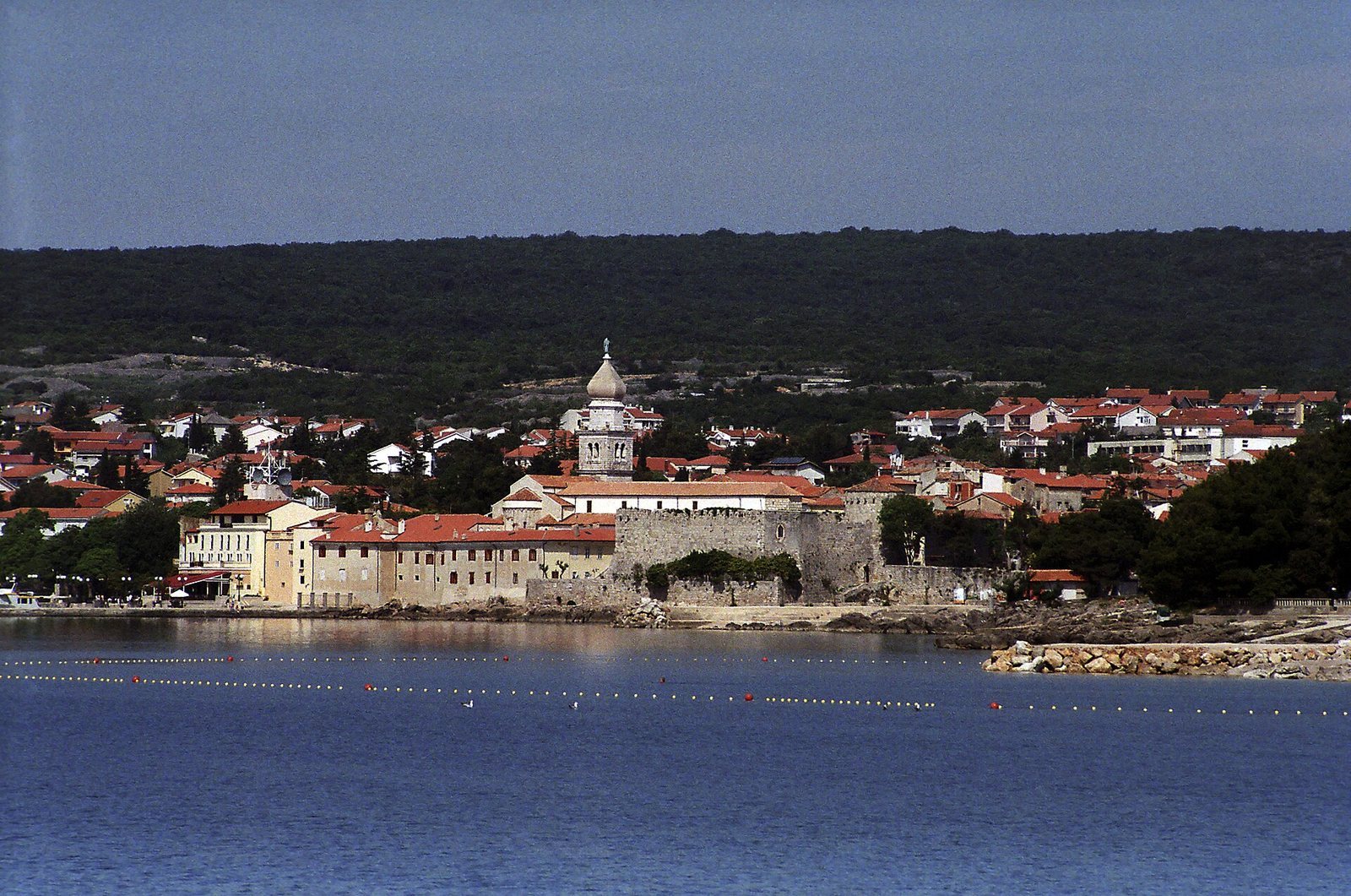
The cathedral stands below the hill of Krk and forms a three-nave basilica oriented from east to west. A basilica is a longitudinal church with a central nave and parallel side aisles. The façade faces a street running through the town along a north-south axis. The building is 40 metres long and 14.5 metres wide inside. Its surviving fabric incorporates elements from the earlier basilica, later Romanesque construction, and successive additions to the cathedral complex.
Cathedral interior
The cathedral contains 14 columns. Twelve have Corinthian capitals, one has a Classical capital, and a column in the northern row near the altar bears reliefs of early Christian Eucharistic symbols. The relief represents a fish being eaten by two birds, with the fish signifying Christ and the birds representing Christians. The seven columns nearest the altar originally belonged to the earlier basilica. They were built of stone, and their shafts were not connected to the capitals.
Excavation exposed the foundations of the wall that closed the original basilica. An inscription above the fourth interior capital when counted from the southern side entrance dedicates the church to the Virgin Mary and identifies the point where the early Christian basilica formerly ended.
Chapels and furnishings
The Chapel of Saint Barbara retains the coats of arms of the House of Frankopan on its ceiling. In the present Chapel of the Holy Heart of Jesus, a barrel-shaped piscina, a basin used in a Christian baptismal installation, lies beneath the floor. The sacristy contains walnut furnishings, including a cupboard made between 1697 and 1698 that covers one wall, 13 canon benches made in 1699, and a bishop’s throne added in 1717.
Churches and associated structures
The Church of Saint Quirinus stands in front of the cathedral. It is a Romanesque building made from locally quarried white stone and is described as Croatia’s only early-Christian two-story church. Because space was restricted, its apses face south. Three semicircular apses are topped by Romanesque arcades. The complex also contains the Church of Saint Margaret, dedicated to Margaret of Antioch, together with an early Christian baptistry and an apse.
Roman bath remains
Excavated remains of the first-century Roman bath complex include a hypocaust, an ancient underfloor heating system, the tepidarium, or warm room, and a preserved mosaic-tile floor. Large sections of the mosaic were worn by people walking across them. These remains provide the physical setting for the later Christian activity associated with the site and its baptismal use.