Santo Stefano Oratory: A Gothic Aristocratic Chapel in Italy
Site at a Glance
- Rating
- 4.7
- Popularity
- Very Low
- Country
- Italy
- Primary era
- Medieval
- External website
- Open
- Eras represented
- Medieval
- Civilizations
- Holy Roman Empire
- Site type
- Religious
- Remains
- Chapel
On this page6 sections
History
Santo Stefano Oratory is a Roman Catholic aristocratic chapel in Lentate sul Seveso, Italy, built in 1369 in the Gothic style for Count Stefano Porro. Dedicated to Saint Stephen the Protomartyr, traditionally regarded as the first Christian martyr, it was affiliated with the Ambrosian rite and the Archdiocese of Milan. The chapel formed part of the religious and dynastic world of the Porro family, whose connections reached the Visconti rulers of Milan and the imperial court of Charles IV.
Foundation under Stefano Porro
Stefano Porro commissioned the chapel during a period of considerable political influence for his family. He was a trusted associate and ambassador of Bernabò and Gian Galeazzo Visconti, the fourteenth-century lords of Milan, and served at the court of Charles IV, Holy Roman Emperor from 1346 to 1378. Charles made him a palatine count in 1368, shortly before the oratory was built.
The foundation probably served both private and commemorative purposes. It provided the Porro family with a place for personal prayer and may also have expressed a desire for reconciliation after the family’s involvement in the planned killing of the Dominican inquisitor Peter of Verona in 1252. Two Porro ancestors, Pietro and Alberto, had arranged the murder with Confalonieri of Agliate, a local leader associated with heresy. The oratory probably belonged to a larger aristocratic complex, and indications suggest that Stefano Porro’s castle or fortified residence stood nearby.
Burial and later history
The chapel was intended to hold the remains of Stefano Porro and his family. Stefano’s remains have never been found, including during the most recent restoration, and they may never have been placed at Lentate. An inscription on the tomb slab outside the burial chest preserves information about the count, the chapel, and his wife. A crypt beneath the church probably contains members of the Porro family. Structural concerns led to its closure in the nineteenth century, and its entrance was covered by the present floor during work in the 1930s.
Santo Stefano Oratory is recognized as a national monument. Restorations took place in the 1930s and 1960s, followed by a further restoration that led to the building’s reopening on 21 October 2007. Humidity remains a continuing threat to the painted decoration, despite the twentieth-century interventions.
Remains
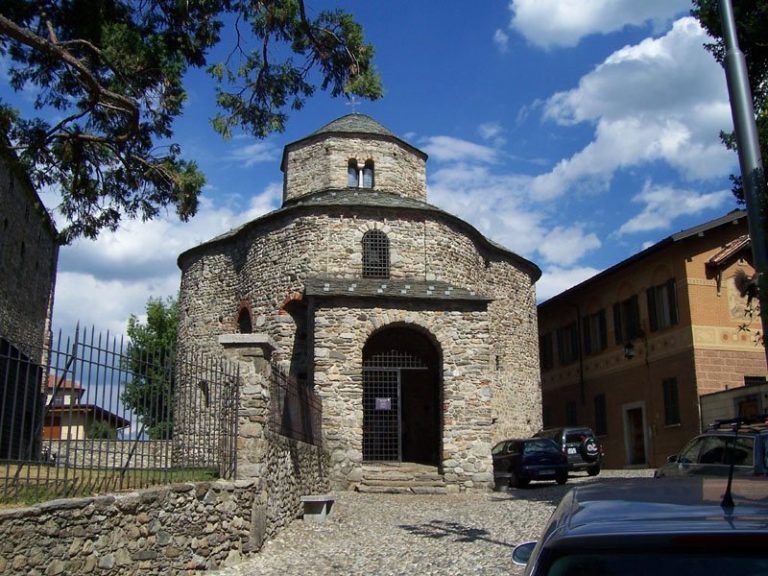
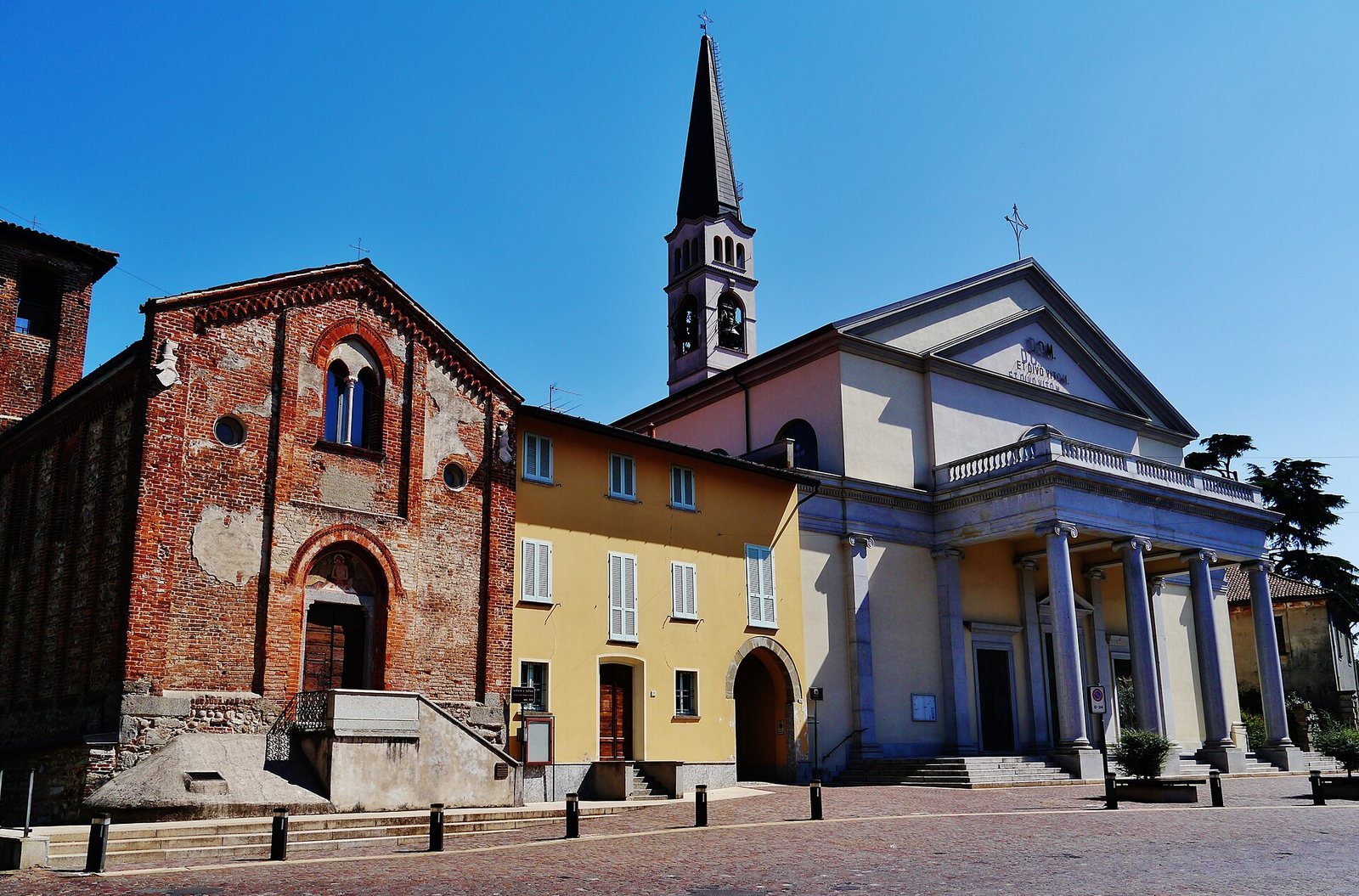
The oratory is a plain, two-storey medieval chapel with a single nave and a raised presbytery, separated by a triumphal arch. Its exterior walls use mixed masonry, known as listata construction, in which river pebbles and bricks are bonded with lime mortar. The exterior is described as dilapidated. The entrance to the nave is reached by a stairwell descending below the right side of the facade, while a mullioned window with an ogival frame stands above the entrance.
Chapel structure
The nave has a flat, exposed wooden roof supported by five scissor trusses, which carry the secondary roof structure. The presbytery is covered by a cross-vault, above which are mixed timber-and-iron trusses. Beneath the present floor lies the closed crypt associated with the Porro family. The exterior burial chest and its inscribed slab also remain part of the chapel’s funerary arrangement.
Fresco decoration
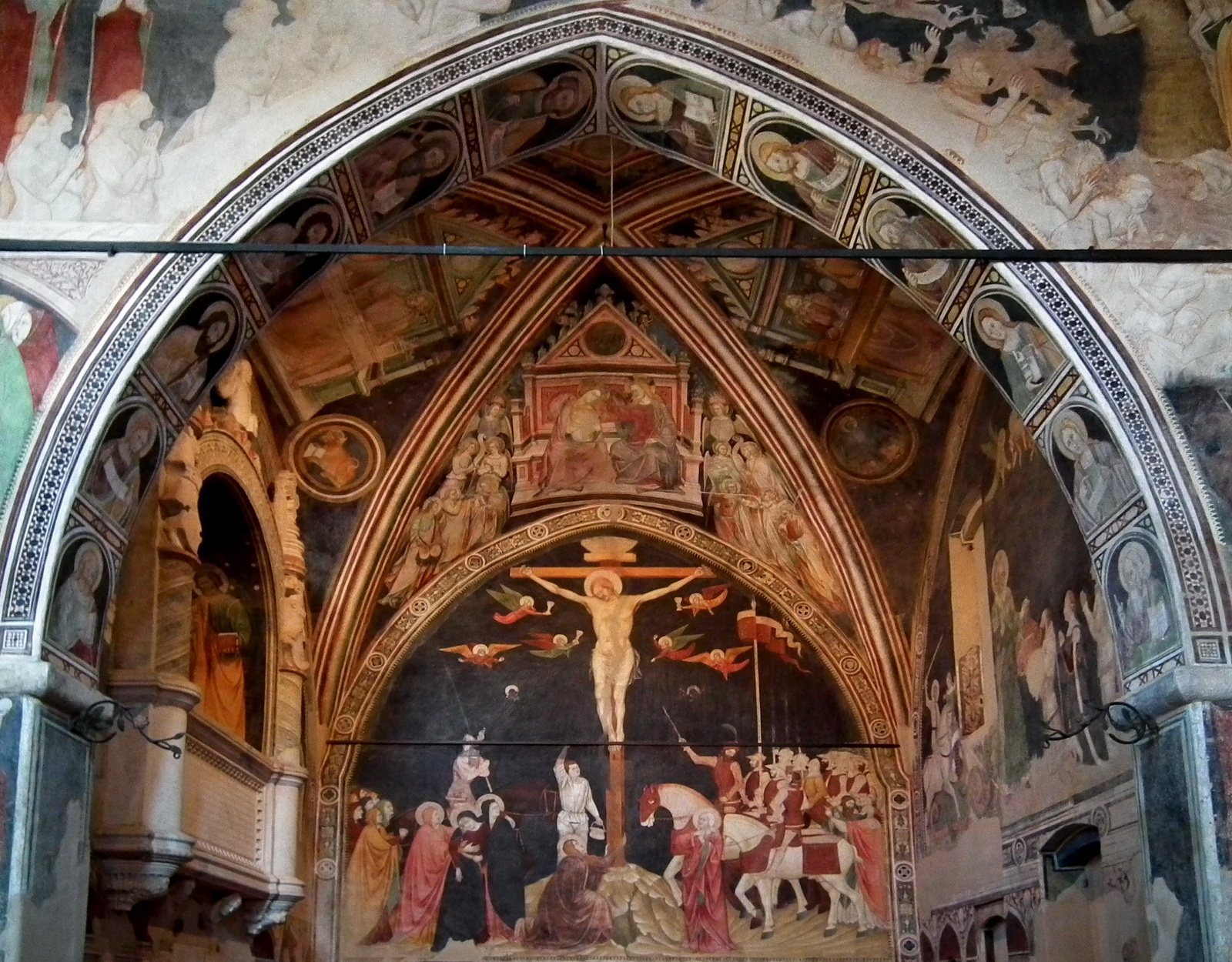
The walls contain a cycle of 43 fresco panels devoted to the life of Saint Stephen, arranged in two registers. When facing away from the altar, the scenes are read from left to right, beginning with the upper register. They depict episodes from the saint’s life before and after his death, drawing principally on the Acts of the Apostles and Jacobus de Voragine’s Golden Legend. The cycle is described as the longest fresco series devoted to Saint Stephen.
Anovelo da Imbonate, associated with the school of Giovanni da Milano, painted the principal Crucifixion, the compartments of the vault, and the Imago pietatis, a devotional image of the dead or suffering Christ, in the lunette above the entrance portal. The works’ resemblance to Florentine painting once led to the belief that they were by a Florentine painter. Other scenes were created by artists conventionally known as the Masters of Lentate, representatives of International Gothic, a late-medieval style noted for courtly refinement and decorative detail. The two principal painters in this group worked during the early fifteenth century.
Three later frescoes were painted over the decorative velarium, a curtain-like lower wall zone, and beneath the Crucifixion. They were probably commissioned by other Porro descendants during the following century. On the right side of the apse, another fresco shows the donation of the chapel to Saint Stephen. Stefano Porro kneels before the saint and offers him the church, which Saint Stephen holds in his hands. Porro’s wife, Caterina Figini, appears with their sons Galeazzo, Antonio, and Giovanni, and with three daughters whose names have not survived.
Largely anonymous graffiti cover parts of the walls, including three Solomon’s knots, bishops, animals, and monsters probably representing pike. The monster figures may have been left by a rival family as a curse or a wish for misfortune. These marks, together with the painted decoration and the chapel’s architectural fabric, form part of the surviving evidence for the building’s long religious and aristocratic history.