Basilica di San Michele Arcangelo: Parish Church and Minor Basilica in Piano di Sorrento


Site at a Glance
- Rating
- 4.7
- Popularity
- Low
- Country
- Italy
- Primary era
- Early Modern
- External website
- Open
- Eras represented
- Medieval, Early Modern
- Civilizations
- Byzantine, Habsburg, Kingdom of Naples, Spanish
- Site type
- Religious
- Remains
- Basilica
On this page24 sections
History
The Basilica di San Michele Arcangelo is a Roman Catholic church in Piano di Sorrento, Italy, built in the ninth century and dedicated to Saint Michael the Archangel. It belongs to the Roman rite, serves as a parish church, and is part of the Archdiocese of Sorrento-Castellammare di Stabia. The church was already standing between 913 and 917, when Bishop Leopardo visited it.
Early foundations and medieval development
The church may have been built over an ancient Roman temple, possibly one dedicated to Minerva, the Roman goddess associated with wisdom, crafts, and strategic warfare. Another possibility is that it occupies the site of a necropolis, an ancient cemetery or burial area. Evidence for earlier activity emerged during repaving works in 1886, when workers found a Roman funerary urn and a Byzantine-period bas-relief showing the crucified Jesus.
A major rebuilding took place in 1405. The church became a parish church in 1451, giving it a more defined role in the religious life of Piano di Sorrento and its surrounding community.
Earthquake, restoration, and basilica status
The earthquake of 1688 severely damaged the building. The bell tower collapsed, as did the dome, part of the nave, and part of the facade. Restoration followed the disaster, and Bishop Ludovico Agnello Anastasio reconsecrated the church in 1726. Much of the building’s present Baroque character belongs to the period of repair and refurbishment that followed the earthquake.
In 1914, Pope Benedict XV elevated the church to the status of minor basilica. This is a special papal title granted to a church because of its religious, historical, or pastoral importance, and it does not make the building a cathedral.
Remains
The basilica is approached by a broad stone staircase and presents a Baroque facade organized around a strong vertical division. Its interior follows a Latin-cross plan, in which the nave intersects the transept to form a cross, and contains three naves, a marble pavement, and eight large windows. The surviving fabric brings together medieval foundations, post-earthquake rebuilding, and furnishings added between the fifteenth and eighteenth centuries.
Facade and bell tower
Baroque facade
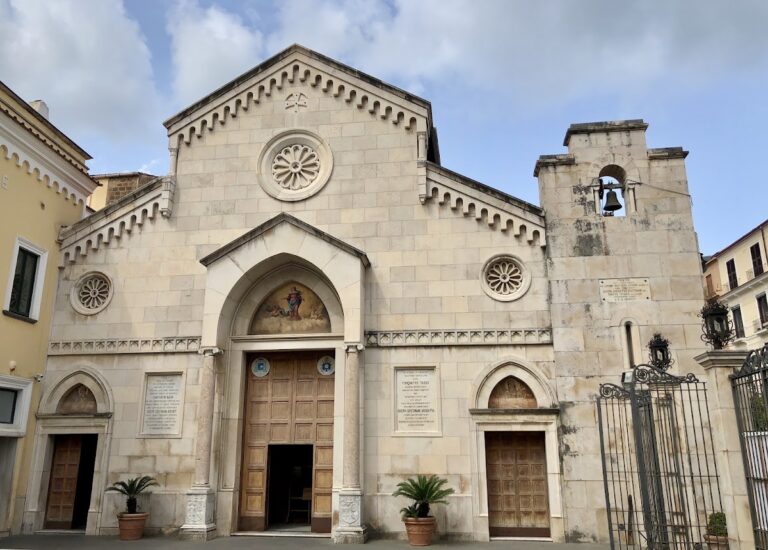
Two columns with capitals divide the facade into three vertical sections. The central section contains a sixteenth-century entrance portal with bronze doors made by Alessandro Romano. Their reliefs show archangels, the Trinity, and other figures. Above the portal is a fresco of Saint Michael expelling Satan. The two side sections contain smaller portals, each surmounted by an oval opening that serves as a light well.
A horizontal trabeation, the architectural member placed above the columns, separates the lower and upper parts of the facade. The upper section ends in a pediment and includes stucco decoration within its central aedicule, a small shrine-like architectural frame.
Bell tower
The external bell tower dates from the sixteenth century and was rebuilt after the earthquake of 1688. It has a square plan and rises through three levels. The upper level is the bell chamber, with a single-light opening on each side.
Nave, ceiling, and crossing
Central nave
The marble pavement replaced an earlier floor during the eighteenth century. Above the central nave, a coffered ceiling contains seven paintings devoted to episodes from the life of Saint Michael. Their authorship remains uncertain, with attributions to Girolamo Imparato, Francesco Solimena, and Paolo De Matteis. Two paintings are identified by signatures as works by R. De Crescenzo: Saint Michael Appearing in a Dream to the Bishop of Siponto and The Apparition of Saint Michael on Mount Gargano.
Painted dome
The crossing is covered by a painted trompe-l’oeil dome. This type of decoration uses painted forms to create the illusion of three-dimensional architecture. The dome depicts Saint Michael and was made in 1729 by Francesco Saraceni.
Chapels and side aisles
Cota and Cafiero chapel
In the left aisle, the chapel patronized by the Cota and Cafiero families contains Fabrizio Santafede’s sixteenth-century painting The Madonna of Succour among Clouds of Angels. A tombstone dated 1618 is also preserved there.
Ecce Homo chapel
The Chapel of the Ecce Homo contains an eighteenth-century sculpture and altar devoted to the same subject.
Other left-aisle chapels
The left aisle also includes the Chapel of the Sacred Heart of Jesus, the Chapel of Our Lady of Grace, and two chapels patronized by the Maresca family.
Maresca chapels
One of the Maresca chapels contains Ippolito Borghese’s The Hunt of Saint Eustace. The other contains Giuseppe Cesari’s Descent from the Cross. The left aisle also gives access to the sacristy, an adjoining room used to prepare and store liturgical objects and vestments. Its barrel vault is accompanied by three paintings: The Plague of 1656 by Giuseppe Castellano, Our Lady of the Snows from the school of Giovanni Bellini, and Saint Thomas Touching Jesus’ Side by Pacecco De Rosa.
Mariners’ Chapel
The right aisle contains the Mariners’ Chapel, with a statue of Saint Mary of Trapani and a statue of Saint Antoninus in a niche. The statue of Saint Antoninus was made by Vincenzo D’Adamo.
Lauro family chapel
The chapel patronized by the Lauro family contains a painting of the Madonna of Carmel and Saint Francis of Paola, attributed to the school of Mattia Preti.
Maresca and Serracapriola chapel
The chapel patronized by the Maresca and Serracapriola families preserves a sixteenth-century painting attributed to Giacomo di Castro. It depicts the Madonna and Child with Saint Francis and Saint Stephen and stands with an altar dated 1606.
Mastellone family chapel
The Mastellone family chapel contains a statue of the Sorrowful Virgin. Beneath the altar is a wooden statue of the Dead Christ, protected by an old grille brought from the enclosed convent of Santa Maria della Misericordia.
Chapel of the Most Holy Rosary
The Chapel of the Most Holy Rosary has a marble altar dated 1577 and a painting by Francesco Solimena showing the Madonna giving the rosary to Saint Dominic. The fifteen small paintings of the Mysteries of the Rosary that once surrounded the main image were stolen and replaced on 25 March 1979.
Massa family chapel
The Massa family chapel has an altar with a fifteenth-century balustrade and a triptych from 1587 by Marco dal Pino. The three connected panels depict the Crucifixion with Saint Catherine of Alexandria and Saint Anthony the Abbot. Statues of Saint Vincent Ferrer and Saint Anthony of Padua stand at the sides, while a plaque dated 1393 commemorates Pandolfo Massa, the beneficiary of the chapel.
Presbytery and furnishings
Presbytery and high altar
The presbytery, the area around the main altar reserved for principal liturgical functions, is enclosed by an eighteenth-century marble balustrade made by Giambattista Antonini. The balustrade supports four angels in Carrara marble from the school of Gian Lorenzo Bernini. Antonini also made the high altar in 1705, which contains relics of Saints Giocondino and Felice.
In the apse, the semicircular end of the church, stands a gilded and silvered statue of Saint Michael carved in mulberry wood by Giuseppe Maresca. Two frescoes by Achille Jovine flank the statue. They depict the Destruction of Sennacherib’s Army and Saint Michael against Lucifer.
Other furnishings
Additional furnishings include a marble pulpit dated 1778 by Vincenzo D’Adamo, walnut-wood choir stalls, and two eighteenth-century holy-water stoups. A pipe organ dated 1642 stands on the organ loft at the rear of the church and has been renovated repeatedly. The building also preserves a marble baptismal font dated 1766.