Basilica of St. John the Baptist’s Beheading in Chojnice: A Brick Gothic Parish Church


Site at a Glance
- Rating
- 4.7
- Popularity
- Low
- Country
- Poland
- Primary era
- Medieval
- External website
- Open
- Eras represented
- Medieval
- Civilizations
- Teutonic Order
- Site type
- Religious
- Remains
- Basilica
On this page10 sections
History
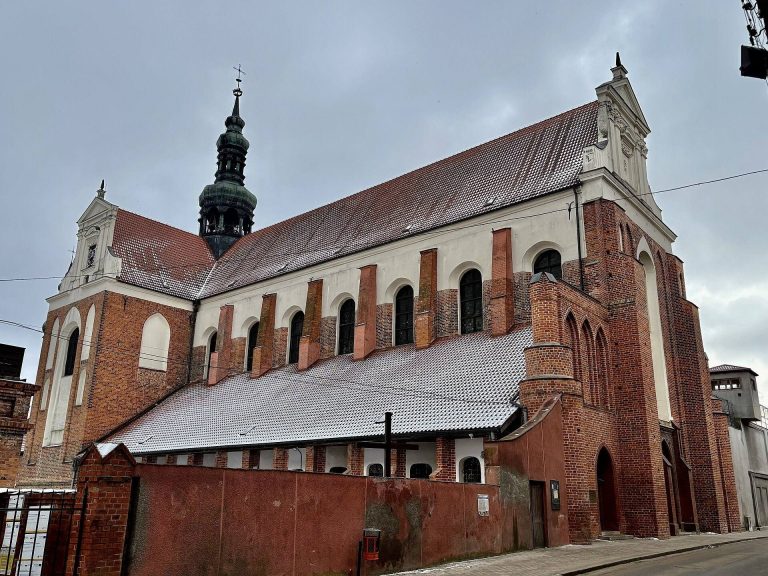
The Basilica of St. John the Baptist’s Beheading in Chojnice is the city’s oldest Roman Catholic parish church in Poland. Built in the Pomeranian Brick Gothic tradition, its construction began in 1340 on the site of an earlier wooden church, starting at the choir end. The building was completed in 1360 and consecrated in 1365 by Piotr of Gniezno, a suffragan bishop serving under the archbishop of Gniezno. Dedicated to the beheading of St. John the Baptist, the church observes its patron’s feast on 29 August, commemorating his martyrdom.
Medieval foundation and religious change
The church’s construction proceeded in stages, with the presbytery and tower begun before the body of the nave was completed. In 1466, patronage passed to Casimir IV Jagiellon, the fifteenth-century king of Poland and grand duke of Lithuania.
During the Reformation, the sixteenth-century movement that created Protestant churches and changed ecclesiastical control across much of Europe, Protestants took over the church in 1555. The parish priest, Sińcki, was killed during disturbances outside the building. Catholic worship was restored in 1616.
Fires, rebuilding, and modern status
Fire repeatedly altered the church’s history and fabric. After the blaze of 1657, rebuilding continued for 21 years. A second fire in 1733 also destroyed the parish archive. The vaults were rebuilt in 1924, while the stained-glass windows were destroyed at the outbreak of the Second World War in 1939. Another fire in 1945 led to a further ten years of rebuilding.
The church received visits from senior Polish Catholic figures over several centuries, including Archbishop Wawrzyniec Gembicki in 1619, Archbishop Krzysztof Antoni Szembek in 1741, Cardinal Stefan Wyszyński in 1953, and Archbishop Henryk Muszyński in 2012. In 1961, the image of Our Lady of Częstochowa arrived at the church with Cardinal Wyszyński, the superior general of the Pauline Order, and numerous bishops and other senior clergy.
Through the efforts of Canon Roman Lewandowski and Bishop Jan Bernard Szlaga, Pope John Paul II granted the church the title of Basilica minor in 1993. This is an honorary papal designation for a church of particular religious importance and is distinct from a cathedral, which is the seat of a bishop. Cardinal Józef Glemp and Apostolic Nuncio Archbishop Józef Kowalczyk visited the church on the first anniversary of the title in 1994. The building was conserved in 2007 and stands on Church Square beside the so-called Gymnasium Church and near the market.
Remains
Building and spatial arrangement
The basilica is a monumental three-aisled hall church in the Pomeranian Brick Gothic style. A hall church has a central nave and side aisles of approximately similar height, producing a unified interior space. The building is constructed from red brick on a foundation of granite blocks. It measures 46 metres in length, almost 20 metres in width, and 14.6 metres in height.
A single square tower rises at the western end and contains the main portal. The central nave extends eastward to the choir, or presbytery, where a post-conciliar altar stands. A sacristy is attached to the north side of the presbytery, while the Chapel of the Virgin Mary is attached to the body of the nave.
Interior architecture and furnishings
Vaults and organ gallery
The main nave is covered by a star vault, a ribbed vault whose ribs form a star-like pattern. The north and south aisles have cross-ribbed vaults, formed by intersecting structural ribs. A western gallery holds the organ, which has 37 stops and two manuals.
Altars and Marian chapel
The choir windows contain stained-glass images mainly representing St. John the Baptist. Four altars are recorded in the church, including side altars dedicated to the Sacred Heart of Jesus and St. Joseph, together with an altar dedicated to the Virgin Mary. The Chapel of the Virgin Mary contains a copy of the Beautiful Madonna of Toruń from Toruń Cathedral.
The Gothic Revival high altar survived a fire before later being replaced by a silver altar showing scenes from the Gospel. A Baroque chalice-shaped baptismal font from the early eighteenth century remains among the church’s furnishings. Its lid depicts Christ and St. John.
Paintings, memorials, and crypts
Polychrome painting decorates the nave walls, and the interior contains a Crucifixion Group. Commemorative plaques honor Blessed Jerzy Popiełuszko, Cardinals Stefan Wyszyński and Józef Glemp, Archbishop Józef Kowalczyk, the parish priest Sińcki, and Bishop Jan Bernard Szlaga.
The north aisle provides access to the crypts, which can be seen through a glass panel. The Danzig painter Herman Han is buried there. He was associated with the frescoes and paintings made for the church.
External features and grounds
A mission cross dating from 1948 is attached to the church’s north wall. On the south side stands a papal oak grown from acorns blessed by John Paul II, the Polish pope who granted the church its Basilica minor title in 1993.