Schloss Steinfels: A Historic Castle Estate in Germany
Site at a Glance
- Rating
- 5
- Popularity
- Very Low
- Country
- Germany
- Primary era
- Early Modern
- Eras represented
- Medieval, Early Modern
- Civilizations
- Holy Roman Empire
- Site type
- Military
- Remains
- Castle
On this page7 sections
History
Schloss Steinfels is a historic castle estate in Mantel, Germany. Its origins lie in a moated castle established to protect the Steinfels hammer mill, a water-powered industrial workshop that processed metal with large mechanical hammers using the Haidenaab. Steinfels is first recorded in 1052, while the present castle building dates from the seventeenth century and incorporates medieval components.
The Steinfels and Mendel owners
The hammer mill remained in the possession of the Lords of Steinfels until the fifteenth century. From 1400 to 1624, it belonged to the Mendel von Steinfels family. Hans Mendel paid the St Martin’s rent to Parkstein in 1416, and Erhard Mendel appears as the owner in the Parkstein land register of 1440. Friedrich Mendel is identified as the hammer master of Steinfels in records from 1478 and 1486.
The family also produced figures connected with the church and universities. Christoph Mendel von Steinfels, who died in 1508, became the first rector of the University of Ingolstadt and served as Bishop of Chiemsee from 1502 until his death. Adam Mendel of Steinfels appears in the register of landed subjects in 1521. His successors included the brothers Hieronymus and Fabian Mendel, last recorded there in 1552, followed by Gabriel Mendel, listed between the 1560s and 1580s. Hans Jakob Mendel of Steinfels is recorded in 1583 and in the territorial homage of 25 February 1607. He was the last Mendel owner.
War, recovery, and the Weveld period
In 1624, Steinfels passed to the hammer master Paul Schlaher, who had acquired the Thumsenreuth estate in 1596. The Thirty Years’ War, the major European conflict of 1618 to 1648 that brought extensive military and economic destruction to the German lands, left Steinfels completely devastated. In 1661, Paul Schlaher’s widow, Anna Maria Magdalena, later remarried as Sieber, described the estate as being in a desolate condition. Georg Pfreimdter of Bruck owned it that year.
The Weveld family held Steinfels from 1671 to 1835. Johann Simon von Weveld was a councillor of Palatinate-Neuburg, a colonel in Jülich, commander at Parkstein and Weiden, and owner of the lordships of Mechtildshausen and Steinfels. He probably acquired Steinfels through his command at Parkstein. His descendants included Jakob Ignaz von Weveld, who died in 1728, and Wilhelm Adam von Weveld, born in 1674 and deceased in 1734.
Jakob Ignaz owned the landed estates of Steinfels, Grub, and Lebau and served as Upper War Commissioner in the Nordgau. He probably also succeeded his father as commander at Parkstein and Weiden. In June 1717, Elector Karl Philipp appointed him a Palatinate chamberlain. Jakob Ignaz and his brother then acquired a house in the upper town of Neuburg. Jakob Ignaz was buried at St Peter’s Church in Neuburg rather than in the Steinfels family crypt, while his wife, Catharina Countess von Wrschowetz-Sekerka and Sedschitz, was buried in the crypt of the nearby parish church of St Pankratius in Parkstein.
A deed of assignment dated 1 May 1746 named Maria Elisabetha von Weveld as owner of both landed estates. By a deed of gift dated 27 August 1770, she transferred them to her nephew, Imperial Count Anton Christoph von Weveld of Sinning. In 1808, his son Max von Weveld purchased the Steinfels and Grub estates.
Nineteenth- and twentieth-century changes
On 8 March 1828, Max von Weveld received permission to establish a second-class patrimonial court. This was a judicial authority exercised by an estate owner over a defined territory and its inhabitants within the nineteenth-century Bavarian legal system. The Weveld property later had to be auctioned, and the court’s jurisdiction was suspended on 15 April 1835.
In 1835, Johann Friedrich of Böhmischbruck acquired the castle from Josef Alois von Weveld. Carl Trautner sold it in 1884 to Commercial Councillor Heinrich Knab of Münchberg. Hugo Auvera leased the Steinfels estate and its kaolin mines in 1927, purchased the property in 1937, and managed it until 1957, when he sold it to Wolff Freiherr von dem Bongart.
A mixed-gravel plant was established at Steinfels in 1966 but later disappeared. After Wolff Freiherr von dem Bongart died in 1979, operations around the main building ceased. Repeated attempts to find an investor to revive the castle were unsuccessful. Schloss Steinfels is now listed as a protected architectural monument, and medieval and early-modern archaeological remains in the area of the former castle are separately recorded as an archaeological monument.
Remains
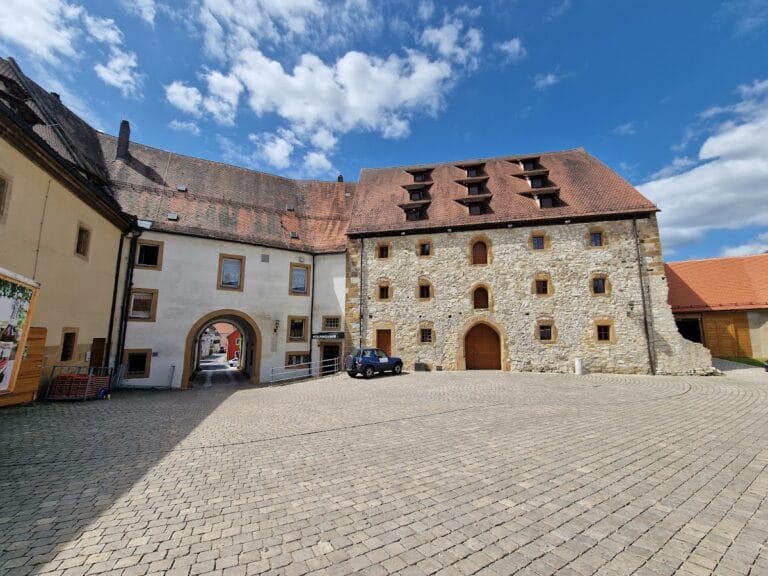
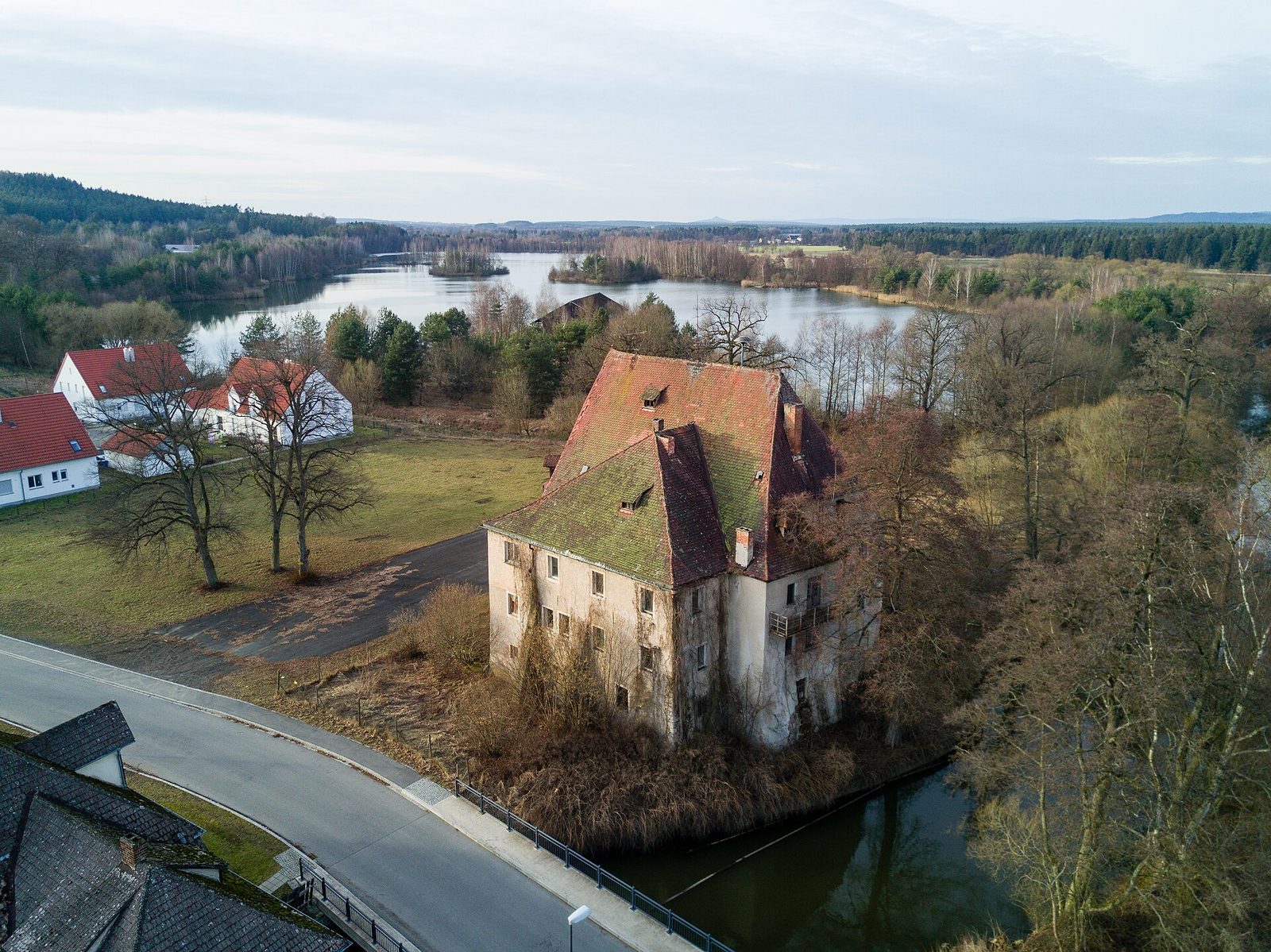
The surviving complex combines a seventeenth-century castle building with medieval fabric, a south-facing annex, and a castle church attached to the north-west side. The castle’s earlier role was connected with the moated stronghold and the nearby hammer mill, while the archaeological monument preserves medieval and early-modern findings from the area of the former castle.
Main castle building
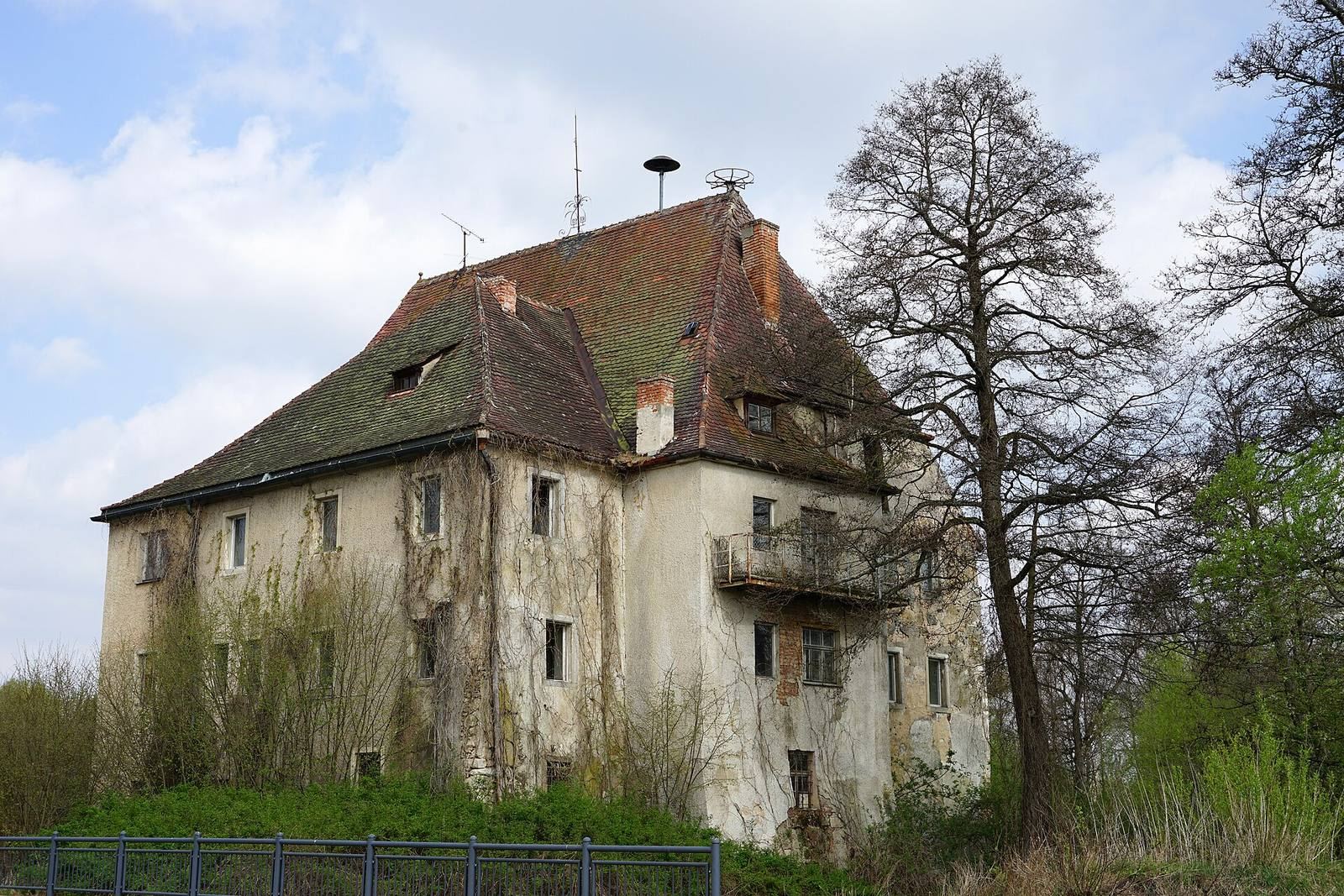
The main building is a three-storey structure covered by a gabled roof. Medieval components are incorporated into the present seventeenth-century building. A south-facing annex with a hipped roof is attached to the main structure, extending the complex on that side. The castle entrance is formed by a round-arched portal decorated with a coat of arms.
Castle church
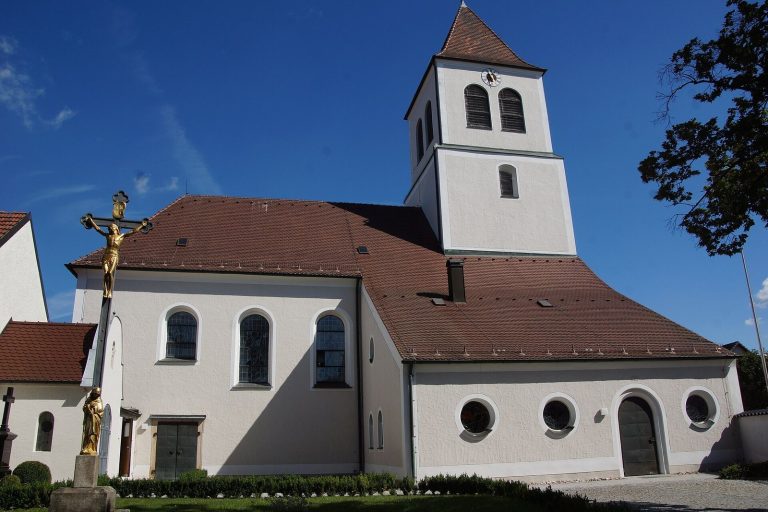
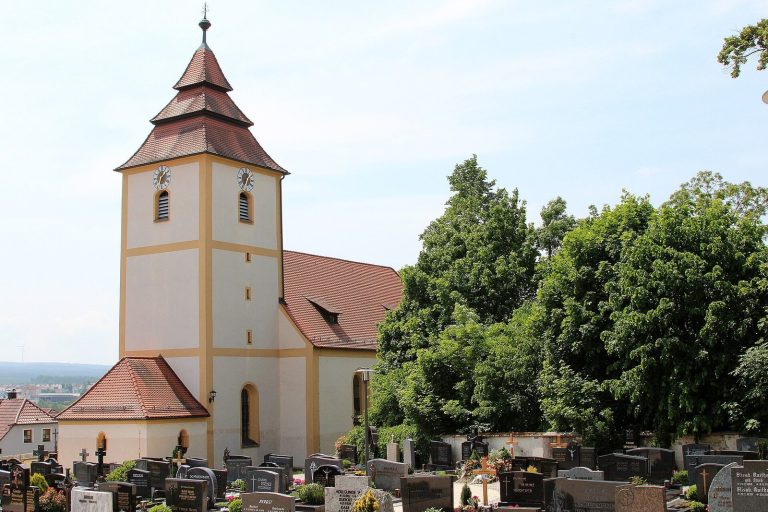
The renovated castle church is attached to the north-west side of the castle. Built in 1707 by Ignatz Freiherr von Weveld, it is a hall building closed on three sides, with a gabled roof and a roof turret. The church was dedicated to the Assumption of the Virgin Mary in 1723, a Christian feast commemorating Mary’s bodily taking into heaven.
Inside the church are wooden figures dating from around 1520. A passage leads from the chapel gallery into the castle, physically connecting the church with the main building. The archaeological monument in the area of the former castle includes medieval and early-modern findings that provide material evidence for the site’s earlier phases.