Darülhadis Mosque: An Ottoman Religious and Charitable Complex in Edirne


Site at a Glance
- Rating
- 4.9
- Popularity
- Low
- Country
- Turkey
- Primary era
- Medieval
- Eras represented
- Medieval
- Civilizations
- Ottoman
- Site type
- Religious
- Remains
- Mosque
On this page11 sections
History
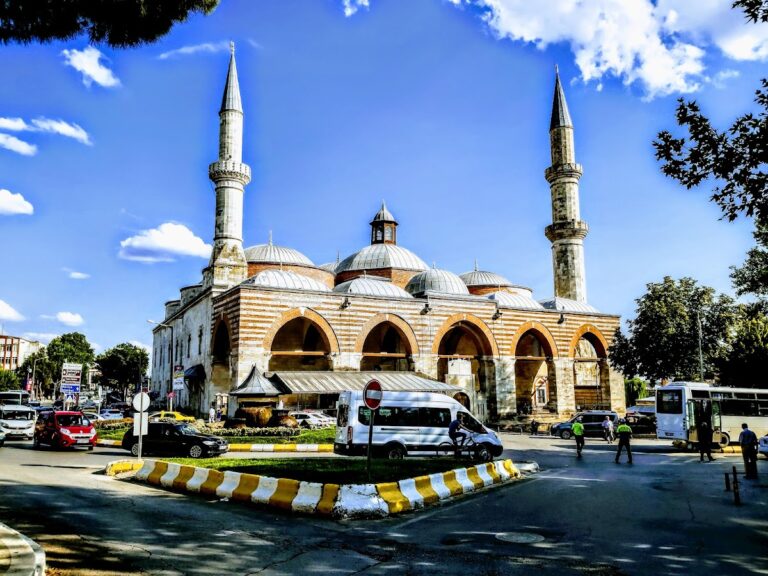
Darülhadis Mosque is an Ottoman Sunni Muslim mosque in Edirne, Turkey, founded under Sultan Murad II in 1434 and completed in 1435. Built beside the Tunca River, it formed part of a religious and charitable complex designed to support both worship and the surrounding community.
Foundation under Murad II
The building was initially planned as a darülhadis, an Islamic school devoted specifically to the study and transmission of hadith, the reports of the sayings and actions of the Prophet Muhammad. Murad II later ordered its redesign as a mosque by the architect Koçu Ahmet. Whether the structure was first built as a mosque or as a madrasa, an Islamic school or college, remains debated.
The mosque belonged to a wider Ottoman religious foundation that included a madrasa, a public bath, an inn, and a public kitchen. Such income-producing and charitable facilities helped sustain religious institutions and provide services to the surrounding population. The bath, built by Murad II to generate revenue for the mosque, was later known as Eski Tahtakale Hamamı.
Fire, wartime damage, and continued use
A fire in 1903 destroyed much of the madrasa. During the Balkan Wars, Bulgarian artillery damaged the mosque and other parts of the complex. The inn, portico, and minaret were destroyed, after which the mosque was rebuilt with a minaret having a single balcony.
Long-term deterioration has affected the complex and its associated structures. The mosque remains in active use, while the bath has closed and fallen into disrepair. Two historic tombs behind the mosque, on the qibla side, preserve burials connected with members of the Ottoman ruling family, including Hasan and Orhan, two sons of Murad II, as well as children of Mustafa II and Ahmed III and Alicenab Kadın, a consort of Mustafa II who died at Edirne Palace in 1699.
Remains
Prayer building and entrance portico
Main prayer building
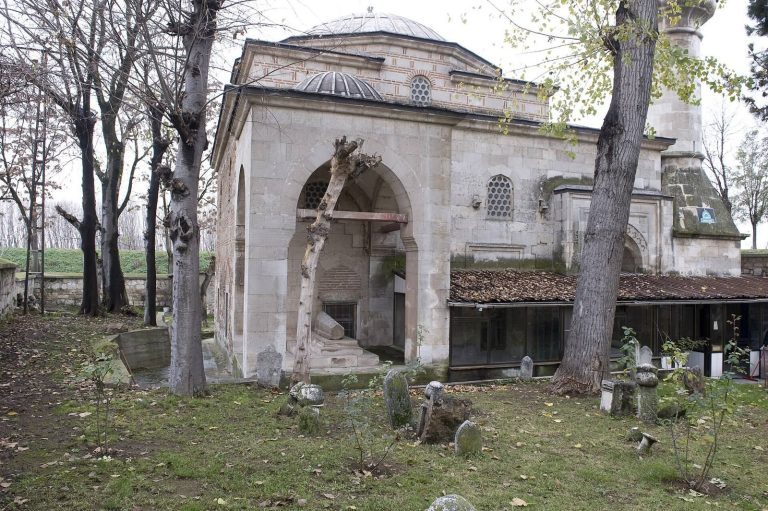
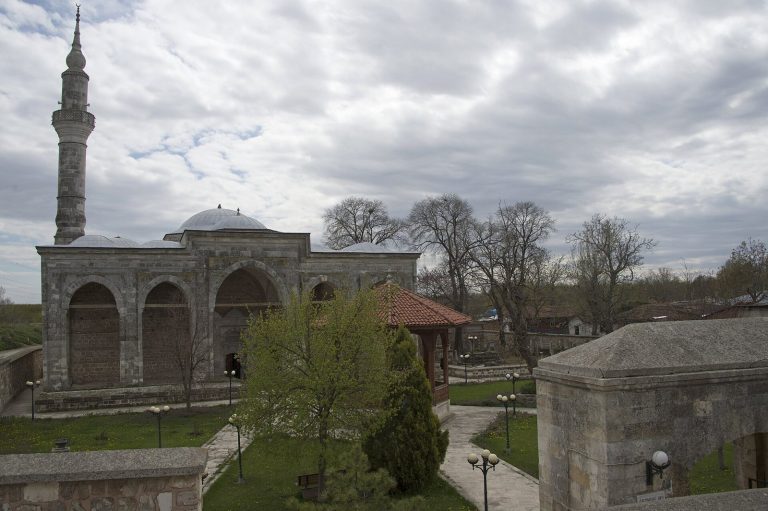
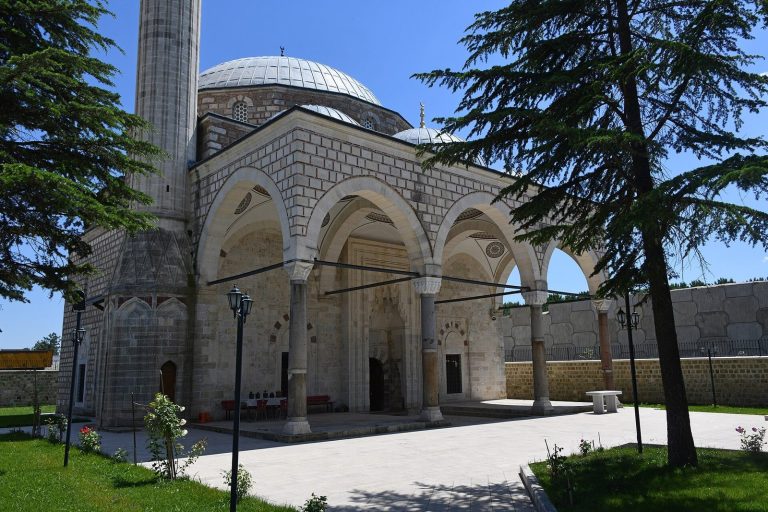
The mosque stands along the Tunca River on Darül Hadis Street, near the Great Synagogue of Edirne and about 1.5 kilometres northeast of Selimiye Mosque. Its rectangular main building measures 15.4 by 9.85 metres. Cut stone forms the principal material, while brick appears in the upper part of the central arch.
The interior has two principal sections. The front part contains three rooms covered by elliptical domes. Behind it, the square prayer hall is crowned by a large dome carried on pendentives, curved transitions that support a circular dome above a square room.
Portico and minaret
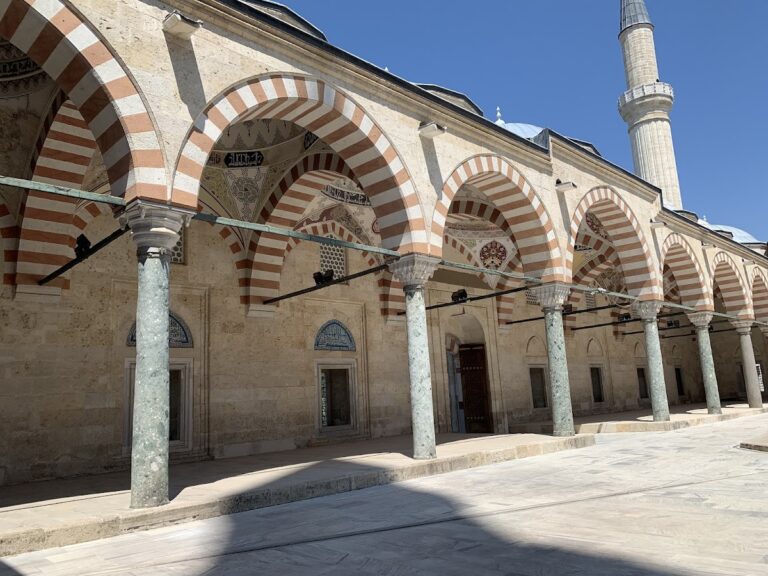
The entrance portico has eleven arched bays, with five across the front and six along the sides. Six original marble pillars support the frontal section, while wooden posts support the side sections. The central bay directly before the entrance rises higher than the others.
The mosque originally had a single minaret. After the Balkan Wars, it was rebuilt with one balcony, forming part of the structure’s reconstructed appearance.
Dynastic tombs
Açık Türbe
The garden surrounding the mosque contains the Açık Türbe, or Open Mausoleum. Built in 1434, it is an open hexagonal structure and forms one of the two historic tombs associated with the complex.
Şehzadeler Türbesi
The Şehzadeler Türbesi, or Princes’ Mausoleum, was established in 1449 with an octagonal plan. Its burials include Ottoman dynastic family members, among them Hasan and Orhan, two sons of Murad II, and children of Mustafa II and Ahmed III. Alicenab Kadın is also associated with the tomb group.
Eski Tahtakale Hamamı
The complex’s public bath stands about 650 metres east of the mosque in the Kaleiçi area and is now known as Eski Tahtakale Hamamı. Murad II built it to provide income for the mosque’s operation. It had separate bathing areas for men and women and was the largest bath in Edirne at the time.
The bath continued operating until the second half of the twentieth century. It is now closed and derelict, although its damaged domes remain visible among the house roofs along Saraçlar Street. Periodic cleaning has taken place, while systematic restoration has not been undertaken.