Our Lady of Częstochowa Church in Duninowo: A Fourteenth-Century Parish Church
Site at a Glance
- Rating
- 4.6
- Popularity
- Very Low
- Country
- Poland
- Primary era
- Medieval
- External website
- Open
- Eras represented
- Medieval, Early Modern
- Civilizations
- Brandenburg-Prussia, Duchy of Pomerania, Holy Roman Empire
- Site type
- Religious
- Remains
- Church
On this page13 sections
History
Our Lady of Częstochowa Church in Duninowo, Poland, is a fourteenth-century church whose medieval foundation developed into a parish centre and later a Roman Catholic place of worship. It was consecrated on 21 June 1374 under the dedications of Saint Mary, Saint John the Apostle and Evangelist, and Saint Margaret by Philipp von Rehberg, Bishop of Cammin.
Medieval parish
The church was formerly known as Dünnow. A document from 1493 describes it as the parish church of Dünnow and names Balthasar Rubake as its priest. The parish served Dünnow, Lindow, and Muddel, while the independent parish of Saleske was attached as a filial locality. A filial church is a subordinate church served by the clergy of a principal parish. A Lutheran church visitation had already taken place at Duninowo in 1539.
Evangelical administration
Until 1945, the parish belonged to the Stolp-Stadt church district, the Pomeranian ecclesiastical province, and the Church of the Old Prussian Union. This was a Protestant church formed by the union of Lutheran and Reformed congregations in the Prussian state. Before 1945, 98 percent of the local population was evangelical, and the parish had 3,090 members.
Changes after 1945
After the Second World War, the largely undamaged evangelical church was compulsorily expropriated by the Polish administration for the Catholic Church in Poland. Roman Catholic clergy reconsecrated it on 15 August 1945, the Feast of the Assumption of Mary. A Roman Catholic parish was established at Duninowo on 8 December 1958. It includes filial churches at Możdżanowo and Zaleskie and belongs to the Ustka deanery in the Koszalin-Kołobrzeg Diocese. A deanery is an administrative district grouping Catholic parishes under a diocese.
Organs and renovation
Gerth Jakob von Below, the church patron, donated a small organ in 1731. The instrument was probably built by Bartsch, an organ builder from Rügenwalde, who repaired it frequently in the years that followed. During the renewal of 1877–1878, the local organ builder Christian Friedrich Völkner replaced it with a large new organ. The church was extensively renovated in 1911, when hot-air heating was installed.
Remains
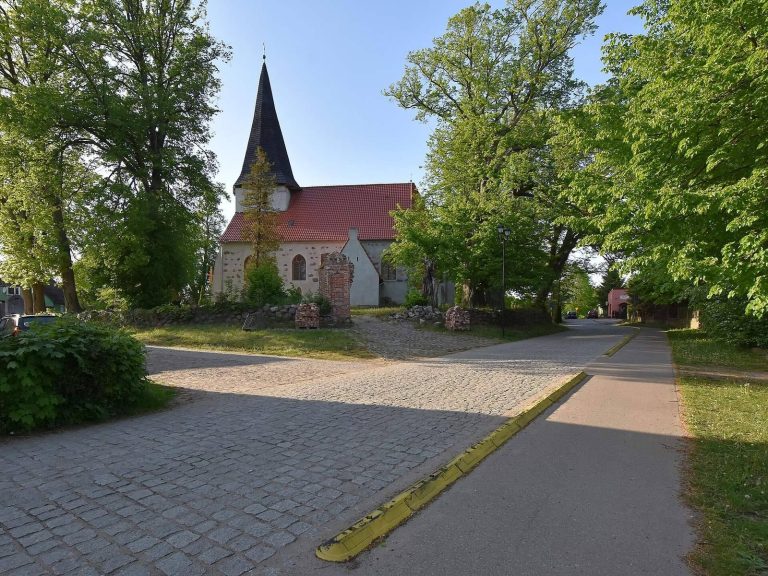
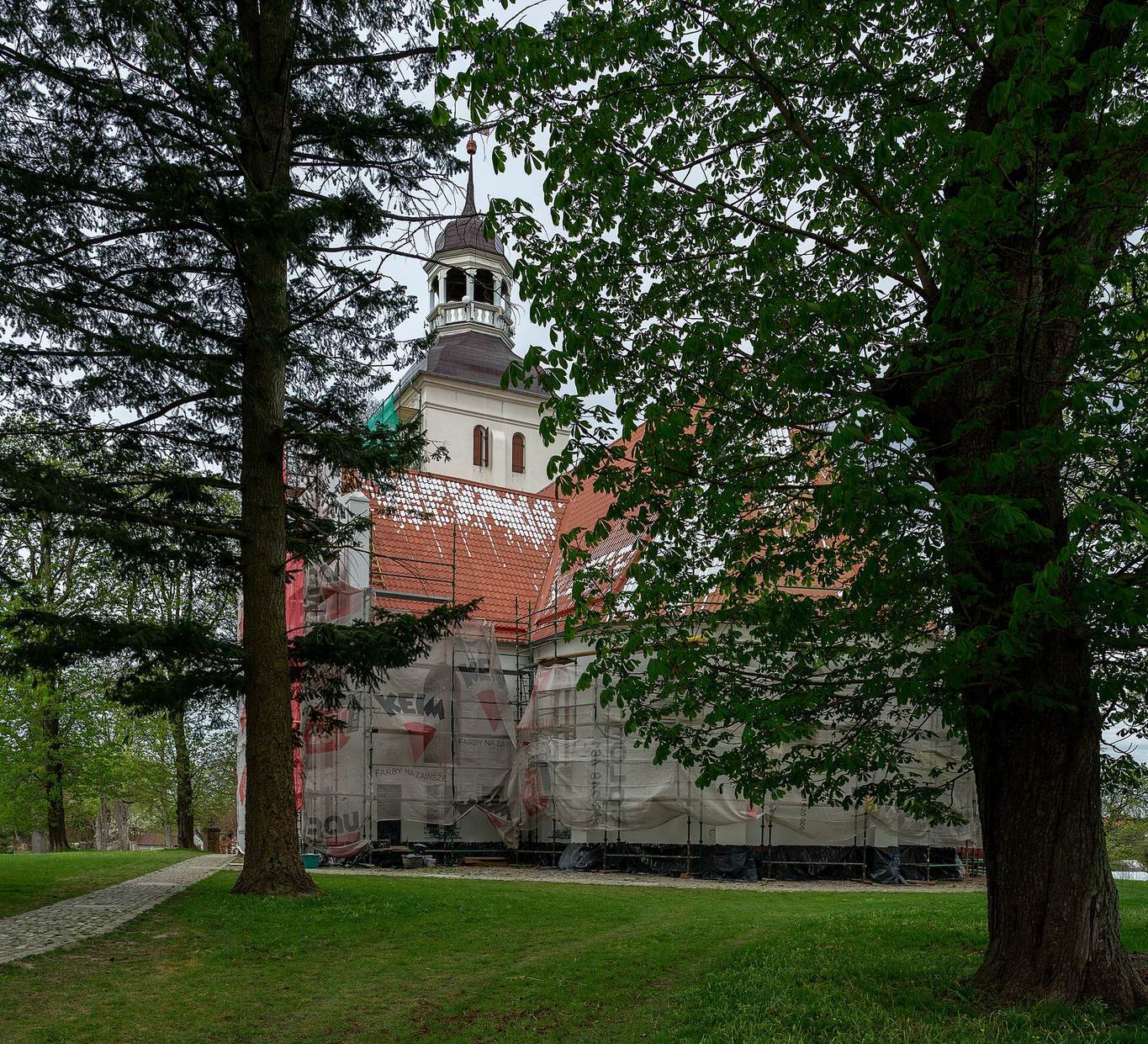
The church is a brick building on fieldstone foundations. Its fourteenth-century core was enlarged in the fifteenth century by the addition of a tower and a chancel extension. A chancel is the part of a church surrounding the principal altar and traditionally reserved for the clergy. The surviving fabric combines the medieval nave with later rebuilding and interior features connected with the church’s long religious history.
Main building
Nave and chancel
The nave is entered through a pointed-arch opening and has buttresses. Inside, it is covered by a flat wooden ceiling, while the later chancel extension is vaulted. The different ceiling forms distinguish the main medieval body from the fifteenth-century extension and preserve the building’s successive phases of construction.
Tower
The tower stands on fieldstone foundations and has a curved pyramidal roof crowned by a large open lantern with a curved finial. A lantern is an open structure above a roof that provides light and visual emphasis. A tower clock was recorded as early as 1721. Structural decay led to the tower’s demolition and reconstruction in brick between 1749 and 1753. The earlier clock was then reinstalled, and the roof structure received a new copper covering in 1936.
Altar and church furnishings
Carved altar figures
Part of the former altar remains, including wooden-carved figures of Mary and John from a Crucifixion group. The altar’s former principal image, a carved representation of Jesus in Gethsemane, was transferred to the museum in Stolp.
Historic vessels and tomb slab
A seventeenth-century brass baptismal dish made in Nuremberg forms part of the church’s historic furnishings. A pewter jug bears the date 1773. In the tower vestibule stands the partly damaged and repaired 1615 tomb slab known as the Krümmel Stone. Its Latin inscription states that Georg Krümmel, the last member of the Krümmel family, died on 5 July 1602 at the age of 63 and was buried on 4 August in the crypt at the outer edge of the altar. He was the hereditary lord of Muddel, now Modła.
A tradition says that Georg Krümmel was killed while hunting by a stag. The animal’s antlers were believed to have hung in the church for a long time before being moved to the manor house at Saleske, now Zaleskie.
Völkner organ
Völkner’s organ, built in 1878, was unusually large and richly voiced for a village church. It had two manuals, a pedal, and twelve registers, making it a distinctive surviving feature of the nineteenth-century renewal.