Cambuskenneth Abbey: A Royal Scottish Monastic Foundation


Site at a Glance
- Rating
- 4.4
- Popularity
- Low
- Country
- United Kingdom
- Primary era
- Medieval
- External website
- Open
- Eras represented
- Medieval, Modern
- Civilizations
- British, Kingdom of Scotland
- Site type
- Religious
- Remains
- Monastery
On this page12 sections
History
Cambuskenneth Abbey in the United Kingdom was founded during the 1140s by order of David I, the twelfth-century king whose ecclesiastical reforms promoted monasteries linked to royal administration. Dedicated to the Virgin Mary, it was established as a daughter house of the French Arrouaise congregation of Canons Regular, clergy who lived under a common religious rule while performing pastoral and institutional duties. It was the only Arrouaise house in Scotland and was later associated with the Augustinian order. The medieval abbey stood near Stirling, a royal burgh, strategic centre, and occasional capital, which helped make it one of Scotland’s important religious foundations.
Foundation and royal connections
The abbey was initially called the Abbey of St Mary of Stirling, or Stirling Abbey. Pope Eugene III granted it protection in 1147, and this protection was confirmed by Pope Alexander III in 1164 and Pope Celestine III in 1195. Papal documents from around 1207 use the name Cambuskenneth, showing that the later name had by then replaced the earlier association with Stirling. The abbey’s community also supplied literate personnel for the royal court and administrative work under David I.
Cambuskenneth became closely connected with the Scottish monarchy and the Wars of Independence, the conflicts through which Scotland resisted English military and political control. Edward I of England prayed at the abbey and received an oath of loyalty from Robert Wishart, Bishop of Glasgow, in 1303. In 1308 Niall mac Cailein, Gilbert II de la Hay, and other nobles swore allegiance to Robert the Bruce, the Scottish king who led the kingdom during the Wars of Independence.
The abbey was associated with the campaign that culminated in the Battle of Bannockburn in 1314 and served as Robert the Bruce’s base before the battle. The spoils of the victory were distributed on the abbey grounds. In November 1314, Robert held a parliament there and declared the estates of people who had fought for the English and had not sworn loyalty to him forfeit. Implementation of the decision was postponed for a year.
Parliaments, destruction, and later medieval history
A second parliament met at Cambuskenneth in 1326. Scottish nobles and clergy confirmed the succession of Robert the Bruce’s son, David II, and representatives of Scotland’s burghs attended for the first time. The frequency of fourteenth-century parliaments at the abbey led one associated building to be known as Parliament Hall.
Robert II granted charters at Cambuskenneth in 1380 and stayed there for several days. His son Robert III conducted royal business at the abbey in 1392. In 1383, the army of Richard II of England burned the abbey, and the buildings were later repaired. In 1423, the abbot negotiated for the release of James I, who was being held in England. By 1445, the community comprised the abbot, a prior, and seventeen monks.
Royal associations continued into the late fifteenth century. Queen Margaret of Denmark died near Stirling Castle in 1486 and was buried at Cambuskenneth. After James III was killed at the Battle of Sauchieburn on 11 June 1488, his body was brought to the abbey and buried near Margaret. His tomb was completed in 1502 and painted by David Pratt. James IV prepared for burial at Cambuskenneth, but after his death at Flodden in 1513 he was probably buried at Sheen in Surrey; his remains were later lost during the Reformation.
Patrick Paniter became abbot in 1513. He was also secretary to James V and fought at Flodden that year. Alexander Myln succeeded him in 1517 and later became the first president of the College of Justice. David Arnot is recorded as abbot from 1503 to 1509.
Reformation and heritage management
The abbey declined and closed during the Scottish Reformation, the sixteenth-century religious and political transformation that established Protestantism in Scotland and dissolved many Catholic monasteries. By 1559, only a few monks remained, and the buildings had been burned and plundered. In 1560, the site came under the authority of John Erskine, the military governor of Stirling Castle, while Adam Erskine was appointed commendator, an administrator responsible for the revenues and affairs of a former religious foundation.
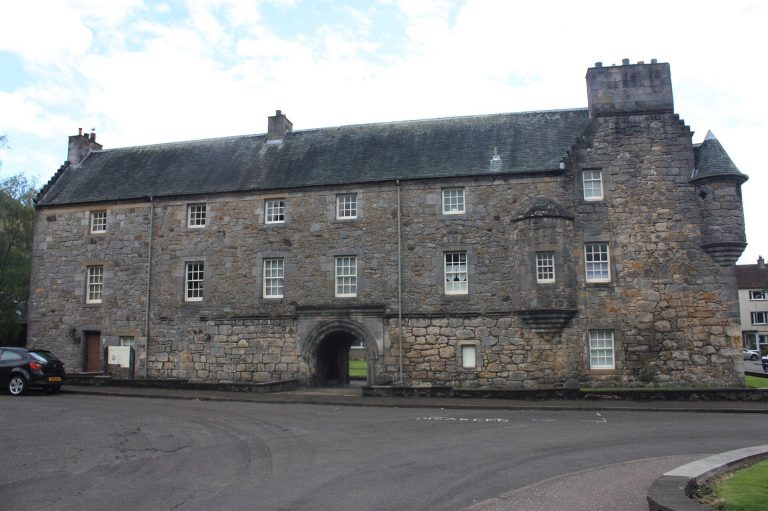
Much of the abbey’s masonry was removed for construction at Stirling Castle. John Erskine is also said to have reused material at Mar’s Wark in Stirling. Cambuskenneth passed to the municipality of Stirling in 1709. The Crown acquired it in 1908, and Historic Scotland subsequently managed the ruined abbey and its surviving tower under public heritage administration.
Remains
Cambuskenneth Abbey occupied land within a meander of the River Forth near Stirling. The river enclosed the site on three sides, while an embankment and ditch marked the northern edge of the monastic precinct. Today, the former layout is chiefly readable through the foundations of the church and adjoining monastic buildings. Most of the surviving fabric consists of foundations or low ruins, with more substantial walling beside the river and near a modern farmstead.
Church and monastic buildings
Abbey church
The early-thirteenth-century church was a long, narrow basilica, meaning a church with a central nave and side aisle. It had a rectangular choir inserted into the eastern part of the building, short transepts, a square tower over the central crossing, and an angular end to the choir. Solid walls separated the choir from the nave and the transept arms. A single northern side aisle was probably added in the later thirteenth or early fourteenth century, creating an asymmetrical plan that has been compared with Cistercian church buildings. The church now survives mainly as foundations and low wall remains.
Cloister and service buildings
A cloister, the covered walkway around a monastic court, adjoined the church together with the monks’ residential and service buildings. These included a refectory and a chapter house, the room where the community met for formal business. Substantial sections of two residential or service buildings survive beside the River Forth and near the modern farmstead. Other ancillary buildings are represented by foundations, while remnants of a western passage or portal help define the former precinct.
Bell towers and royal burials
Crossing tower
The church’s central bell tower collapsed after being struck by lightning in 1378, damaging the choir. Its remains form part of the ruined church complex and help explain the later condition of the eastern end of the building.
Freestanding campanile
The late-thirteenth-century campanile, or freestanding bell tower, stands southwest of the former church. More than 20 metres high, it is the only major structure at the abbey to remain intact. Figural decoration survives in the parapet area, and the tower underwent extensive renovation during the nineteenth century. Remains of James III’s earlier tomb are displayed on its ground floor. The tower may have been spared after the Reformation because it could serve as a lookout, although that purpose is uncertain.
Royal burial monument
The historic graveyard contains the burials of James III and Margaret of Denmark, together with graves associated with many abbots of Cambuskenneth. James III’s original monument was damaged after the abbey was dismantled. During nineteenth-century restoration, human remains identified with James III and Margaret were found near the former high altar. They were reburied in 1865 beneath a new Classical-style sarcophagus decorated with heraldry and a Latin inscription. The monument stands within a railed enclosure at the eastern end of the ruins.
The neighbouring village of Cambuskenneth takes its name from the former abbey. Abbey Craig, where the Wallace Monument stands, is likewise named for its proximity to the monastic site.