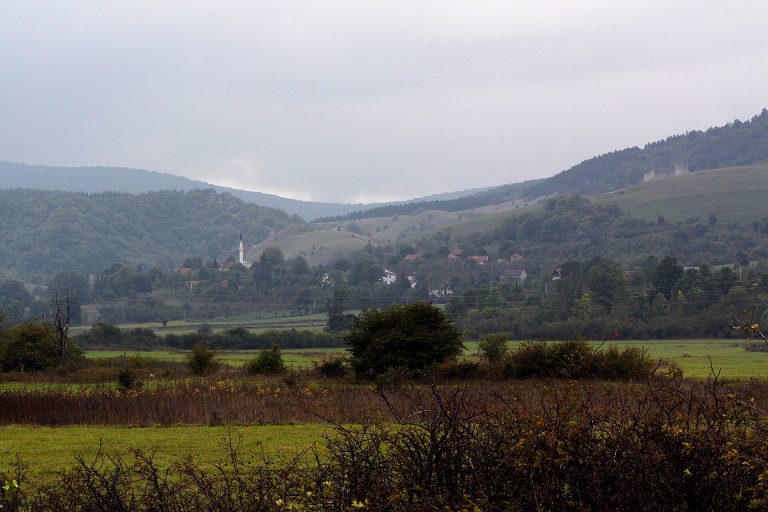
Fethija Mosque: A Gothic Church Converted into a Mosque in Bihać


Site at a Glance
- Rating
- 4.7
- Popularity
- Medium
- Country
- Bosnia and Herzegovina
- Primary era
- Medieval
- Eras represented
- Medieval, Modern
- Civilizations
- Hungarian, Kingdom of Croatia, Ottoman
- Site type
- Religious
- Remains
- Church
On this page8 sections
History
Fethija Mosque in Bihać, Bosnia and Herzegovina, is a Gothic building constructed in 1266 as the Catholic Church of Saint Anthony of Padua. Built in the medieval Gothic style, it is regarded as the oldest Gothic structure in Bosnia and Herzegovina and as one of the few European Islamic places of worship in that style. A Dominican monastery accompanied the church and was mentioned in a thirteenth-century charter of the Croatian nobility.
From church to mosque
After the Ottoman conquest of Bihać in 1592, the church was converted into the city’s principal mosque. The Ottoman Empire was an imperial state whose territories included much of southeastern Europe, western Asia, and North Africa. The new mosque received the name Fethija, meaning “conquered,” and it remains an active Sunni mosque.
The building’s unusual combination of a Gothic structure and Islamic elements influenced mosque design in the Bosnian Krajina, a historical region in northwestern Bosnia. Its influence included elongated prayer spaces, elongated windows, and two-level mahfils, or elevated galleries used for additional prayer or recitation space.
Changes and damage
The original Gothic bell tower served as the mosque’s minaret, the tower traditionally associated with a mosque and historically used for the call to prayer. Its deteriorated condition led to its demolition in 1863, when it was replaced by the present minaret. During the Austro-Hungarian period, a new Church of Saint Anthony of Padua was built elsewhere.
During the Second World War, fire destroyed the mosque’s roof and all of its wooden interior elements, while the minaret also suffered damage. Conservation work began after the war. In July 2003, the mosque, its harem, nine inscribed grave slabs, and their inscriptions were designated a National Monument of Bosnia and Herzegovina.
Remains
Fethija Mosque stands in the lower part of Bihać, at a square on Bosanska Street. The former church and present mosque measures approximately 22 metres in length and 11.5 metres in width. Its maximum height is about 15.5 metres, excluding the minaret, and its stated capacity is 250 worshippers. Bihacite stone forms the main building, preserving the material character of the medieval structure.
The Gothic building
The mosque retains the form of a Gothic building adapted for Islamic worship. Gothic architecture was a medieval European style associated with pointed arches, strong vertical emphasis, and large elongated windows. At Fethija, the elongated prayer space and windows belong to the building’s distinctive architectural character, while the interior arrangement reflects its later function as a mosque.
The minaret
The present minaret occupies the site of the demolished Gothic bell tower and was built from the same type of Bihacite stone as the main building. Its rectangular pedestal measures 2.73 by 1.55 metres. The cornices and balcony are richly decorated with twisted-rope motifs and spherical projections, and the upper part also carries ornament.
The wooden mahfil
A wooden mahfil is positioned beside the entrance. The gallery is 6 metres deep and arranged on two levels. Six wooden columns support it, with saddle supports set in three transverse rows. Together with the elongated prayer space, this gallery forms one of the building’s defining adaptations for mosque use.
Harem and grave slabs
The mosque complex includes a harem and nine inscribed grave slabs. Their inscriptions form part of the surviving historical material associated with Fethija Mosque, alongside the Gothic building, its stone minaret, and the architectural elements introduced for Islamic worship.