Ostrovica Fortress: A Medieval and Ottoman Stronghold in Bosnia and Herzegovina


Site at a Glance
- Rating
- 4.5
- Popularity
- Low
- Country
- Bosnia and Herzegovina
- Primary era
- Early Modern
- External website
- Open
- Eras represented
- Classical, Medieval, Early Modern
- Civilizations
- Kingdom of Croatia, Ottoman, Roman
- Site type
- Military
- Remains
- Fort
On this page6 sections
History
Ostrovica Fortress is a medieval and Ottoman hilltop stronghold in Bosnia and Herzegovina, whose present form developed mainly from the fifteenth century onward. It stands on the site of an ancient fortification dating to Roman times or earlier and occupied a strategic position above the Una valley.
Medieval Croatian and noble rule
Ostrovica lay within the medieval Croatian Kingdom, in Lapac County. The fortress was first mentioned in a charter of 1407, when King Ladislaus of Naples, a claimant involved in the dynastic struggle over the Kingdom of Hungary and its Dalmatian possessions, confirmed Ostrovica and Skradin to Sandalj Hranić. A powerful Bosnian nobleman and grand duke, Sandalj had received Ostrovica as a marriage dowry in 1405 and probably rebuilt the stronghold during the early fifteenth century.
In 1409 and 1410, Sandalj sold Ostrovica and Skradin to Venice for 5,000 ducats. During the fifteenth and early sixteenth centuries, the fortress was associated with the Kurjaković family, later known as the Karlović family and titled Princes of Krbava. Other recorded holders included the Frankopan family, Juraj Mikulčić, Ivan Keglević, and the Hranić-Kosača and Disislavić families.
Ottoman incorporation and military administration
Ottoman pressure intensified after the conquest of the medieval Bosnian kingdom in 1463. Ostrovica fell in December 1523 and became part of the Bosnian pashaluk, an Ottoman province governed by a pasha. It remained under Ottoman rule until 1878. The fortress was enlarged and strengthened during this period, becoming a military stronghold commanded first by a dizdar, an Ottoman fortress commander, during the sixteenth and seventeenth centuries, and later by a captain.
For much of the Ottoman period, Ostrovica served as the seat of the Old Ostrovica Captaincy. A captaincy was an Ottoman military-administrative district centered on a fortified stronghold. Its territory also included the smaller strongholds of Orašac, Havala, Džisri-kebir, Čovka, and Donji Lapac. Members of the Kulenović family, a prominent Bosnian beg family whose title belonged to provincial notables and the ruling or military elite, held the captaincy for many years.
The fortress endured repeated attacks and sieges in 1560, 1698, 1737, 1789, and 1834. In 1737, during the Austro-Russian–Turkish War of 1735–1739, a Habsburg army unsuccessfully besieged Ostrovica. After Donji Lapac came under Habsburg control and the Croatian-Bosnian frontier moved close to the fortress, the captaincy seat was transferred to Prkose, a stronghold northeast of Ostrovica, placing it farther from the frontier.
Habsburg rule and later preservation
Regular repairs, including work carried out in 1766, 1777, and 1791, kept the fortress in good condition. It was still described as being in good shape in 1838. Ostrovica was abandoned in 1878 after Austria-Hungary took control of Bosnia and Herzegovina. Despite Croatian demands, it was not transferred to the Croatian Kingdom. Instead, it remained under direct Habsburg imperial administration as part of Bosnia and Herzegovina, after which the abandoned stronghold gradually deteriorated.
After the First World War, Ostrovica remained within Bosnia and Herzegovina as the region successively became part of the State of Slovenes, Croats and Serbs, the Kingdom of Yugoslavia, and the Socialist Federal Republic of Yugoslavia. Intermittent stabilization, reconstruction, and restoration have since been carried out on parts of the ruin. The fortress was included in Una National Park, established in 2008, and designated a National Monument of Bosnia and Herzegovina in 2012.
Remains
Hilltop fortification
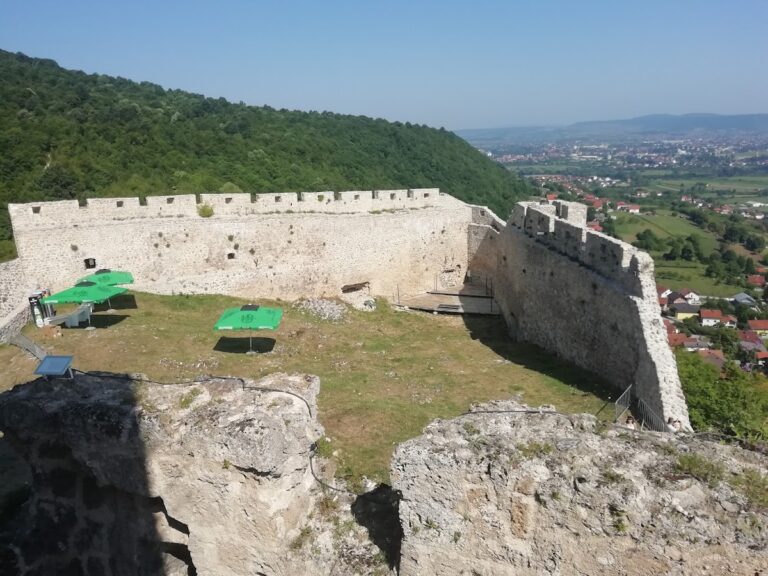
Ostrovica occupies a steep, heavily wooded ridge above the left bank of the upper Una River, near Kulen Vakuf in the Bihać area. Its position overlooks a strategic north–south route through the Una valley. The river below the fortress is relatively shallow, allowing it to be crossed on horseback. This setting placed the stronghold above an important line of movement while giving it a defensible position.
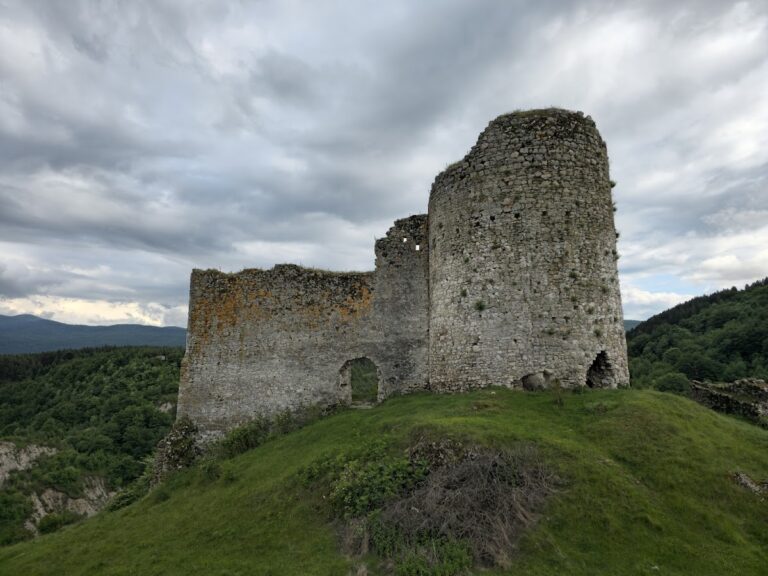
The fortification is built of hewn stone, including ashlar masonry, and its walls were expanded and reinforced several times. Major strengthening took place in the early seventeenth century and again during the eighteenth century. The present form dates from the early eighteenth century and measures approximately 117 metres in length and 83 metres in width. The main entrance is on the southern side, while an auxiliary entrance lies to the north. The surviving structure is a damaged ruin that has been partially renovated, including stabilization and restoration of the entrance gate and northern tower.