Church of San Giuliano: A Historic Catholic Church in Erice


Site at a Glance
- Rating
- 4.4
- Popularity
- Low
- Country
- Italy
- Primary era
- Early Modern
- Eras represented
- Medieval, Early Modern
- Civilizations
- Kingdom of Sicily, Norman, Spanish
- Site type
- Religious
- Remains
- Church
On this page14 sections
History
The Church of San Giuliano is a historic Catholic church in Erice, Italy, traditionally associated with Norman rule and an eleventh-century foundation. Its cult is linked to the early Christianity of the Trapani area and probably dates to the fourth century. Dedicated to San Giuliano of Erice, a Carthaginian martyr traditionally believed to have died in AD 254, the church gave its name to Mount San Giuliano, the former name of Mount Erice until 1934.
Early Christian and Norman traditions
The church stands on the summit of the highest elevation within Erice’s inhabited center. It exercised territorial jurisdiction over the San Giuliano Quarter, an important district that took its name from the church. Construction began in the eleventh century, traditionally on the orders of Roger the Norman, the Norman ruler who established Norman power in Sicily. By 1080, San Giuliano was a small Gothic building.
San Giuliano was represented as a warrior bearing a sword and falcon. Tradition held that he appeared alongside the Normans and helped defeat Muslims attempting to capture Erice. Because of this association, he became known as the “Liberator” and was adopted as the city’s protector. Until the thirteenth century, the church’s structures hosted civic assemblies, including meetings attended by Jews. It was Erice’s primatial church before 1308.
Rebuilding and changing use
The original low building had a cross-vaulted roof, formed by the intersection of two barrel vaults, but its condition threatened collapse. Between 1612 and 1645, it was rebuilt and enlarged into a three-aisled basilica, a longitudinal church plan with a central nave and lower side aisles. The Grimaldi family and religious personnel directed successive enlargements, restorations, and embellishments, giving the church its monumental appearance.
The central nave collapsed in 1926, and the church remained closed for worship until modern restoration works were completed. It reopened on 26 December 2005. The church lost its parish title in 1941 after becoming dilapidated. Precious furnishings and vestments were moved to the San Rocco Institute under the care of the Daughters of Charity of Saint Vincent de Paul. Following the institute’s closure as Erice’s population declined, the silverware and vestments were transferred to the new diocesan seminary at Raganzili.
The church remains part of the Catholic Church and the Diocese of Trapani. A religious feast dedicated to San Giuliano is held on 22 May. Its connection with Erice’s religious life also continues through the Mysteries of Erice, sculptural groups representing the death and Passion of Christ that are carried in procession on Good Friday.
Remains
Layout and exterior
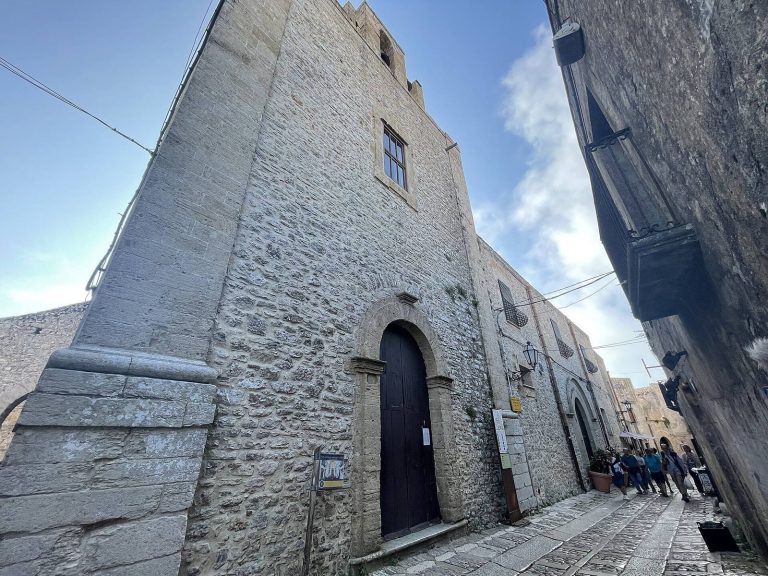
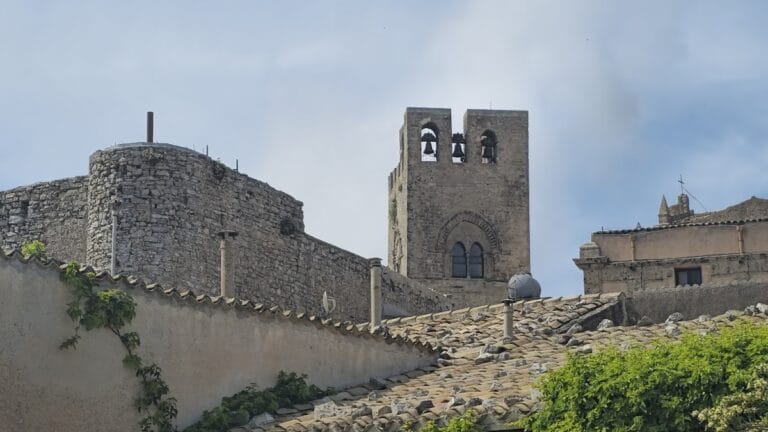
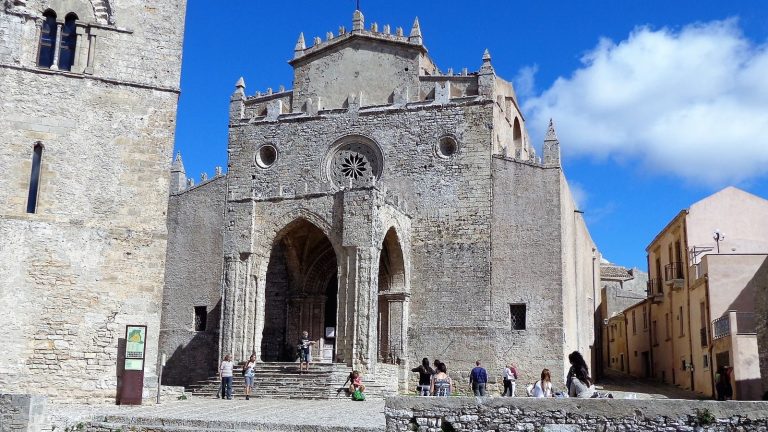
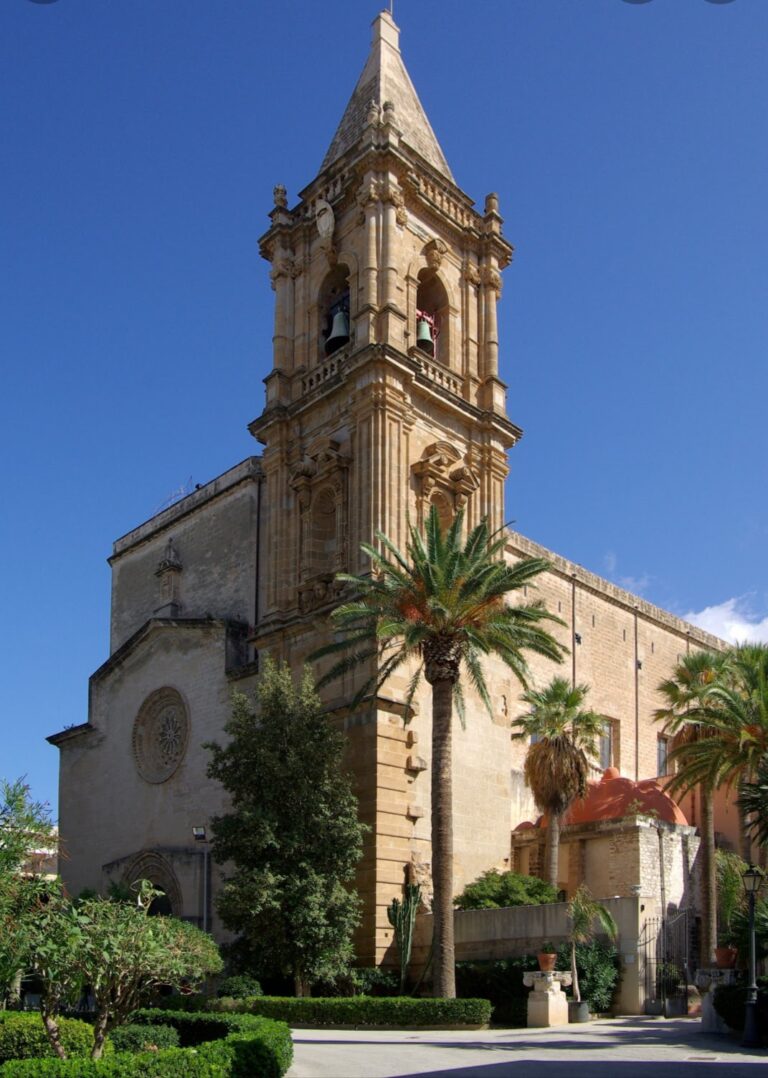
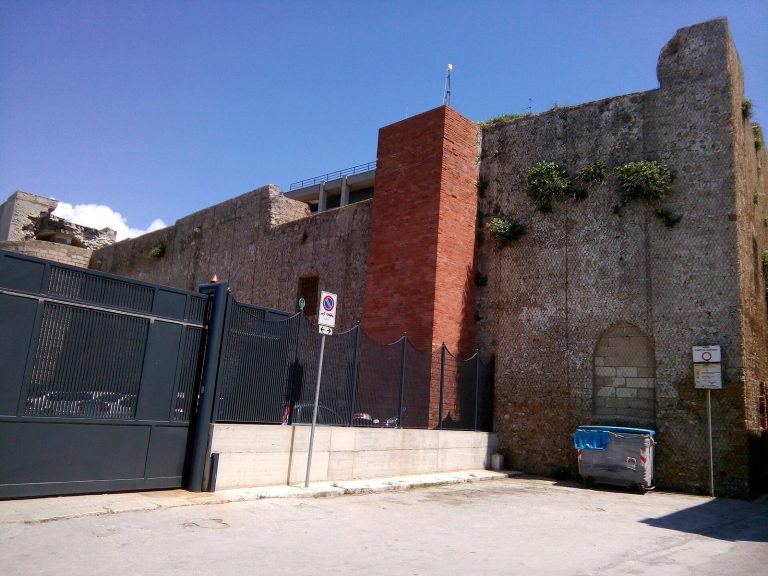
The church has a basilica plan divided into three naves by columns. Its exterior portal is Renaissance in style. Beside the right side of the church stands a separate bell tower, built in 1770 and distinguished by its pagoda-shaped roof. Marble and other stone elements include commemorative slabs and burials.
Naves and chapels
Right nave
The right nave contains a marble baptismal font with a wooden canopy made by Leonardo Crivaglia in 1718. Nearby are an eighteenth-century marble holy-water basin, an eighteenth-century wall painting of Saint Ignatius of Loyola and Saint Philip Neri, and a carved, polychrome wooden statue of Saint Joseph with the Child. Pietro Orlando made the statue in the seventeenth century.
Left nave
The left nave houses the Mysteries of Erice. The eighteenth-century groups include the Prayer of Jesus in the Garden of Gethsemane and Christ Going toward Calvary, while the Flagellation dates to 1760 and the Crowning with Thorns to the eighteenth century. Jesus in the Urn is from the nineteenth century. The same nave also contains a sixteenth-century Crucifix and Pietà.
Apsidal chapels
The right apsidal chapel, a chapel beside the curved-ended sanctuary area, is dedicated to San Giuliano Martyr. Pietro dell’Orto decorated it with stucco, a moldable plaster used for architectural and sculptural ornament, in 1794. Its niche contains a carved, polychrome wooden statue of the saint by Pietro Orlando.
The left apsidal chapel is dedicated to the Immaculate Conception. Its central niche contains a stucco statue made by Orazio Ferraro in 1605. The pediment is decorated with rays and adoring angels surrounding a figure of God Almighty. An inscription records the Confraternity of the Most Holy Conception, the date 1605, and Ferraro’s authorship.
Main chapel
The main chapel has an apse basin decorated with stucco rays and adoring angels. At its center, within a composition framed by twisted columns, is the figure known as the Sacred Heart of Jesus, made by Pietro dell’Orto. The aedicule contains Madonna del Monte, an acrylic painting on wood made by Gaetano Costa in 2003. Two large votive panels hang on the side walls of the presbytery.
Oratories and collections
Oratory of the Conception
The Oratory of the Conception displays sculpture and silverwork from the seventeenth, eighteenth, and nineteenth centuries. Its works include a sixteenth-century carved and polychrome wooden San Giuliano, a repoussé and chased silver repository from 1775, and a similar silver cartagloria from 1785. A cartagloria is a framed support traditionally used to hold a fixed liturgical text on an altar. The oratory also contains a reliquary associated with the Altar of San Michele, whose date is unknown.
Congregation of the 33 of the Crucifix
The Congregation of the 33 of the Crucifix contains seventeenth- and eighteenth-century paintings and sculpture. Among its works is a carved and painted wooden Crucifix made by Matteo Gebbia in 1650. The collection also includes a seventeenth-century panel painting of the Madonna of Custonaci between Saint Ignatius of Loyola and Saint Francis Xavier by an unidentified Sicilian artist.
Sacristy and vestment rooms
The sacristy contains waxwork objects made for sacred subjects. Another room is dedicated to sacred vestments from various periods, preserving part of the church’s liturgical collection alongside the sculpture, paintings, and silverwork displayed elsewhere in the complex.