Abbatiale Saint-Volusien de Foix: A Roman Catholic Abbey Church in France


Site at a Glance
- Rating
- 4.4
- Popularity
- Low
- Country
- France
- Primary era
- Early Modern
- External website
- Open
- Eras represented
- Medieval, Early Modern
- Civilizations
- French
- Site type
- Religious
- Remains
- Church
On this page9 sections
History
Abbatiale Saint-Volusien de Foix is a Roman Catholic church in France, dedicated to Saint Volusianus of Tours and associated with the Augustinian tradition. Canons Regular of Saint Augustine took over the abbey in 1104, and a large church was undertaken in 1125. Its dedication was linked to the relics of Saint Volusianus, a late antique Christian bishop of Tours.
The medieval abbey church
The medieval church had three naves and a transept, the cross-arm that cuts across a church nave to create a cruciform plan. Its original apse, the rounded or polygonal end of the church, was Romanesque, a medieval style known for massive forms and rounded arches. In the fourteenth century, this apse was replaced by a polygonal choir with an angular, multi-sided termination.
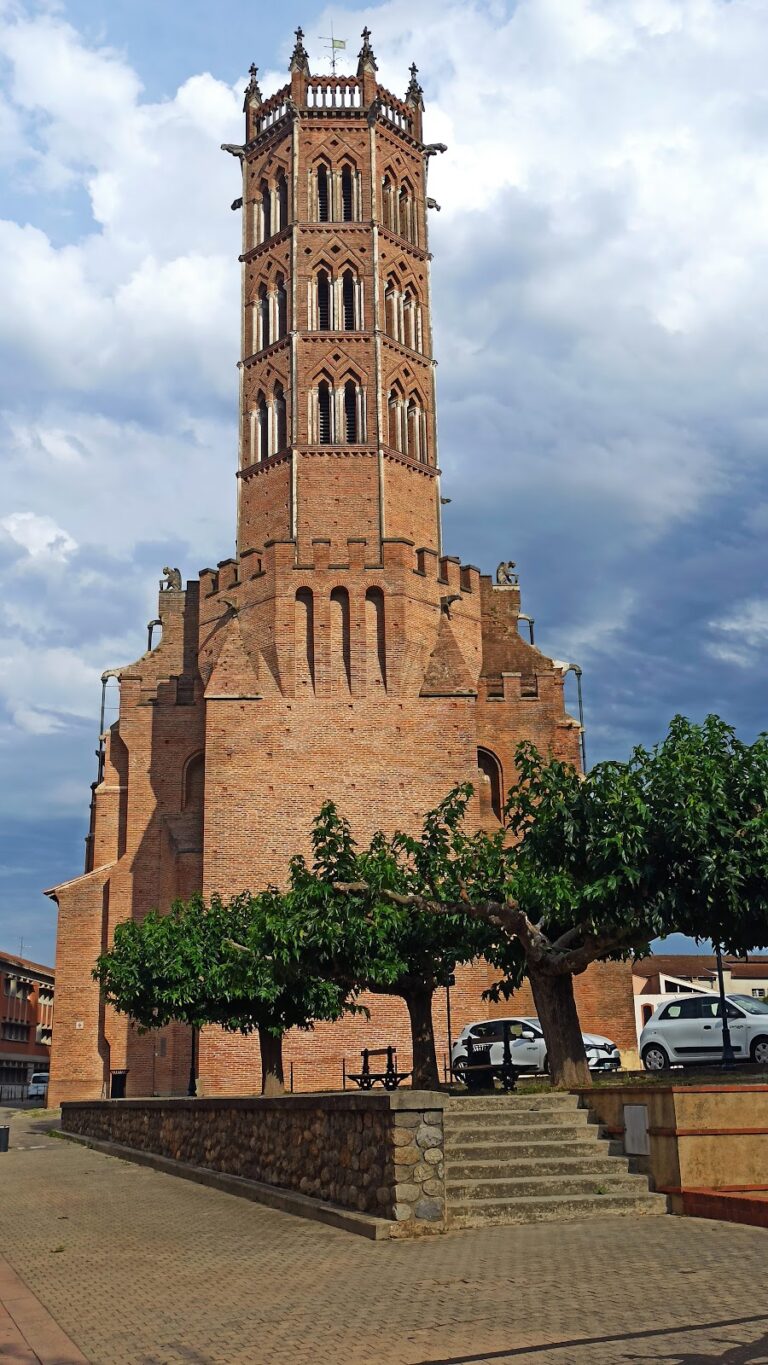
The church’s surviving medieval fabric is concentrated mainly in the portal and the bases of the nave walls. The building that developed around these remains is predominantly Gothic, a style associated with pointed arches, greater verticality, and complex vaulting.
Destruction and reconstruction
The abbey was destroyed during the French Wars of Religion, a series of sixteenth-century conflicts in France involving Catholics and Protestants. Saint Volusianus’s relics were burned during the destruction. Reconstruction began in 1609 and was probably completed around 1670, when the new vault was installed.
An organ was already present in the church in 1502, although little is known about that earlier instrument. The present large organ was built in 1869, while the choir organ was made later by Fermis. The church was classified as a French historic monument by an order dated 30 July 1964. Its tribune organ, including both its case and instrumental part, received protected historic-monument status on 17 October 1997.
Remains
Church fabric and plan
The church has a three-nave plan crossed by a transept and ending in a polygonal choir. Its entrance includes a porch tower. The building is predominantly Gothic, while the earlier Romanesque phase survives chiefly in the portal and in the lower bases of the nave walls. These elements form the principal visible remains of the medieval fabric within the later church.
The later structure includes the choir that replaced the Romanesque apse in the fourteenth century and the vault installed during the reconstruction completed around 1670. Together, these features express the building’s successive medieval and post-medieval phases without separating them from the surviving earlier fabric.
Organs
Tribune organ
The tribune organ is a 40-stop Romantic instrument housed in an organ case. Leroy-Legendre and Fermis, father and son, built it in 1869. Lucien Simon and Jean-Pascal Villard restored it in 2004. The case and instrumental part are protected as historic monuments under the status granted in 1997.
Choir organ
Fermis built the choir organ after the large organ. Claude Armand, an organ builder from Ganac, restored it in the 1980s. The instrument was subsequently placed in a chapel near the choir, and it now stands on the floor near the choir stalls.
Bells
Three bells are associated with the church. Jeanne-Paule is an eighteenth-century bronze bell measuring 112 centimetres in diameter and 83 centimetres in thickness. Jean Baptiste was cast anonymously in 1805; it has a medium profile, a diameter of 87 centimetres, and a thickness of 61 centimetres. Conception was cast by Bollée of Orléans in 1982. It replaced a bell dated 1641 that had formerly been placed at the Notre-Dame de Montgauzy chapel, and measures 67 centimetres in diameter and 50 centimetres in thickness.
The three bells hang from demoiselle-type yokes made by the founder Barnabé Martin. Before the church was electrified, they were rung by rotating the bells.