Basarbovo Monastery: A Rock-Cut Orthodox Monastery in Bulgaria


Site at a Glance
- Rating
- 4.8
- Popularity
- Medium
- Country
- Bulgaria
- Primary era
- Medieval
- External website
- Open
- Eras represented
- Medieval, Modern
- Civilizations
- Second Bulgarian Empire
- Site type
- Religious
- Remains
- Monastery
On this page11 sections
History
Basarbovo Monastery is an active male Orthodox monastery in Bulgaria, associated with the Bulgarian Orthodox Church and the Ruse Eparchy. Its origins are placed in the period of the Second Bulgarian Empire, the medieval Bulgarian state that existed from 1185 to 1396, with construction broadly dated to the twelfth through fourteenth centuries and its foundation to the fourteenth century. Its creation is associated with the reign of Tsar Ivan Alexander, a fourteenth-century ruler of the Bulgarian Empire.
Medieval origins and early records
The monastery’s earliest written reference appears in an Ottoman tax register from 1431. The register records “Besaraba” as a property containing 14 households and identifies it as the timar of the great voivode Ivanko Basarab. A timar was an Ottoman landholding assignment whose revenues supported its holder, commonly in return for administrative or military service. Ivanko Basarab was a Wallachian voivode, or ruler of Wallachia, and the father of Queen Theodora Basarab, Ivan Alexander’s first wife. The nearby village of Basarbovo also bears his name.
One foundation tradition connects the monastery’s patronage with Queen Theodora Basarab. Another tradition holds that it was originally dedicated to Saints Theodore Tiron and Theodore Stratelates, two distinct Christian military saints venerated in the Eastern Orthodox tradition.
Saint Dimitar and the Ottoman period
Saint Dimitar Basarbovski became the monastery’s best-known resident and is traditionally regarded as its perpetual abbot. He is said to have spent much of his life there after first living simply as a layman, and is also described as having been born in 1685. His association gave the monastery its principal devotional identity. The eighteenth-century Bulgarian monk and historian Paisius of Hilendar mentioned the monastery in his Slavo-Bulgarian History.
During the Russo-Turkish War of 1768–1774, a conflict between the Russian and Ottoman empires, General Ivan P. Saltikov transferred Saint Dimitar’s relics, physical remains or associated sacred objects venerated because of their connection with a saint, from the monastery to Bucharest. They were placed on 13 July 1774 in the Metropolitan Church, now the Patriarchal Church of Saints Constantine and Helena, where they remain. In 2005, at the request of Bulgarian Patriarch Maxim, Romanian Patriarch Teoctist gave the monastery an icon containing a fragment of Saint Dimitar’s relics.
Renewal and continuing life
The monastery’s permanent occupation during the Ottoman period ended at an unknown date. In 1919, the future Bishop Tihon of Smolyan assumed responsibility for it. The Czech archaeologist and traveller Karel Skorpil visited and described the monastery in 1912 during a journey along the Lom River connected with Bulgaria’s archaeological mapping. His wider scientific journeys in Bulgaria had taken place in 1887 and 1892.
Renewal began in 1937, when the monk Hadji Hrisant of Preobrazhensky Monastery settled at Basarbovo. A committee formed that year to build the Chapel of Saint Dimitar of Basarbovo. Its first project was a monk’s cell in the enclosed courtyard, consecrated on 14 May 1937, but a flood destroyed it in 1940. Hrisant then raised donations, and two replacement cells beside the church were completed on 30 August 1940. The monastery was declared an archaeological cultural monument of local significance in 1978. It remains active, with its feast celebrated on 27 October, the feast day of Saint Dimitar Basarbovski.
Remains
Basarbovo Monastery is a rock-cut complex in the valley of the Rusenski Lom River, near Basarbovo and approximately 10 kilometres from Ruse. The monastery stands about 35 metres from the river, and its principal rooms are excavated into the rock. A cultivated garden courtyard forms the entrance area, while paths and stone steps connect the courtyard with the carved spaces above.
Rock-cut spaces
Church and iconostasis
The rock-cut church contains a carved wooden iconostasis, the decorated screen separating the sanctuary from the main worship area in an Eastern Orthodox church. Made in 1941, it includes a large icon of Saint Dimitar surrounded by ten scenes from his life. The inscriptions on the icon are in Romanian written with Cyrillic letters and in Greek.
Steps, niche, and cave
A path from the courtyard leads to a well traditionally attributed to Saint Dimitar as its excavator. Forty-eight steps rise to a rock ledge containing a niche traditionally identified as the place where he slept. Further stone steps lead to a natural cave where the monk Hrisant was buried and where the bones of other deceased monks were later placed. The bones were subsequently reburied in the monastery cemetery, and the cave now houses a museum-style exhibition.
Courtyard and later buildings
Monastic rooms and refectory
Two rooms and a refectory, or communal dining room, were built in 1956 at the foot of the cliffs. They form part of the later built accommodation and service area below the rock-cut spaces.
Church of the Transfiguration
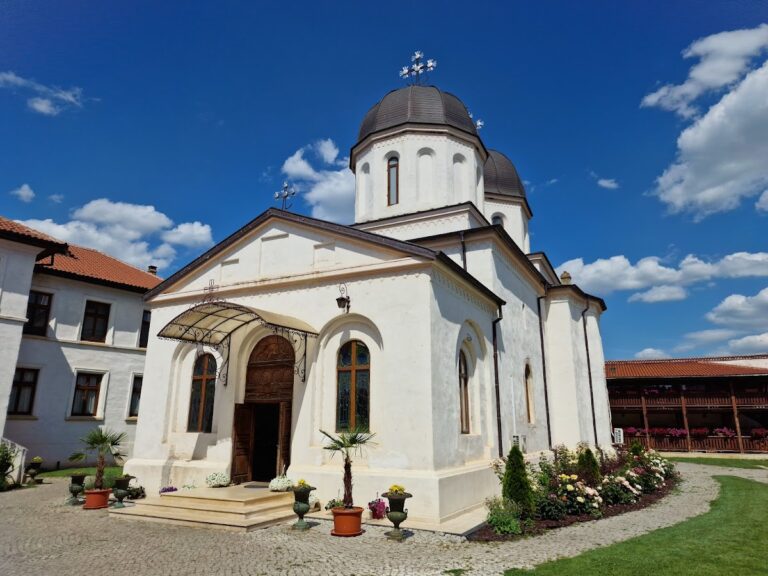
A larger church dedicated to the Transfiguration of the Lord was consecrated at the monastery in 2016. Its interior was completely decorated with frescoes. A memorial sign also stands near the monastery.