Saint Andrew Bobola Church in Wojciechy: A Historic Parish Church in Poland
Site at a Glance
- Rating
- 4.6
- Popularity
- Very Low
- Country
- Poland
- Primary era
- Medieval
- External website
- Open
- Eras represented
- Medieval, Early Modern, Modern
- Civilizations
- Duchy of Prussia, German, Kingdom of Prussia, Polish–Lithuanian Commonwealth, Teutonic Order
- Site type
- Religious
- Remains
- Church
On this page13 sections
History
Saint Andrew Bobola Church in Wojciechy is a historic church in Poland, with origins in a fourteenth-century foundation at the settlement formerly known by its German name, Albrechtsdorf. The present building developed through several phases, reflecting the religious and administrative changes that shaped East Prussia and later northern Poland.
Medieval and Lutheran beginnings
A church stood at Albrechtsdorf during the fourteenth century. It may first have been a modest wooden building erected between 1335 and 1362. Over the next two centuries, a fieldstone church was built, probably using the foundations of the earlier structure.
The Reformation, the sixteenth-century movement that established Protestant churches across much of northern Europe, brought the church into Lutheran use during the 1520s. Clergy initially came from neighboring communities. Gregorius Braun was probably the first resident Protestant pastor, beginning his service at the parish church in 1577.
The Albrechtsdorf parish
Until 1945, the church served as the Protestant parish church of Albrechtsdorf in East Prussia. At different times, the parish belonged to the Peisten inspection and the Landsberg superintendent’s district, within the Preußisch Eylau church district of the East Prussian ecclesiastical province of the Church of the Old Prussian Union. This nineteenth-century Protestant body united Lutheran and Reformed congregations in the Prussian territories.
The parish covered eight places and had 1,227 members in 1925. Baptismal, marriage, and burial registers survive for various periods between 1700 and 1874 and are held by the German Central Office for Genealogy in Leipzig.
Postwar Roman Catholic use
The flight and expulsion of the local population in 1945 ended Protestant parish life at the church. The building then became available for Roman Catholic use and was adapted to Roman Catholic worship.
A Roman Catholic parish was established in Wojciechy in 1962, and the church became its parish church under the patronage of Saint Andrew Bobola, a seventeenth-century Polish Jesuit priest and martyr venerated as a Roman Catholic saint. Before 1945, Albrechtsdorf had no Roman Catholic church and was served from the parish church in Landsberg.
Since 1992, the Roman Catholic parish has belonged to the Archdiocese of Warmia and the Górowo Iławeckie deanery, an administrative subdivision grouping several parishes. Protestant residents of Wojciechy now belong to the parish in Bartoszyce, a filial parish served in association with Saint John’s Church in Kętrzyn within the Masurian Diocese of the Evangelical-Augsburg Church in Poland.
Remains
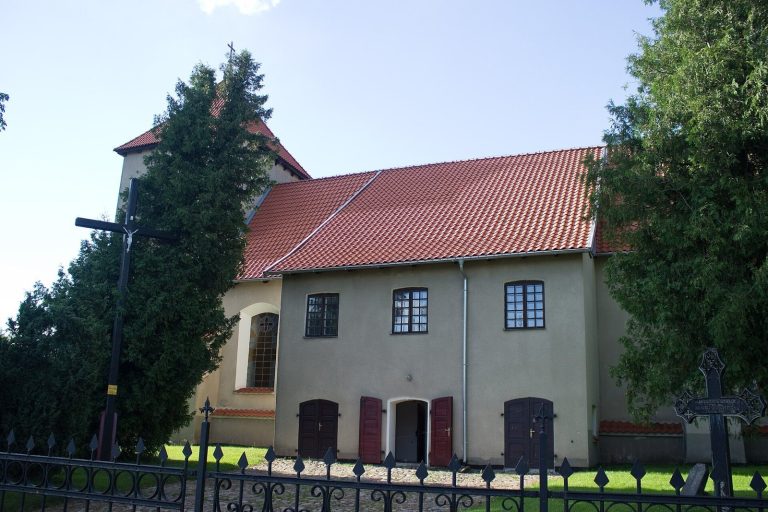
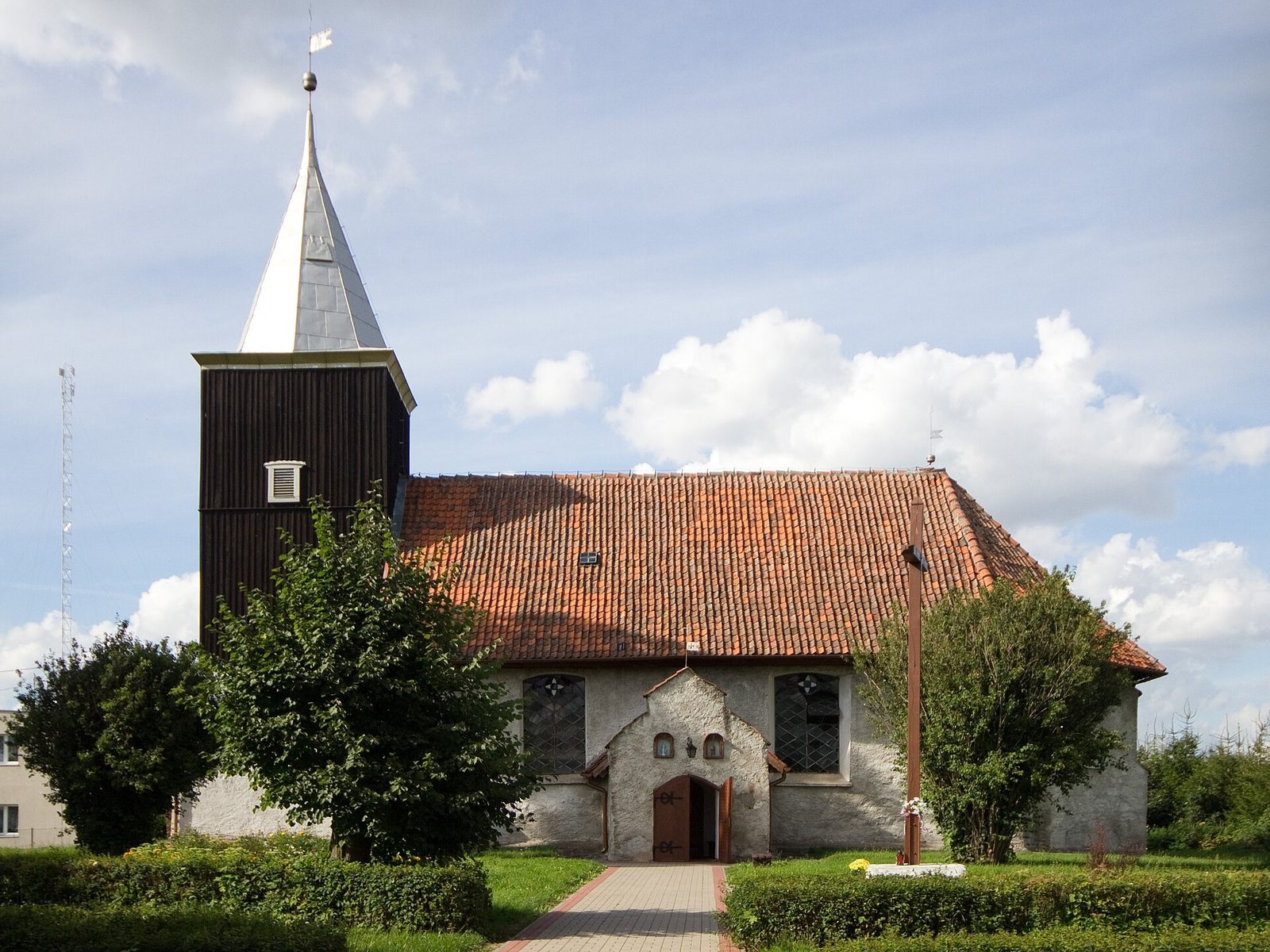
The church stands in the center of Wojciechy on the eastern side of the road to Barciszewo. It is a plastered fieldstone building without a choir, with a western tower that combines a masonry lower section with a wooden upper part and a pyramidal roof. Additions and alterations made between the seventeenth and nineteenth centuries remain part of the building’s present form.
Building and exterior
Main body and later additions
The main body is constructed of fieldstone and has a three-sided termination added in 1656. A south-side entrance hall was added to the nave in 1720, a date indicated by its weather vane. The sacristy, a room used for vestments and liturgical objects, dates from 1869.
Western tower
The western tower has been altered or rebuilt several times. Its recorded changes include work in 1655, 1658, and 1818, as well as interventions at points between 1700 and 1850. The wooden upper section is capped by a pyramidal roof, while a weather vane on the tower bears the date 1751.
Interior furnishings
Altar
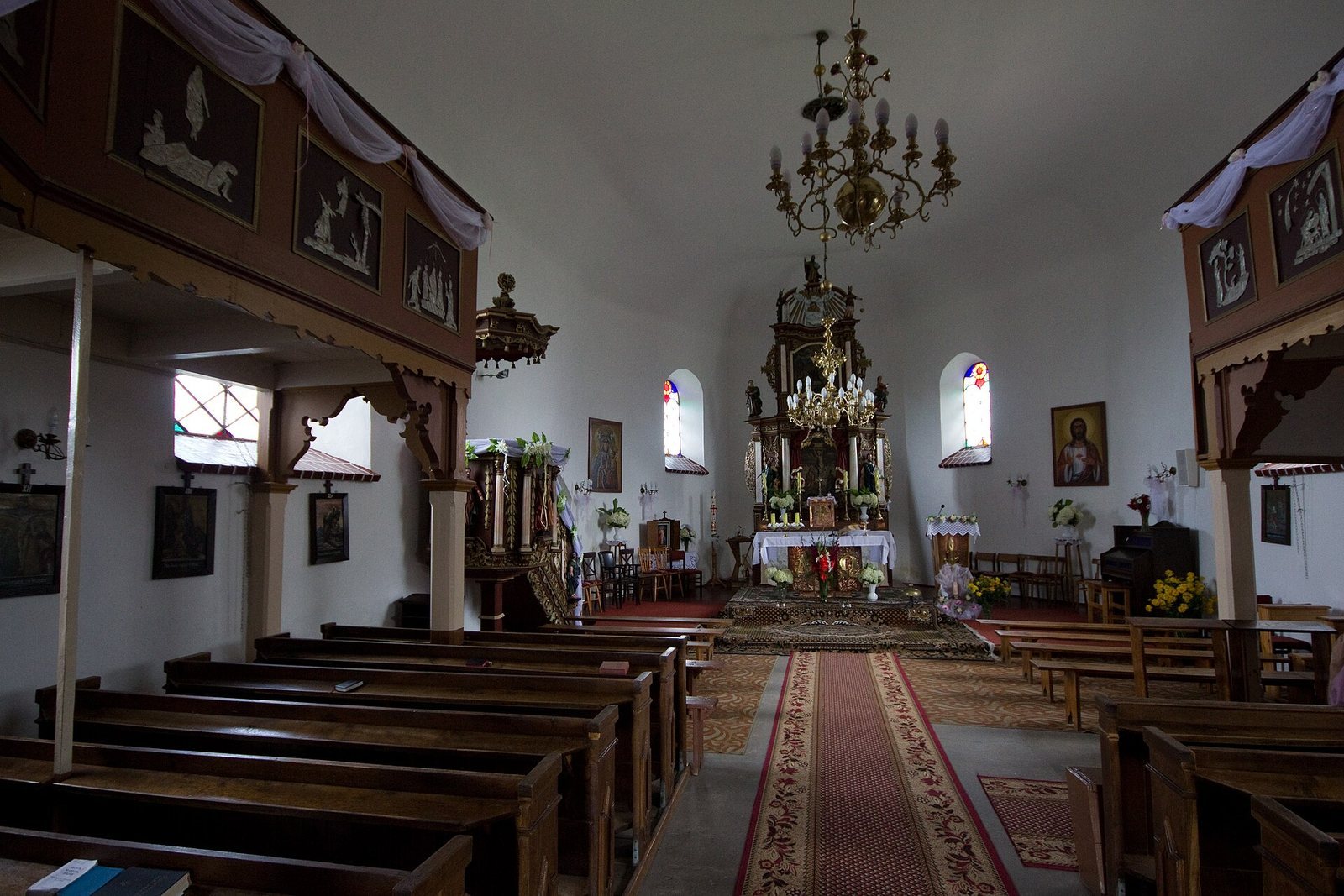
The altar dates from 1725 and was painted and decorated in 1787. Its main level presents the four Evangelists. Above them are figures of God the Father, Moses, and Aaron.
Pulpit and confessional
The carved pulpit and the confessional both date from 1735. The pulpit was probably made in the same workshop as the altar.
Organ
The organ was made in 1877 by August Terletzki, an organ builder from Elbląg.
Patronal seating
Patronal seating, associated historically with a church’s patrons or benefactors, was found with the coats of arms of the von Lehndorff, von Tettau, and von Kreytzen families.
Inside, the church also retains a flat ceiling that was originally painted, adding to the surviving evidence of its successive periods of religious use and interior decoration.