Collegiate Church of St. Secondus: A Roman Catholic Church in Asti


Site at a Glance
- Rating
- 4.6
- Popularity
- Low
- Country
- Italy
- Primary era
- Medieval
- Eras represented
- Medieval, Early Modern
- Civilizations
- Duchy of Milan, Duchy of Savoy, Holy Roman Empire, Kingdom of Sardinia
- Site type
- Religious
- Remains
- Church
On this page23 sections
History
The Collegiate Church of St. Secondus is a Roman Catholic church in Asti, Italy, dedicated to St. Secondus, the Christian martyr and patron saint associated with the city. Tradition places the church on the site of his martyrdom and burial. The present building developed through medieval rebuilding, with a Romanesque character and a construction history that began in 1256.
Early church and relics
The foundation date of the church is unknown. Its earliest surviving mention appears in a legal judgment dated 1 August 880, when Baterico, viscount of Asti under the Supponids, referred to property belonging to the church. The Supponids were a powerful early medieval aristocratic dynasty whose members held territorial and governmental authority in northern Italy.
By 940, St. Secondus had become a parish church located extra muros, meaning outside the settled urban area. It served as a cemetery church. After barbarian incursions in the ninth and tenth centuries, the saint’s body was transferred to the cathedral within the city. The circumstances and date of the transfer are uncertain, although documents from 880 describe the cathedral as dedicated to both Saint Mary of the Assumption and St. Secondus.
Stefano Giuseppe Incisa attributed the transfer to the episcopate of Bishop Bruningo, but this attribution is not certain. Bruningo is also credited with beginning the church’s first major enlargement in the tenth century. After that work, St. Secondus became one of Asti’s three principal centers, alongside the fortified episcopal residence of Castelvecchio and the Cathedral of Saint Mary of the Assumption.
Municipal and collegiate development
From the eleventh century, the church held an important place in Asti’s political life. Episcopal authority did not remove its autonomy, and the church became a gathering point for the commune’s political forces and aspirations. Its surroundings also supported commercial exchange and economic activity, leading to the name San Secondo “of the market.”
As the bishops gradually withdrew from civic affairs, major political and commercial events in Asti took place inside the church or nearby. The presence of the saint’s relics and the concentration of political, demographic, and commercial activity around the site may also have contributed to the establishment of a Lombard ducal court in the area, mentioned in a document of 940. The Lombards were a Germanic people who ruled a kingdom in Italy from the sixth to the eighth century, while a ducal court served as a regional center of political administration.
The church’s institutional role was expressed through its collegiate chapter. A collegiate church is served by a chapter of canons who share responsibility for its liturgical and institutional life. In 1256, the Canons of St. Secondus ordered the construction of the present church. Work proceeded intermittently through the thirteenth century and into the second half of the fourteenth century. The earlier building was largely replaced, although its imposing Romanesque bell tower survived. Construction received support from Popes Alexander IV, Nicholas III, Clement VI, and Eugene IV.
Later enlargement
The building was enlarged in 1440 by the addition of the final bay facing the piazza. The facade was completed in 1462. Later changes continued to shape the interior, including the sixteenth-century lateral doors, the eighteenth-century central portal, and substantial alterations to the presbytery. These successive phases left the church with medieval fabric alongside Renaissance, Baroque, and later elements.
Remains
Plan and exterior
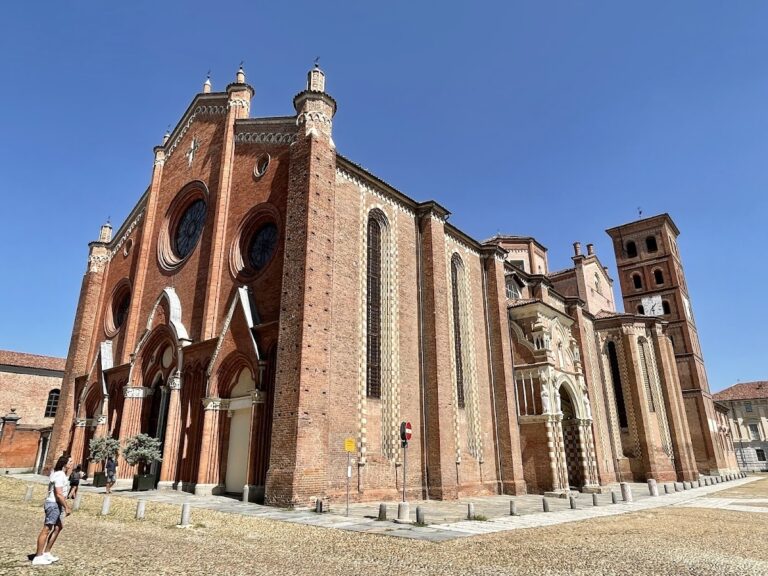
The church has a longitudinal plan divided into three irregular naves, with the central nave larger than the two side naves. The central nave terminates in a pentagonal apse, while the left nave ends in a flat apse and the right nave in a circular one. The facade has three gabled sections in a Romanesque composition. Its central brick rose window incorporates Renaissance elements. The lateral doors date from the sixteenth century, and the central portal was added in the eighteenth century.
Romanesque bell tower
The imposing Romanesque bell tower is the principal surviving element of the earlier church. It predates the construction of the present building and preserves a direct physical link with the structure that preceded it.
Crypt and relic chamber
Early crypt
The crypt preserves the only surviving indication of the church’s pre-Romanesque arrangement. Its oldest section dates from the sixth or seventh century and consists of four columns with capitals imitating Corinthian capitals in two tiers of leaves. The crypt contains the relics of St. Secondus.
Cella confessionis
Two lateral walls and two wrought-iron grilles enclose the cella confessionis, a relic chamber or sacred enclosure associated with the burial place of a martyr. Within it, a sixteenth-century silver reliquary holds the bones of St. Secondus.
Chapel and civic banners
Chapel of St. Secondus
At the rear of the church, beside the right side of the presbytery, stands the Chapel of St. Secondus, a work of Piedmontese Baroque architecture. Golzio frescoed the chapel in 1779. It contains the permanent display of the church’s historic Palii and banners, linking the saint’s cult with Asti’s civic traditions.
Historic Palii
Fifteen historic Palii in the chapel date from 1700 to 1870. They show St. Secondus on horseback and bear the coats of arms of the House of Savoy. In Asti, a Palio is a ceremonial banner awarded in a traditional horse race or civic competition, and the term also refers to banners associated with the city’s Palio tradition.
Seventeenth-century banners
Ten silk banners displayed under glass date from the seventeenth century. They are white and red and depict scenes from the life of St. Secondus. They are described as the oldest banners of Asti.
Paintings and medieval elements
Earlier arches
The first wall of the left nave contains two arches made of brick and sandstone. They belonged to an earlier medieval building and probably formed a passage through the municipal palace.
Nativity panel
The second wall of the left nave holds a sixteenth-century panel by an unknown artist. The painting depicts the Nativity with Saints.
Adoration of the Magi
The third wall of the left nave contains a large polyptych, a painted altarpiece made of several connected panels. Dating from the fifteenth or sixteenth century, it is attributed to Gandolfino d’Asti and depicts the Adoration of the Magi.
Fresco fragments
The lateral chapels contain fragments of frescoes dating from the fourteenth or fifteenth century. One fragment is attributed to the school of the Zavattari.
Madonna of Loreto
The right nave also contains a work by Gandolfino depicting the Madonna of Loreto. It came from Asti’s Church of Loreto and was acquired on the antiquarian market by the Cassa di Risparmio Foundation of Asti.
Presbytery and Palio chariot
Presbytery
The presbytery has been substantially altered over the centuries and retains mainly a seventeenth- and eighteenth-century character. Its furnishings include a carved walnut choir from the seventeenth century and an altar made of black Mondovì marble and red French marble. A statue of St. Secondus stands at the center of the altar.
Palio chariot
The first wall of the right nave contains the chariot used in Asti’s September Palio. It is displayed with a series of modern Palii dating from 1967 onward, donated to the collegiate church during the saint’s feast.