Asti Cathedral: A Gothic Cathedral in Piedmont, Italy


Site at a Glance
- Rating
- 4.6
- Popularity
- Medium
- Country
- Italy
- Primary era
- Medieval
- External website
- Open
- Eras represented
- Medieval, Early Modern
- Civilizations
- Holy Roman Empire, Kingdom of Sardinia
- Site type
- Religious
- Remains
- Cathedral
On this page20 sections
History
Asti Cathedral is the principal Catholic church of Asti, Italy, and the cathedral of the Diocese of Asti. Dedicated to the Assumption of the Virgin Mary and associated with Saint Gotthard, it developed from a fifth- or sixth-century episcopal church into a major Gothic building, with later Baroque and eighteenth-century alterations.
Foundation within the city walls
Tradition connects the cathedral’s establishment with the decision to move Asti’s episcopal church inside the city walls. The new position provided room for a larger congregation and greater protection. The earlier Church of San Secondo stood outside the walls over the crypt of the martyr. The first cathedral was probably built around the fifth or sixth century, perhaps incorporating materials from demolished buildings in the episcopal area. The Church of San Giovanni, one of the surviving buildings in that complex, served as the baptistery.
Around 1070, the earlier cathedral collapsed after a fire reportedly ordered by Adelaide of Susa during disputes with the bishops of Asti. A replacement church was consecrated in 1095 by Pope Urban II, the medieval pope who promoted the First Crusade after the Council of Clermont. Urban was passing through Asti on his return from Clermont.
Medieval Gothic rebuilding
The bell tower began to be rebuilt in 1266 under Jacopo Ghigo, a master mason, meaning a senior medieval building craftsman who directed major masonry work. Reconstruction of the church continued through the late thirteenth and early fourteenth centuries. Local tradition associates its beginning with Bishop Guido of Valperga, who held office from 1295 to 1327, and its completion with his successor, Bishop Arnaldo De Rosette, who remained in office until 1348. De Rosette’s coats of arms decorate the pillars of the central tiburium, a raised tower-like structure over a church crossing.
This rebuilding created a major Gothic church influenced by the French architecture developed under Louis IX and by Angevin traditions in southern France. The cathedral is also regarded as a notable example of Lombard Gothic, the northern Italian form of Gothic architecture that combined pointed arches and vertical emphasis with regional building traditions.
Between the first and second decades of the fourteenth century, the cathedral received its grand southern portal, later known as the Pelletta Portal. The nobleman Gerolamo Pelletta financed moderate additions in the late fifteenth century, including decoration for the portico vault and a relief of the Assumption in the front gable. The portal itself, however, belongs to the earlier medieval development rather than to that later campaign.
Early modern changes
Later interventions altered aspects of the cathedral’s medieval artistic character. Baroque chapels were opened on the north side, while early eighteenth-century decoration led to the partial removal of pointed ribs, the reduction or blocking of some windows, and the plastering and frescoing of the lateral walls. Francesco Fabbrica, Pietro Antonio Pozzi, and the Bolognese painter Bocca decorated the vaults with biblical scenes and allegories of religious orders.
The cathedral’s connection with Saint Gotthard also became institutionally established. In 1641, property belonging to the cathedral chapter was assigned to provide a permanent income for a priest responsible for pastoral care associated with the Chapel of Saint Gotthard. The chapel was subsequently united with the title of Santa Maria Assunta of the cathedral. Saint Bruno of Asti, a Benedictine abbot and theologian who later became Bishop of Segni, had introduced the cult of Saint Gotthard to Asti.
Eighteenth-century remodelling
In 1764, architect Bernardo Antonio Vittone enlarged the eastern end under Bishop Paolo Maurizio Caissotti. The project had begun about fifty years earlier under Bishop Innocenzo Milliavacca. Vittone moved the choir farther back, enlarged it, added two lateral apses and three new vault arches, and installed a monumental high altar. In 1767, Carlo Innocenzo Carloni of Scaria, working with Rocco Comanedi of Cima, frescoed the remodelled area with scenes from the lives of Christ and the Virgin, episodes involving Saints Marziano and Secondo, and sacred allegories.
The cathedral’s patronal celebrations were historically elaborate. Platforms were erected for singers and musicians who came from other parishes and cities. Asti Cathedral remains an active cathedral and is recognized as one of Piedmont’s largest churches as well as a major expression of regional Gothic architecture.
Remains
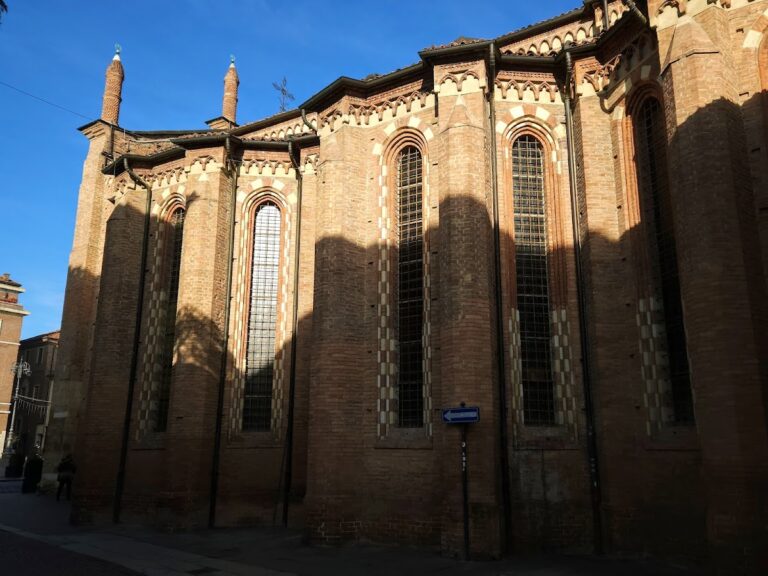
Asti Cathedral is a three-aisled church approximately 82 metres long, with a stated height and width of 24 metres. Its Gothic design emphasizes height through pointed arches and strong vertical lines. The south side brings together the Romanesque-style bell tower, tall single-light windows framed alternately in sandstone and brick, the lantern tower, and the Pelletta Portico. The facade contains three rose windows, two oculi, or circular windows, above them, and a cruciform window.
Medieval exterior
Bell tower
The Romanesque bell tower belongs to the rebuilding begun in 1266. It originally had seven storeys and an octagonal spire. Later changes reduced it by one storey, and the tower was altered again in the eighteenth century. Its surviving bells form a set of nine.
Pelletta Portal and portico
The Pelletta Portal has statues of saints in its corner sections, including Jerome, Peter, Paul, and Blaise, generally dated to the late fifteenth century. The portico vault carries Gerolamo Pelletta’s coat of arms, while the front gable contains a bas-relief of the Assumption of the Virgin. A marble statue of the Assumption, surrounded by six winged angel heads, was installed in 1470 as part of the Pelletta embellishment campaign. It stands above the cathedral square.
Earlier eastern structure
A substantial earlier building was incorporated into the fourteenth-century cathedral and reused as its apse, the rounded eastern end of a church. It has been interpreted as either the presbytery, the area reserved for the clergy and altar, of the preceding Romanesque cathedral or a separate church within the episcopal complex. The structure is divided into three vaulted aisles, carries important devotional wall paintings, and is substantially lower than the Gothic building.
Eighteenth-century interior
Choir and presbytery
Vittone’s remodelling gave the eastern end its enlarged choir and presbytery, added two lateral apses and three vault arches, and created the setting for the monumental central altar. Carloni and Comanedi’s frescoes cover the remodelled area with scenes from the lives of Christ and the Virgin, episodes of Saints Marziano and Secondo, and sacred allegories.
Chapel of the Epiphany
The Chapel of the Epiphany was decorated by the Astigian painter Gian Carlo Aliberti. Its altar contains a gilded copper statue of the Assumption by the Astigian sculptor Giovanni Groppa.
Paintings and sculpture
Works by Gandolfino da Roreto
The cathedral preserves paintings by Gandolfino da Roreto, a local Renaissance artist active there from the late fifteenth century until 1530. His Marriage of the Virgin, commissioned by the Alfieri bankers, dates to the early sixteenth century. His Genealogy of the Virgin is in the Chapel of Saint Philip Neri, while the Madonna of the Banker, dated 1516, portrays the kneeling patron Oberto Solaro. A Deposition is located in the ante-sacristy.
Other devotional works
The Resurrection, dated broadly to the sixteenth or seventeenth century, is by Guglielmo Caccia, known as Il Moncalvo. The cathedral also contains an early sixteenth-century polychrome terracotta group representing the Lamentation over the Dead Christ. Eight figures surround Christ, who lies dead at the centre. The Virgin is supported by Saint John and Mary of Cleophas, while Mary Magdalene, Mary Salome, Nicodemus, and Joseph of Arimathea complete the composition. The group came from the former Chapel of the Ascension.
Choir, organs, and cloister
Wooden choir
The present wooden choir was made by the Astigian master Salario of Moncalvo. It replaced an earlier choir made in 1477 by the Pavian sculptor Baldino da Surso. Baldino’s earlier work is now in the cathedral diocesan museum’s San Giovanni area.
Organs
The Serassi brothers of Bergamo built the cathedral organ in 1844, replacing the instrument made by Liborio Grisanti in 1768 for the south tribune. Grisanti’s disused and severely deteriorated organ was restored and inaugurated in 2010. The two instruments form a rare pair of tuned organs designed to be played together.
Cloister remains
Ruins of a cloister survive within the cathedral complex, preserving part of the buildings associated with the cathedral’s wider episcopal setting.
Nearby sites