Kviteseid Old Church: A Medieval Romanesque Parish Church in Norway
Site at a Glance
- Rating
- 4.8
- Popularity
- Very Low
- Country
- Norway
- Primary era
- Medieval
- External website
- Open
- Eras represented
- Medieval, Early Modern, Modern
- Civilizations
- Denmark–Norway, Norwegian
- Site type
- Religious
- Remains
- Church
On this page15 sections
History
Kviteseid Old Church is a medieval Romanesque stone church in Norway, built over several years during the Middle Ages and serving as the main parish church of Øvre Telemark for about 700 years. Its Romanesque architecture, characterized by massive masonry and thick walls, belongs to a period when churches were constructed with substantial stone volumes and simple rounded forms. The exact construction date is uncertain. Architectural comparisons have suggested origins as early as the tenth century, while the broader building period may have extended from about 1150 to 1260. Tree-ring dating places the roof timbers around 1260, showing that at least part of the church was complete by then, although construction of the stone building probably began earlier.
Medieval church and deanery centre
The church was originally Catholic and was historically associated with St. Olav, the medieval Norwegian king Olaf II Haraldsson, later venerated as Norway’s principal national saint. The dedication to him is possible, but it is not documented as certain. For long periods, Kviteseid was the religious centre of the Øvre Telemark deanery, an ecclesiastical district overseen by a senior cleric called a provost. The parish priest of Kviteseid was often also the deanery’s provost. Kviteseid Old Church is one of the two surviving former main churches of Øvre Telemark, the other being Seljord Church.
In 1595, the southern part of the building reportedly collapsed despite its massive walls. It was rebuilt soon afterward, adding a major episode of repair and reconstruction to the church’s long medieval history. Several former parish priests, including provost Peder Povelsson Paus, were later buried beneath the church floor. Paus served as parish priest from 1633 to 1653 and was buried at the head of the choir. His son, Povel Pedersson Paus, wrote a Latin commemorative poem that hung in the church for more than two hundred years. The original poem is now held in the manuscript collection of the National Library.
Ownership and civic role
In 1723, King Frederik IV sold the church to the widow of Christen Thomesen. The sale formed part of the disposal of Norwegian churches after the state treasury had been depleted by the Great Northern War, a major European conflict of the early eighteenth century. By 1784, the church was recorded as belonging to the local community, indicating that the congregation had regained control.
Kviteseid parish also took part in the political changes of 1814. The church served as an election church, meaning that it was used as a polling place in the elections connected with Norway’s Constituent Assembly. The parish first elected electors, who then helped choose representatives to the assembly at Eidsvoll, where Norway’s constitutional settlement was prepared.
Relocation of the parish and later restoration
During the late nineteenth and early twentieth centuries, plans developed to move the parish church to the village of Kviteseid and to construct a new church at Fjågesund for the eastern part of the parish. The new Kviteseid Church was built in 1915–1916 and consecrated on 18 June 1916. Fjågesund Church was consecrated the following day. Kviteseid Old Church then closed and remained unused for several decades.
The building was carefully restored in 1929 and again in 1969. These campaigns removed later whitewash and brought older painted decoration and drawings back into view. The church is now an active parish church of the Church of Norway within the Agder og Telemark Diocese and the Øvre Telemark Deanery. It is automatically protected as a Norwegian cultural-heritage site.
Remains
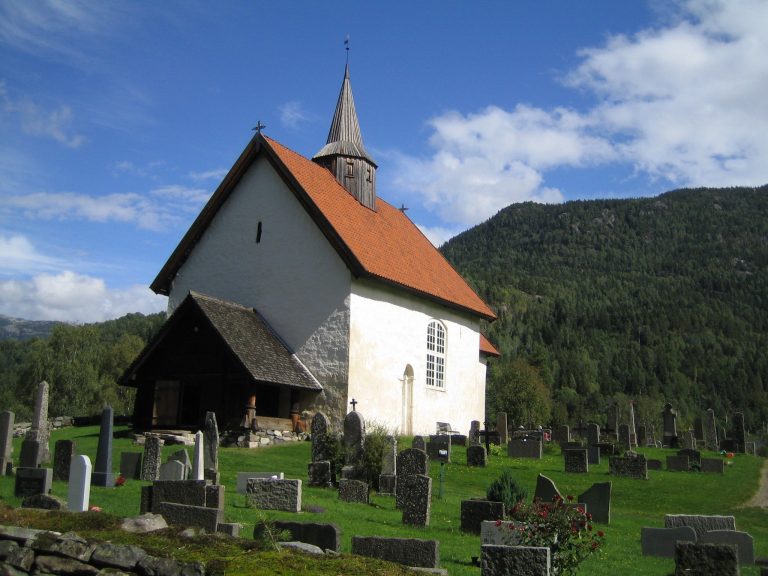
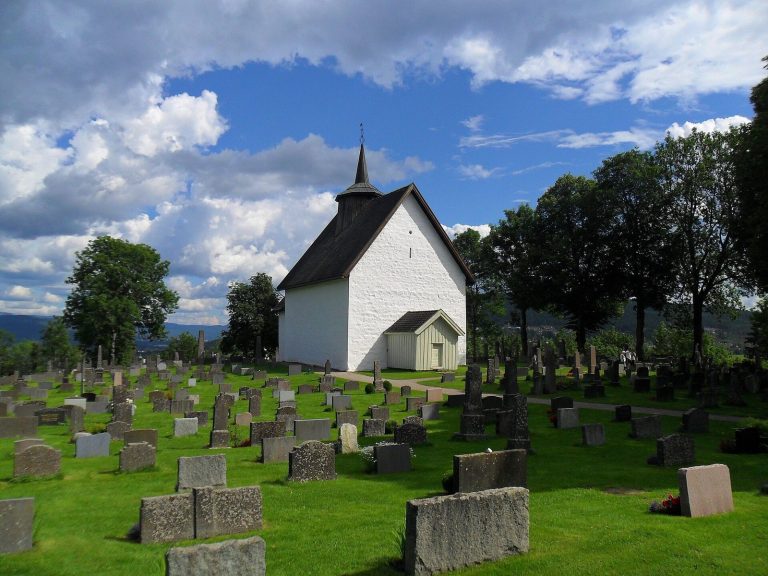
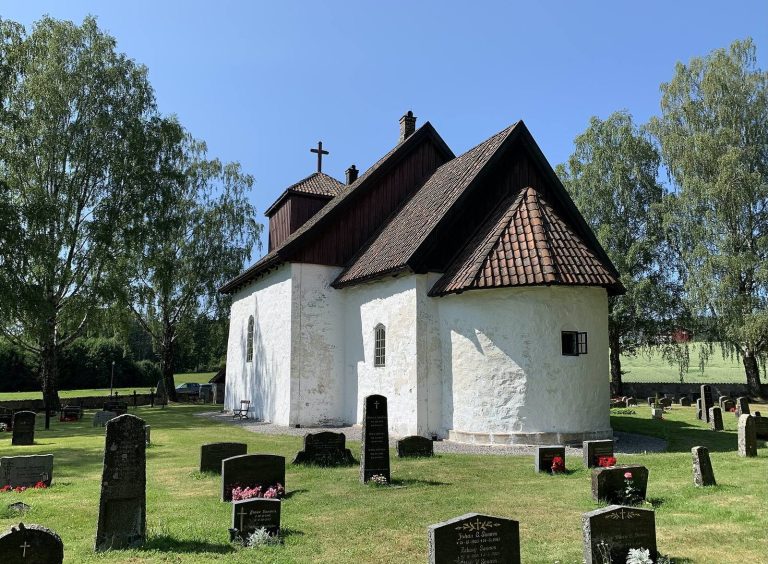
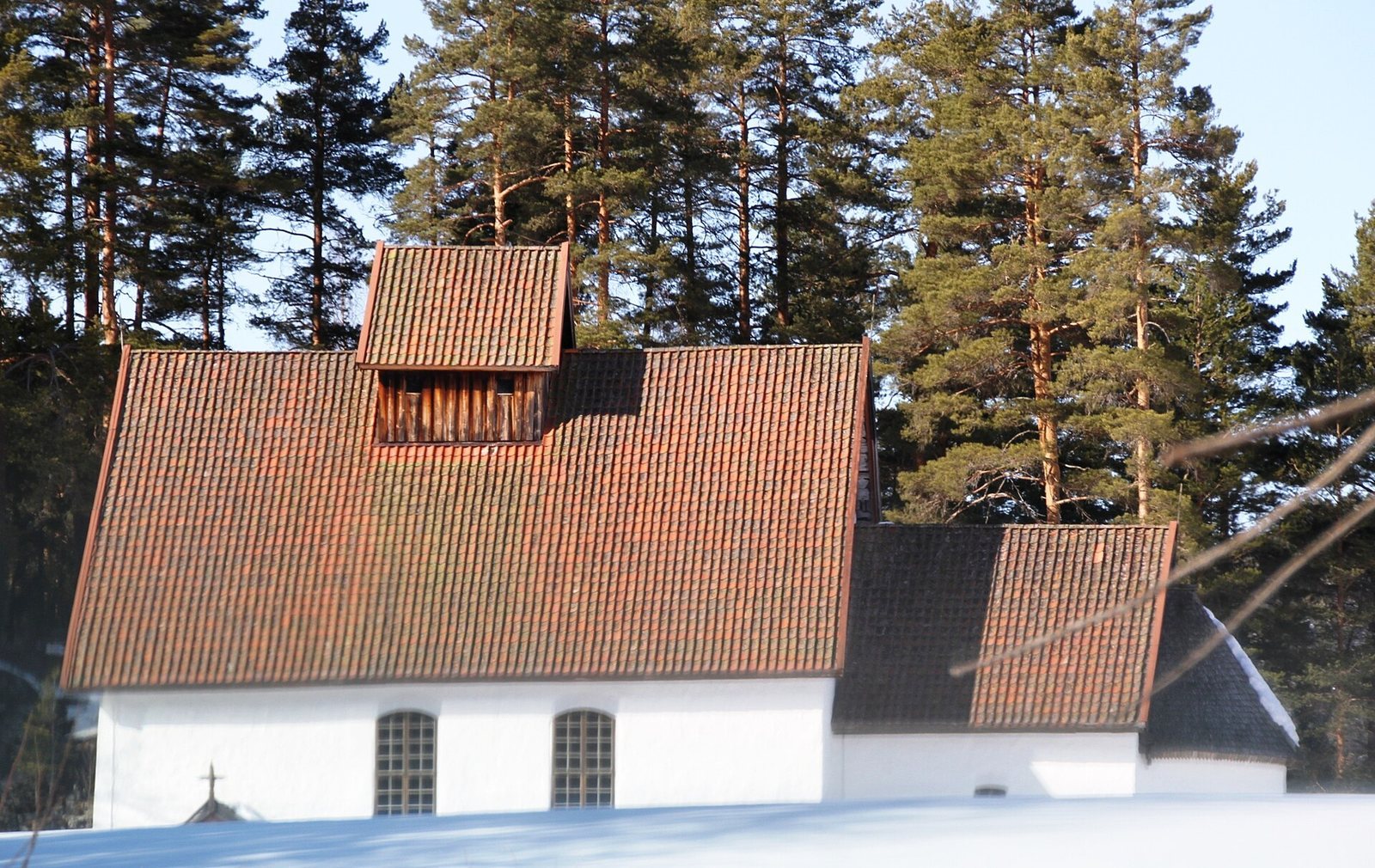
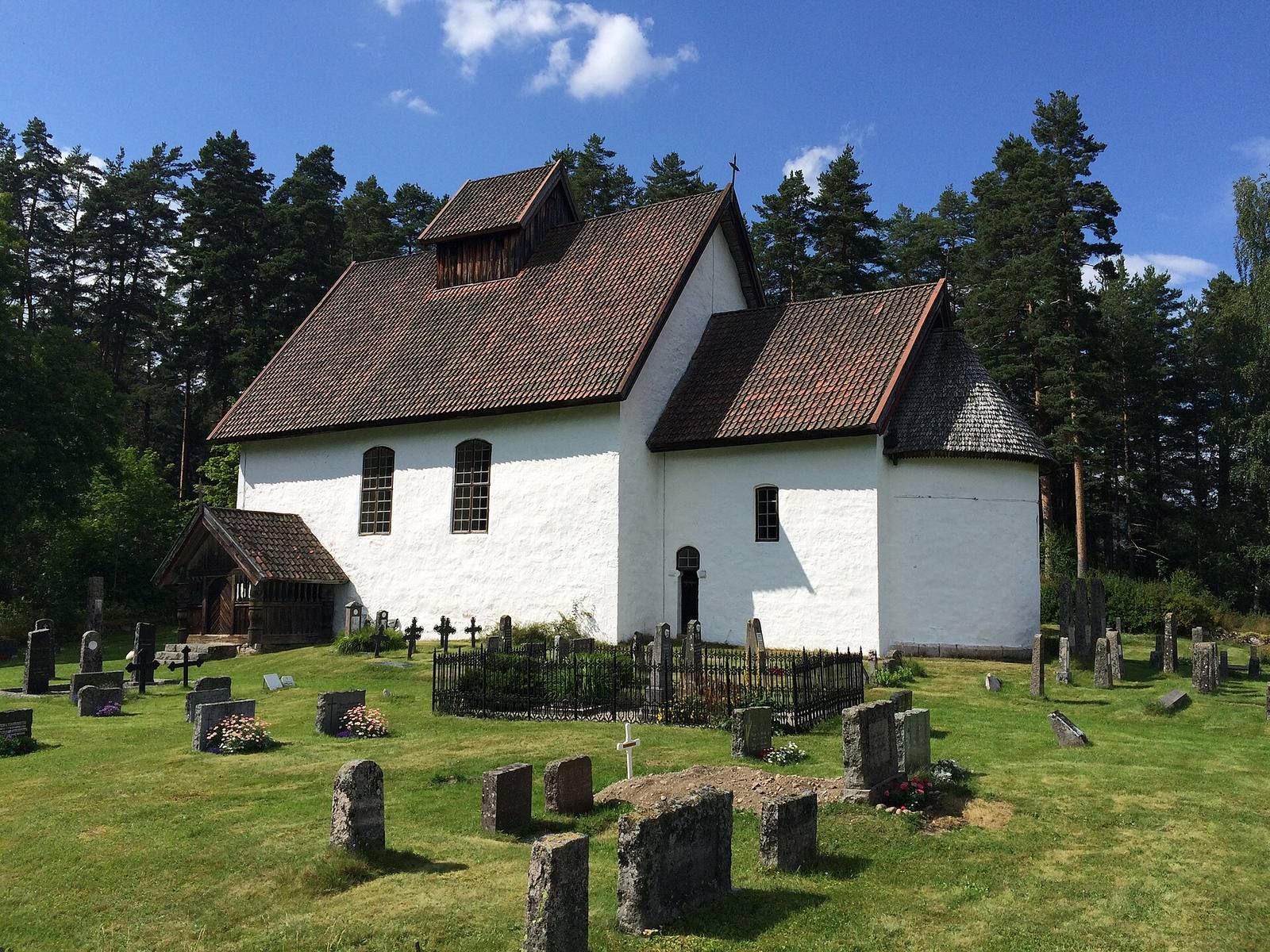
Kviteseid Old Church is a white Romanesque long church beside Kviteseidvatnet, near the northern end of the lake and next to Kviteseid open-air museum. Its position beside the water was useful when waterways were the municipality’s principal transport routes. The building has a rectangular nave, a narrower and lower rectangular choir, and a semicircular apse, the rounded eastern end of the church. It follows the traditional east–west orientation. The exterior walls are approximately 1.5 metres thick, and the building provides seating for about 150 people.
Exterior and entrances
South portal
The western wall was replaced at an uncertain date, and a window was installed there in place of a door. Because the ground falls steeply on the western side, the principal entrance is through the south portal. Two half-columns flank the portal, which is covered by an inserted wooden arch carved with a dragon motif. An iron ring on the door is linked with a local legend that the end of the world will come when the ring has been worn away.
Roof turret and windows
A small roof turret near the middle of the main roof contains a bell cast in 1857. Its inscription speaks of praise of the Lord, divine help in suffering, and consolation in life and death. A porch was added in front of the south portal during the eighteenth century. The roof turret and the greatly enlarged windows in the south wall date from the nineteenth century. The north wall has no windows.
Interior decoration and furnishings
Choir paintings
The choir originally had an open-rafter roof, but this was replaced by a flat ceiling in 1713–1714. During the same period, Thomas Blix painted decorative rose painting, a Norwegian tradition of stylized floral and leafy patterns, on the interior walls. Foliage ornaments covered the choir ceiling, while floral vines were painted along its sides.
The restorations of 1929 and 1969 removed nineteenth-century whitewash. Beneath it were older examples of rose painting, thirteenth-century crosses, and frescoes in the choir showing animals, ships, and soldiers. Inscriptions probably dating from the sixteenth and seventeenth centuries also became visible. In 1969, further whitewash was removed from the apse and choir, revealing numerous older drawings. A small former window in the apse was discovered and reinstalled.
Royal portraits
Eleven paintings of the first kings of the Oldenburg dynasty date from around 1750. The Oldenburgs supplied the monarchs of Denmark-Norway during the period represented by the portraits. The paintings were formerly displayed in the choir, but the 1969 restoration moved them to the west and north walls of the nave.
Font and altarpiece
A seventeenth-century wooden baptismal font has an hourglass form and carved ornament. The church received a new altarpiece in 1732. Its altar painting, dated 1777, depicts the Last Supper and the Crucifixion. Two pairs of Corinthian columns, a classical form with leaf-decorated capitals, frame the painting. An inscription at the base states that Halvord Grod made the decorated altarpiece by royal commission on 9 February 1732.
Burials and sacred traditions
Burials beneath the church and in the cemetery
The church floor covers the burials of historically prominent members of the parish, including several parish priests and provosts. Peder Povelsson Paus lies at the head of the choir. The church cemetery contains the grave of the poet Jens Zetlitz.
St. Olav’s Bread
A smooth, rounded stone known as “St. Olav’s Bread” or the “Tear Stone” is set in a recess in the choir wall. One tradition tells of a Norwegian servant forced by an evil count in Denmark to bake bread on the feast day commemorating St. Olav’s death. After she threatened to stop believing in the saint unless the deed was avenged, the bread supposedly turned to stone.
Another tradition treats the stone as a sacred relic from pre-Christian times. It says that the stone once fell from a chest in the parsonage and killed a boy, whose embalmed body is supposedly buried beneath the altar. These traditions form part of the church’s accumulated religious and local memory, alongside its medieval fabric, later decoration, and long association with the Kviteseid parish.