Sankt Ulrich: A Romanesque Church in Paderborn
Site at a Glance
- Rating
- 4.7
- Popularity
- Very Low
- Country
- Germany
- Primary era
- Medieval
- External website
- Open
- Eras represented
- Medieval, Early Modern, Modern
- Civilizations
- Holy Roman Empire
- Site type
- Religious
- Remains
- Church
On this page12 sections
History
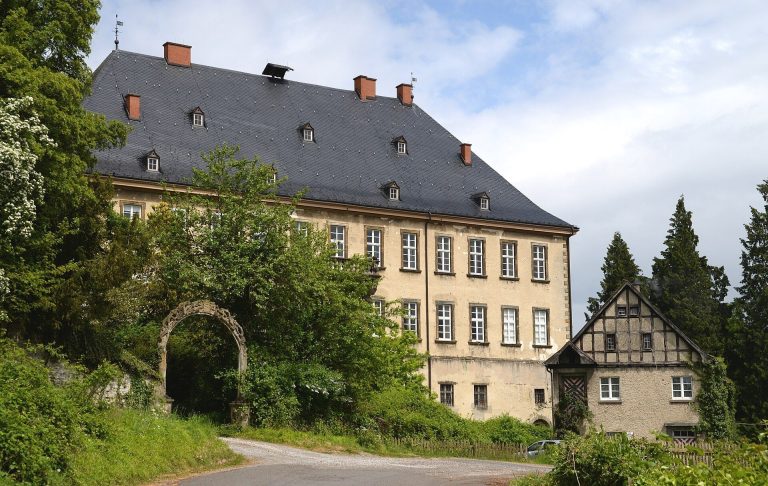
Sankt Ulrich is a Roman Catholic church in Paderborn, Germany, built by the medieval Christian community of the city in the late twelfth-century Romanesque period. It stands on Market or Cathedral Square opposite Paderborn Cathedral and is also known as Gaukirche, Gokirche, Gokerken, or ecclesia rurens, meaning “rural church.” Its predecessor served the population of the Pader district from the tenth century, separately from the episcopal cathedral.
Medieval origins and convent use
The origins of the church are uncertain, but the existing building is generally dated to around 1170–1180, or more broadly to the late twelfth century. This dating rests on stylistic comparison rather than surviving documentary evidence. In 1229, Hermann von Waldeck founded a Cistercian nunnery on the adjacent Sternberger Hof, the administrative center of the Hochstift, an ecclesiastical territory ruled by a prince-bishop. Nuns from Münster formed the first community. Sankt Ulrich became the convent church in 1231, and Bishop Bernhard IV confirmed this status in 1232.
Two chapels were added during the fourteenth century. The Ursulakapelle was built on the north side, while the Kreuzkapelle was placed on the south. Around 1500–1515, Benedictine nuns took over the convent, bringing the church into a new monastic tradition based on the Rule of Saint Benedict.
Baroque transformation
During the Baroque period, Prince-Bishop Clemens August commissioned a comprehensive redesign of the church and convent. The work was carried out by the architect Franz Christoph Nagel, whose intervention gave the complex important Baroque features while the underlying church remained fundamentally Romanesque. In 1787, the sharply pointed tower roof was shortened and replaced with a hood roof.
Secularization, restoration, and war damage
The annexation of the Prince-Bishopric of Paderborn by Prussia in 1802–1803 ended the convent’s existence in political terms. Its secularization, meaning the transfer of the religious institution into secular control, took place in 1810 under the Napoleonic Kingdom of Westphalia.
Between 1883 and 1887, Sankt Ulrich underwent extensive restoration. Baroque furnishings were removed, and Neo-Gothic and historicizing elements were introduced in a process described as “purification.” The Baroque altar was sold to the city of Münster in 1903 and remains in the Dominican church there. Later attempts by the archdiocese to recover it were abandoned.
In 1938, most of the Neo-Gothic additions were removed. During this work, remains of thirteenth-century wall painting were found beneath layers of whitewash. Air raids heavily damaged the church in 1945. Reconstruction began in 1947 and continued for an extended period, producing a rebuilt tower with a lower spire than its predecessor. Since the reconstruction, Sankt Ulrich has served as a parish church. After an almost two-year renovation, it reopened on 6 May 2018. The church is listed as immovable cultural heritage in North Rhine-Westphalia.
Remains
Layout and exterior
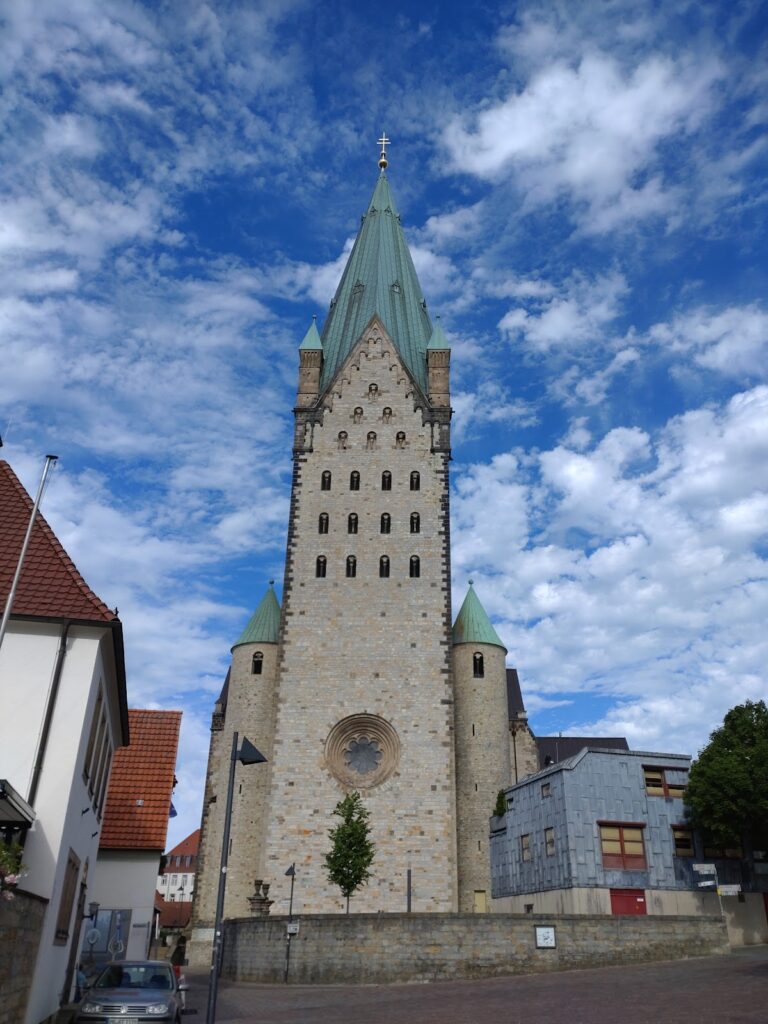
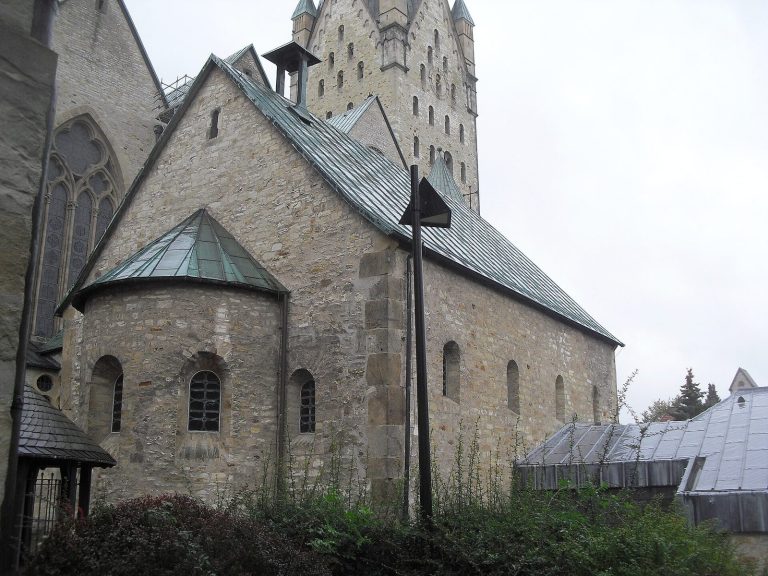
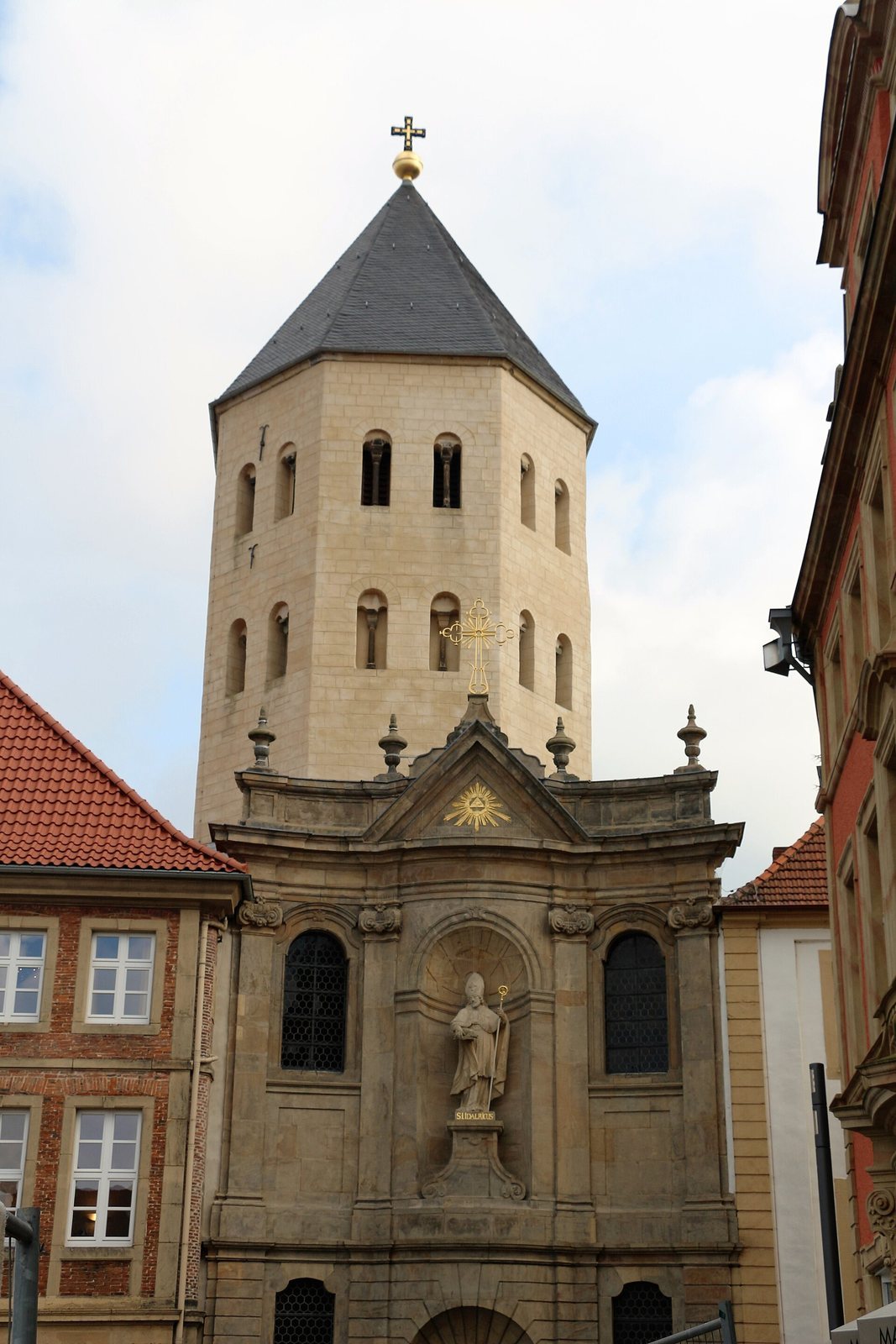
Sankt Ulrich is a three-aisled, vaulted pillar basilica, meaning that a central nave and two side aisles are divided by substantial supporting pillars. Its fundamentally Romanesque construction is expressed in heavy masonry and a largely austere exterior faced with rough limestone. An octagonal tower rises above the western bay of the central nave.
The building stands free along the eastern south side, the east side, and at the western and northern entrances. Elsewhere, adjoining buildings directly enclose it. Part of the former Gaukirch convent survives along the south side and was also remodeled by Nagel. On the west, the entrance from the Market side passes through a Baroque gateway designed by Nagel. This gateway façade has been characterized as one of the finest Baroque façades in Westphalia.
Chapels and furnishings
Ursulakapelle
The Ursulakapelle on the north side contains an altarpiece from 1675. Its Baroque painting depicts the Flagellation of Christ, although that painting was not part of the altarpiece’s original contents.
Liturgical furnishings
The communion benches date from the eighteenth century. The sandstone baptismal font is probably the work of the Paderborn court sculptor Johann Jakob Pütt and also dates from the eighteenth century. Its baptismal screen bears the year 1740.
Sacrament niche
A sandstone sacrament niche from the second half of the fifteenth century is framed in the same material. Its figures are Neo-Gothic, and its enamel doors date from 1938.
Sculpture and altarpieces
A forked walnut crucifix was probably created in the first quarter of the fourteenth century and later received a Late Gothic polychrome finish. A sandstone standing Madonna dates from around 1420 and has a renewed painted finish. A second standing Madonna, made around 1700, is attributed to the Paderborn Baroque sculptor Gertrud Gröninger.
The church also contains an altarpiece with scenes from the life of Mary, made by Anton Hellwig in 1894, and a Crucifixion group produced by Anton Mormann in 1903.
Bells
Sankt Ulrich has four bells tuned to the bell ensemble of Paderborn Cathedral. Their sound follows the Salve Regina motif.