Nonnberg Abbey: Salzburg’s Benedictine Women’s Monastery


Site at a Glance
- Rating
- 4.5
- Popularity
- Medium
- Country
- Austria
- Primary era
- Medieval
- External website
- Open
- Eras represented
- Classical, Medieval, Modern
- Civilizations
- Holy Roman Empire, Roman
- Site type
- Religious
- Remains
- Monastery
On this page12 sections
History
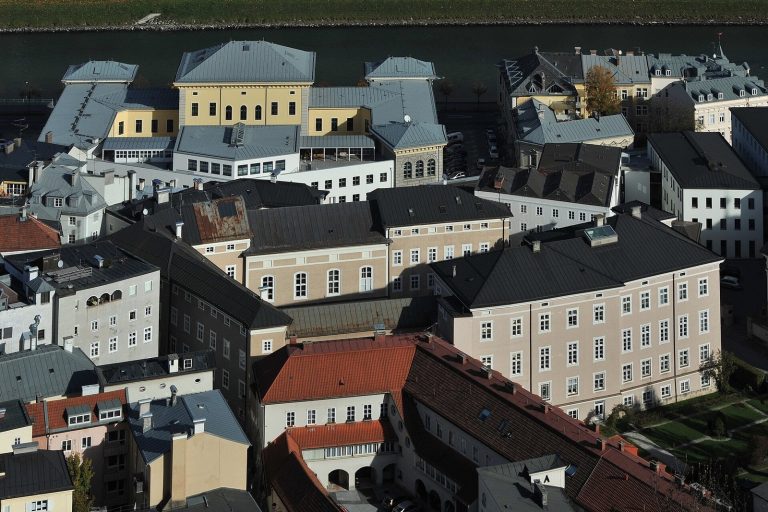
Nonnberg Abbey is a Benedictine women’s monastery in Salzburg, Austria, founded by Saint Rupert of Salzburg in the early eighth century, around 711–712. Built on a terrace beneath Festungsberg, it is described as the world’s oldest continuously existing Christian women’s monastery and the oldest continuously existing nunnery in the German-speaking world. Its buildings developed through Romanesque and Gothic phases, while the community has maintained an uninterrupted tradition of religious life.
Foundation and Early Endowment
Saint Rupert, a Christian missionary and bishop traditionally associated with the foundation of Salzburg’s ecclesiastical institutions, established the monastery on a defensible terrace below Festungsberg. The site occupied surviving parts of the Roman fortifications of Iuvavum, identified as the castrum superior, or upper fortress. Its position connected the new monastery with the earlier fortified landscape of Salzburg.
Erentrudis of Salzburg, a relative of Rupert who may have been his niece or sister, became Nonnberg’s first abbess. A Bavarian Agilolfing duke, a ruler from the early medieval Bavarian dynasty, endowed the abbey and approved her installation. The connection with the Agilolfings continued among the early leadership of the community. Seven of the twelve abbesses who died before 784 had names suggesting links with the dynasty.
Nonnberg was once extensively endowed with land and dependent institutions. In the early Middle Ages, its possessions included the Nonntal, whose church had formerly depended on the monastery, and territory between the Salzach and Leopoldskron Moor south of Salzburg. This estate included Morzg and houses in Kleingmain and Gneis. From the fifteenth century, farming families began settling on these lands and no longer worked for the abbey.
Institutional Development
The abbey became independent of its founding house in 987. Its possessions were later enlarged by Emperor Henry II, who was also Duke of Bavaria. Henry and his wife, Cunigunde of Luxembourg, supported the rebuilding of Nonnberg’s church after an early fire and attended its consecration.
Admission to the community was restricted to women of the nobility until 1451. As the feudal system declined, women from the bourgeoisie could also enter, although until the nineteenth century they were admitted only as lay sisters. The requirement that members be noble was abolished in 1848.
In the early twelfth century, Archbishop Conrad I of Salzburg reorganized and renewed the archdiocese and implemented the Benedictine Rule at Nonnberg. This monastic code, attributed to Saint Benedict of Nursia, regulates communal prayer, work, discipline, and daily life. The nuns’ routine is structured around the Liturgy of the Hours, the cycle of Christian prayers recited or sung at set times throughout the day.
Fires, Rebuilding, and Later Continuity
A fire around 1006 destroyed the first abbey church. A replacement dedicated to the Assumption of Mary was completed in 1009 with substantial support from Henry II. Its crypt was consecrated in 1043. The church was largely destroyed again by a major fire in 1423 and rebuilt between 1464 and 1509 in a late Gothic form. Three side chapels were added in 1624, and the church was refurbished in the Baroque style during the 1880s.
The community continues to be led by abbesses. On 20 July 2017, the convent chapter, presided over by Archbishop Franz Lackner, elected the former prioress Veronika Kronlachner as abbess and as the ninety-second successor of Erentrudis. Lackner consecrated her as abbess in the abbey church on 13 August 2017.
Nonnberg and The Sound of Music
Maria Augusta von Trapp worked as an educator at the abbey school after the First World War. She entered Nonnberg as a postulant in 1924, during the abbacy of Virgilia Lütz. Her life later became the basis for The Sound of Music, and some scenes from the film were shot at the abbey.
The abbey complex, including its enclosing walls and areas with archaeological potential, is protected under Austrian monument law. It also forms part of the Historic Centre of the City of Salzburg, which has been a UNESCO World Heritage Site since 1996.
Remains
Nonnberg Abbey occupies a terrace below Festungsberg, within or beside surviving Roman fortifications associated with ancient Iuvavum. The complex combines substantial Romanesque masonry with later Gothic structures and additions. The surviving church, chapels, enclosing walls, decorated interiors, manuscripts, and liturgical objects preserve evidence of the monastery’s long architectural and religious development.
Church and Gate Structures
Abbey Church
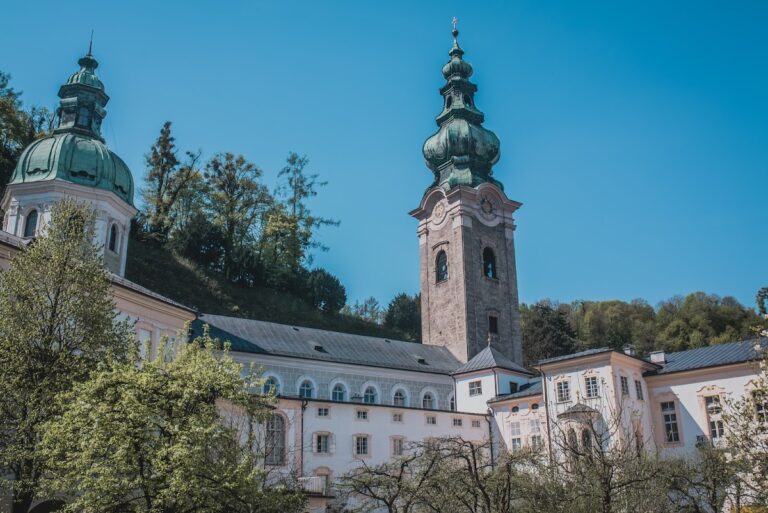
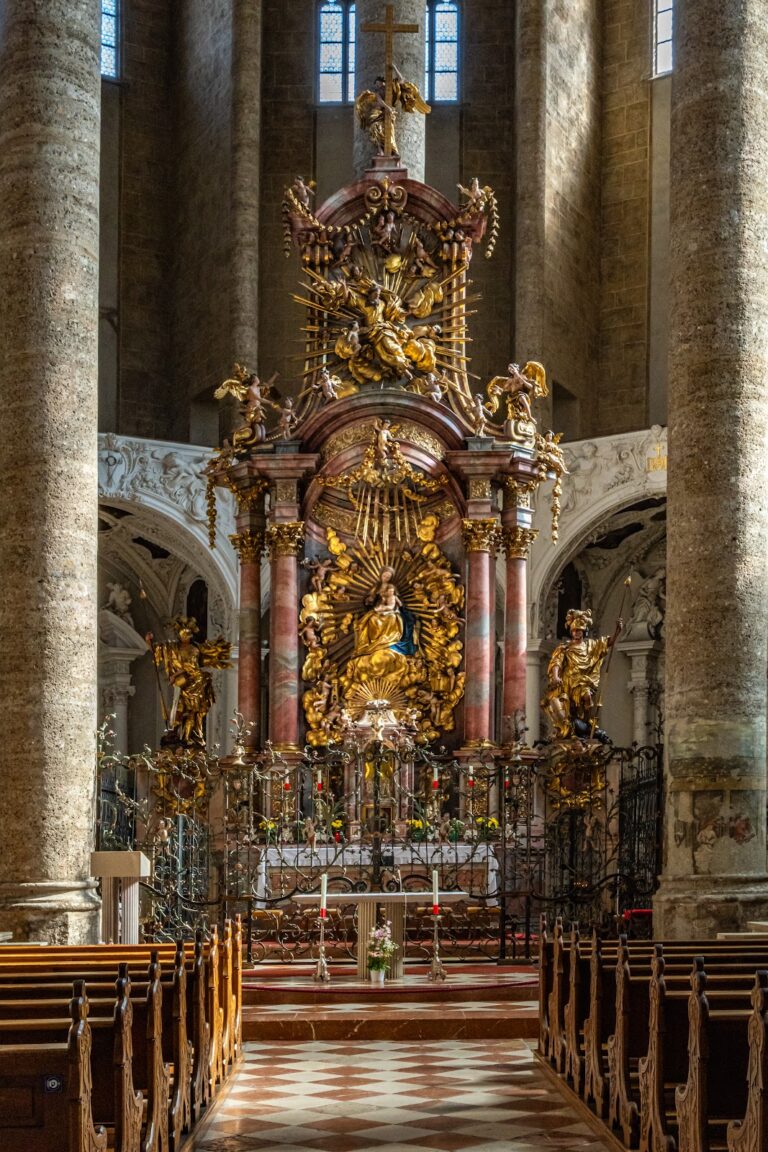
The abbey church rebuilt after the fire around 1006 retains several Romanesque elements. These include the massive church tower, parts of the portal, and the space known as the “Paradise,” situated beneath the nuns’ choir. The Paradise contains frescoes made around 1140 in twelve niches, showing busts of popes, bishops, and saints. The tower was heightened in 1711 and received its present onion dome.
Behind the altar, the central Gothic stained-glass window dates from 1480 and was donated by the mayor Augustin Clanner. The late Gothic altar, with Neo-Gothic additions, came from the former dependent church at Scheffau am Tennengebirge. Together, these features reflect the church’s medieval construction and later phases of alteration and furnishing.
Saint John’s Chapel
Saint John’s Chapel stands beside and above the inner Nonnberg Gate. Built between 1448 and 1451, it has a net-ribbed vault and was slightly altered before 1500. Its stained-glass windows were made by Ludwine Wildner-Eltz in 1957. Access to the chapel is permitted only with the monastery’s authorization.
A Saint John’s dish from the middle of the sixteenth century stands on a console in the chapel. The altar is undated but was probably created in 1498 for a chapel in Salzburg Cathedral. After the Romanesque cathedral was demolished before 1600, the altar probably passed into private hands before eventually reaching Nonnberg. It has stood in Saint John’s Chapel since 1885 and is attributed to Veit Stoss or one of his assistants, although the attribution remains expressed as a possibility.
Manuscripts and Sacred Objects
Medieval Manuscripts and Art
The monastery houses a collection of medieval manuscripts, Gothic figures, and paintings, with particular emphasis on late Gothic altarpieces. About 195 manuscripts dating from the fourteenth to the eighteenth century have been microfilmed by the Hill Museum and Manuscript Library. These holdings form part of the material preserved within the convent alongside its historic buildings.
Abbess’s Liturgical Insignia
The abbey also preserves a faldistorium, a ceremonial folding seat used by an abbess or bishop. Made after 1100, it is decorated with figural reliefs and figures carved from walrus ivory. An ivory pastoral staff dating from 1242 is also preserved at Nonnberg. The staff is a crozier-like object that represents the pastoral office of an abbess or other senior Christian cleric.