Basilica of St Plechelm: A Romanesque Church in Oldenzaal, Netherlands


Site at a Glance
- Rating
- 4.5
- Popularity
- Low
- Country
- Netherlands
- Primary era
- Medieval
- External website
- Open
- Eras represented
- Medieval, Early Modern
- Civilizations
- Holy Roman Empire
- Site type
- Religious
- Remains
- Basilica
On this page18 sections
History
The Basilica of St Plechelm is a Roman Catholic church in the Netherlands, located in Oldenzaal and dedicated to Plechelmus, an Irish Christian missionary of the eighth century. A first church may have been founded on the site around 765 and dedicated to Pope Silvester. Before or in 954, it was rededicated to Plechelmus, whose relics later gave the church an important religious status.
Foundation and Medieval Chapter
In 954, Balderic, Bishop of Utrecht, established a collegiate chapter at Oldenzaal. A collegiate chapter was a community of clergy attached to a church and governed by its own chapter. Balderic expanded or renewed the earlier church and transferred Plechelmus’s relics to it. During the Middle Ages, the chapter became one of only four chapters outside Utrecht entitled to participate in elections of the bishop of Utrecht.
The existing church replaced the earlier building around 1150. Its Romanesque construction was completed approximately by 1180 in Bentheim sandstone, with architectural influences from Westphalia and Saxony. The church’s medieval importance was therefore expressed both through its association with Plechelmus and through its role as the centre of an influential religious community.
Expansion of the West End
Under Otto II of Lippe, Bishop of Utrecht from 1216 to 1227, the west tower and west choir were enlarged. The fourth tower level was completed around 1250, while a fifth level was added around 1500. The tower combines Romanesque construction with later early Gothic details and belongs to more than one phase of the church’s medieval development.
A major fire in Oldenzaal in 1447 damaged the Romanesque southern part of the building. Between 1481 and 1500, the choir and south aisle were rebuilt in the Gothic style. The south transept was incorporated into the new aisle and lost its gable, changing the form of the southern side of the church.
Reformation and Catholic Restoration
The Reformation brought the end of approximately seven centuries of the Plechelmus chapter’s liturgical life during the seventeenth century. The chapter houses within the chapter’s exempt precinct were sold for demolition during the same century. From 1633 to 1810, the church served Oldenzaal’s Protestant community, but its small membership contributed to serious neglect of the building.
In 1810, King Louis Napoleon, who ruled the Kingdom of Holland from 1806 to 1810, enabled the church’s return to the Catholic Church. The fifteenth-century rood screen, a monumental partition between the choir and nave, was demolished at that time.
Restoration and Modern Status
Several restoration campaigns addressed the church’s neglected condition. The most important took place from 1891 to 1900 under Jos Cuypers, a Dutch architect known for church design and restoration. The work removed the seventeenth-century Latin school above the north aisle, reconstructed the northern subsidiary apse after the southern example, and stripped away medieval plaster and painted surfaces. The restoration revealed the Bentheim sandstone of the interior walls and piers.
Pope Pius XII granted the church the honorary title of basilica minor on 13 May 1950. This papal designation is given to churches of particular ecclesiastical or devotional importance. The building is also protected as a Rijksmonument, a nationally protected heritage monument in the Netherlands, with the designation recorded in 1965.
In March 2006, a major campaign supported the basilica’s continued role as a parish church. Since 2010, it has been the principal parish church of the Sint-Plechelmus parish, formed by merging several Oldenzaal churches with churches in Rossum, Deurningen, Saasveld, and Weerselo. The annual patronal festival takes place around 15 July, Plechelmus’s feast day in the medieval Utrecht diocesan calendar. The basilica also marked the saint’s 1050th anniversary in 2004. By royal decree of 17 March 2009, Queen Beatrix granted it permission to bear a coat of arms.
Remains
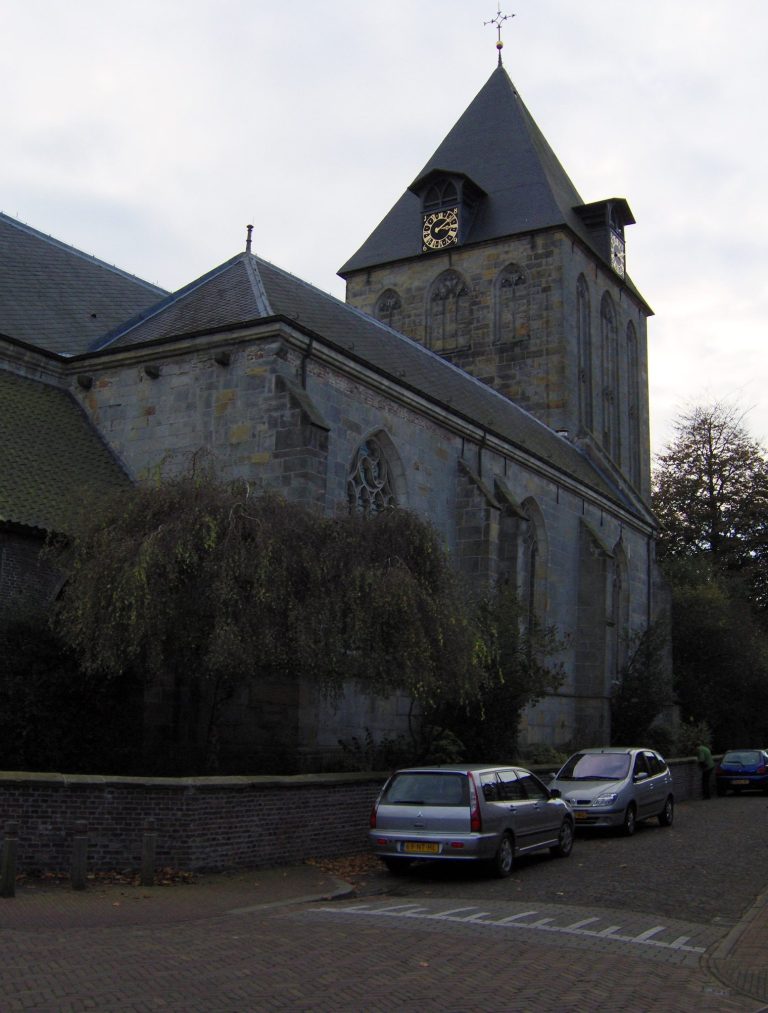
The basilica preserves a Romanesque core built in Bentheim sandstone, together with a Gothic choir, a late Gothic southern extension, and a substantial west tower. Its original layout followed a bound-system plan, a Romanesque arrangement in which the nave and aisles are organized through recurring bay units. The church had a transept, an antechoir bay, and an apse, while the subsidiary transept apses were decorated with engaged half-columns and blind arcades, or wall-set arches that do not open into another space.
Romanesque Core and Tower
Nave and Aisles
The surviving Romanesque parts include the nave, north aisle, north transept, and one choir bay. The interior originally used alternating supports, with the arcades between the nave and aisles carried in turn by columns and piers. The three aisles were covered by groin vaults, and the church displays Westphalian and Saxon influences, including a characteristic Saxon ciborium vault, a Romanesque vaulting form associated with Saxon church architecture.
West Tower
A powerful square-plan tower rises at the west end and contains a west choir. Its lower storey is Romanesque and belongs to the first construction phase. Under Otto II of Lippe, two middle storeys decorated with paired blind arcades were added. Later early Gothic details account for the tower’s classification as Romanesque-Gothic.
The tower is approximately 60 metres high and measures 13.40 metres across its south side, excluding the plinth. Its present height was reached during restoration after 1626. Known locally as the “Old Grey,” it also contains the bell chamber, described as the largest of its kind in Europe.
Gothic Choir and Southern Extension
High Choir and Sacristy
The fourteenth-century Gothic high choir has three-part tracery windows and a rib vault supported by continuous pear-shaped mouldings. A northern sacristy was built at the same time. These elements form the later eastern group around the earlier Romanesque choir bay.
South Aisle
The late Gothic south aisle was built around 1500. Its star vault extended the interior in a hall-like form along the south transept, which was absorbed into the new extension. The rebuilding followed the damage caused by the 1447 fire and replaced the earlier southern arrangement with a Gothic one.
Interior Surfaces and Organs
Stone Interior
Jos Cuypers’s restoration removed the surviving medieval plaster, painted surfaces, and later whitewash from the interior. The work left the Bentheim sandstone visible across the walls and piers, making the stone construction an especially clear part of the present interior appearance.
Organs
The basilica’s organ has been replaced and rebuilt several times. An earlier instrument destroyed in the 1492 town fire was followed by an organ made around 1560 to 1570 by Cornelis and Michael Slegel of Zwolle. That instrument was destroyed in 1795 during the First Coalition War, the conflict between revolutionary France and a European alliance opposing it. G. H. Quellhorst of Oldenzaal built another organ in 1811, which was sold to Utrecht’s Westerkerk in 1897.
In 1909, M. Maarschalkerweerd of Utrecht built a two-manual organ with pneumatic action. Pels of Alkmaar rebuilt it in 1948 as a three-manual electro-pneumatic instrument, reusing existing pipework and giving it a free-pipe façade. In 1971, it was replaced by an organ made by Johan Frederik Witte in Utrecht in 1889 for the newly built Grote Kerk in Hoorn. Verschueren Orgelbouw of Heythuysen later rebuilt the instrument in Oldenzaal and simplified its façade for monument-conservation reasons.
Bells and Carillon
Bell Chamber
The bell chamber contains a 49-bell carillon. A carillon is a set of tuned bells played from a keyboard, while ringing bells are operated by swinging or striking mechanisms for signals and worship. Six of the bells also serve as ringing bells.
Historic and Modern Bells
The Maria bell, cast in 1493 by Geert van Wou, is the second-largest bell and weighs about 2,400 kilograms. Other named twentieth-century bells include Beatrix, weighing 1,600 kilograms; Appolonia, 1,150 kilograms; Henriette, 680 kilograms; and Everdina, 480 kilograms.
Since 2020, the Plechelmus bell has hung in the bell chamber as the largest bell in the tower. Cast by the Spanish founder Abel Portilla, it weighs 3,890 kilograms. Its installation gave the tower the largest combined weight of ringing bells in the province of Overijssel.