Broletto: Novara’s Medieval Civic Complex in Italy
Site at a Glance
- Rating
- 4.6
- Popularity
- Very Low
- Country
- Italy
- Primary era
- Medieval
- Eras represented
- Medieval, Early Modern
- Civilizations
- Duchy of Milan, Holy Roman Empire
- Site type
- Civic
- Remains
- Town Hall
On this page13 sections
History
Broletto is a medieval architectural complex in Novara, Italy, formed by four historic buildings arranged around the Arengo courtyard. Its development belongs to the period of the northern Italian communes, especially the decades after the Peace of Constance in 1183, an agreement that recognized substantial self-government for these cities within the Holy Roman Empire. The complex grew from an enclosed court in the centre of the city, where commerce and public activities took place.
Medieval civic origins
The buildings used for public assemblies and the administration of justice are traditionally placed shortly after the Peace of Constance, although the exact date of construction is unknown. Broletto is mentioned in historical documents from 1208. Its civic functions were distributed among buildings surrounding the courtyard. The portico of the Palazzo del Comune, the oldest structure, provided a setting where the consuls of justice heard civil cases and matters of voluntary jurisdiction, while its upper hall served public assemblies.
Archaeological work carried out during twentieth-century restoration showed that the complex stood over earlier structures. These included walls and mosaic floors from the Roman period, revealing that the site had an urban history before the medieval buildings were erected.
Decline and restoration
From the middle of the sixteenth century, neglect led to the gradual deterioration of Broletto. The first careful efforts to recover the complex began in the nineteenth century. Work by the engineers Luigi Orelli and Stefano Ignazio Melchioni during that century also altered parts of the buildings, and later restoration attempted to remove or reverse some of those changes.
A wider restoration campaign began in Novara in the late 1920s. The architect Giovanni Lazanio worked on Broletto with the aim of recovering the appearance of several areas. The intervention reopened the single-light windows of the Palazzo del Podestà, the three-light windows of the Arengo hall, and the courtyard porticoes that had been blocked with walls. It also reconstructed the well and the outside staircase leading to the Arengo, both of which had been demolished in the eighteenth century. Later intrusive additions in the courtyard, including a large public urinal and a newspaper kiosk, were removed.
Museums and cultural use
Before the most recent restoration, Broletto housed Novara’s civic museums. Their archaeological section contained finds from the Novara area ranging from the Neolithic period to the Lombard period, the era of Lombard rule in Italy from 568 to 774. The historical-artistic section preserved works made in the area between the thirteenth and twentieth centuries.
Alfredo Giannoni donated his collection to the Municipality of Novara in the 1930s. The Paolo and Adele Giannoni Gallery of Modern Art now occupies part of the complex and presents more than 800 Italian paintings from the nineteenth and twentieth centuries in 13 rooms. After a restoration lasting more than two years, Broletto reopened to the public in March 2011. The complex also accommodates temporary exhibitions, cultural events, and open-air cinema during the summer.
Remains
Layout and entrances
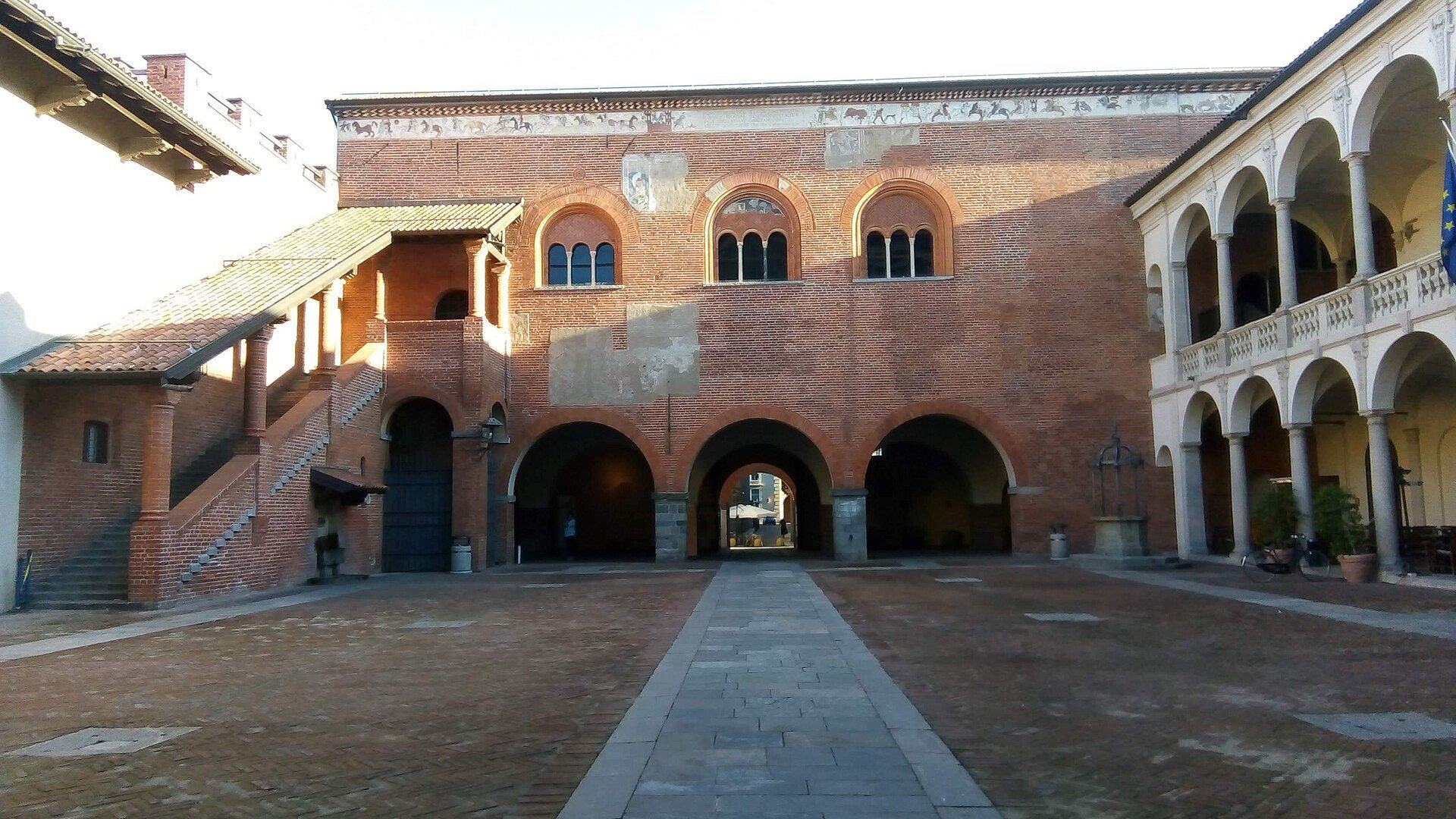
Broletto forms a quadrilateral of four buildings from different periods and artistic styles around the central Arengo courtyard. An arched passage from Piazza della Repubblica provides the southern entrance, while a second arch opens towards Corso Italia on the north. The courtyard includes a well at its northeastern corner, reconstructed during the twentieth-century restoration, and the recovered porticoes define much of its surviving character.
Medieval civic buildings
Palazzo del Comune
The Palazzo del Comune, also called the Palazzo dell’Arengo, occupies the northern side and dates from the twelfth century. Its ground floor has a portico with round arches, where the medieval consuls of justice heard cases. The upper level contains a large hall formerly used for public assemblies. The facade retains four three-light windows and remains of a painted frieze dating from approximately 1230 to 1260. The frieze includes coats of arms and scenes from chivalric episodes.
Arengaria
At the northwestern corner of the Palazzo del Comune stands the covered staircase known as the Arengaria. It is a reconstruction from the first half of the twentieth century and is currently closed.
Palazzo dei Paratici
The Palazzo dei Paratici forms the eastern side of the complex. It dates from the twelfth or thirteenth century and was enlarged during the eighteenth century. Its architectural features include a simple portico and a loggia, a covered gallery or open-sided architectural space.
Palazzo del Podestà
The Palazzo del Podestà occupies the southern side and was built between the late fourteenth and early fifteenth centuries. A podestà was a civic magistrate responsible for justice and government in an Italian city. The building is distinguished by a portico with pointed arches, five single-light windows, terracotta decoration, and fifteenth-century frescoes. The single-light windows were reopened during the twentieth-century restoration.
Palazzo dei Referendari
The Palazzo dei Referendari occupies the western side and belongs to the same period as the Palazzo del Podestà. Its upper-floor windows have terracotta decoration. Unlike the other three buildings, it has no open portico facing the courtyard.
Giannoni Gallery
Part of Broletto houses the Paolo and Adele Giannoni Gallery of Modern Art. Its collection contains more than 800 Italian paintings from the nineteenth and twentieth centuries, displayed across 13 rooms. The gallery provides a later cultural use within the medieval civic complex.