Kirche Thallwitz: An Evangelical Lutheran Church in Saxony
Site at a Glance
- Rating
- 4.5
- Popularity
- Very Low
- Country
- Germany
- Primary era
- Early Modern
- External website
- Open
- Eras represented
- Medieval, Early Modern, Modern
- Civilizations
- Electorate of Saxony, German, Holy Roman Empire
- Site type
- Religious
- Remains
- Church
On this page8 sections
History
Kirche Thallwitz is an Evangelical Lutheran church in Thallwitz, Germany, near Wurzen in Saxony. Originating in the fifteenth century, it combines Gothic, Renaissance, and Historicist architecture, reflecting successive periods of enlargement, rebuilding, and restoration.
Medieval origins and early rebuilding
The church developed from a fifteenth-century foundation. Bishop Johann VI of Saalhausen, a bishop of Meissen during the late medieval history of Saxony, ordered the choir to be enlarged and the church tower to be raised. The tower’s foundations and lower section still preserve material from this earlier church.
A new nave was built in 1626, as indicated by the inscription on the weather vane, probably incorporating older masonry. During the seventeenth century, the tower received its cap above the octagonal upper section, completing an important stage in the form that would shape the later church.
The nineteenth-century rebuilding
In 1896, the church underwent extensive rebuilding to plans by the Dresden architect Oswald Haenel. The exterior of the church and tower was completely replastered, while both roofs were re-covered and repaired and fitted with lightning conductors. Inside, the second gallery was removed, the remaining gallery was enlarged with two rows of seating, and the organ loft was widened. Colored cathedral glass was installed in the windows, and new green, red, and black textile paraments with gold embroidery were acquired.
Following this work, the church was rededicated after Thallwitz’s traditional Totenfest, the old local church-consecration festival. The ceremony included the patronage, the church inspectorate, and numerous pastors from the surrounding region.
Twentieth-century repairs and restoration
In 1968, the nave received new roofing, renewed gutters, improved lightning protection, and a new roof cross. Renovation of the nave began in 1971 and included a new altar and cross. The organ was reinstalled in spring 1972, followed by new exterior plastering of the nave.
The technically refurbished organ was rededicated in August 1992. The church tower was renovated in September 1998, and its crowning was completed on 23 January 1999. Kirche Thallwitz belongs to the Thallwitz-Lossatal parish, which serves a group of villages in the surrounding area.
Remains
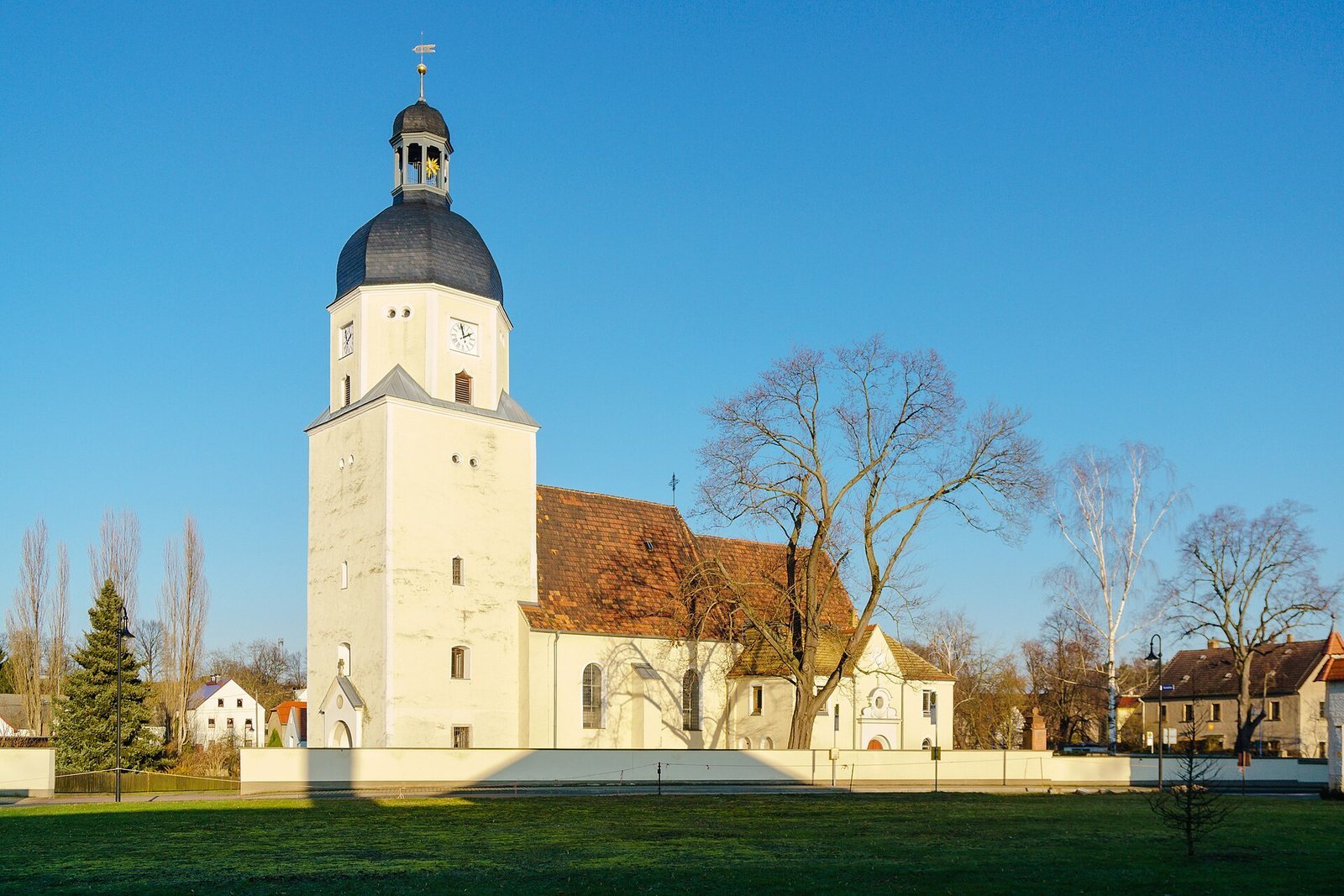
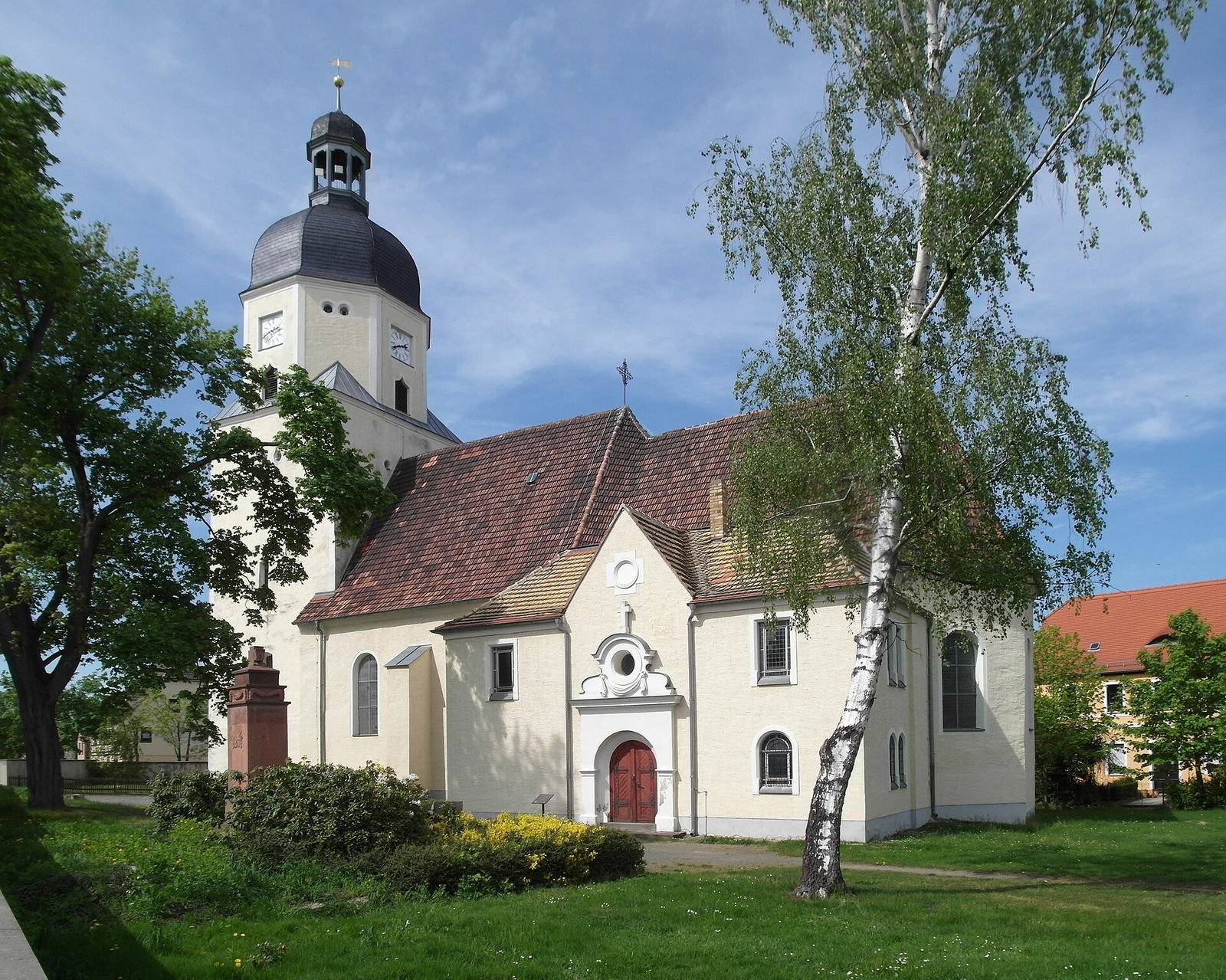
Kirche Thallwitz is a plastered rubble-stone hall church with a choir and tower. The nave and the elongated, slightly recessed choir stand at different heights, and the choir ends in a three-eighths termination. The church occupies a central position in the village directly opposite Thallwitz Castle and its park, forming a prominent part of the local townscape.
Church building and tower
The nave is a two-bay hall, meaning that its main interior space is not divided into a taller central section and lower side aisles. It has a flat barrel vault painted to resemble a cross-ribbed vault. A triumphal arch separates the nave from the choir, whose elaborate forked cross vaults have darkly painted ribs. A simple three-sided gallery is built into the nave.
The west tower has a square ground plan with contrastingly colored corners. Its upper section changes into an octagon and is crowned by a cap and lantern. The surviving foundations and lower section retain fabric from the fifteenth-century church, while the upper stages reflect later construction and alteration.
Funerary monuments
Several sandstone epitaphs, funerary monuments commemorating the dead, survive inside the church. The tomb monument of Christoph Sigismund von Holtzendorff, who died in 1715, has a black-marble, six-sided inscription panel framed by a cloth and topped by an urn and a putto, a childlike figure used in European art. A related sarcophagus and three marble figures representing Faith, Love, and Hope were placed separately in 1896.
Caspar Friedrich Löbelt created the monument to Gotthelf Siegmund von Holtzendorff, who died in 1739. It consists of a narrow sarcophagus with an inscription panel, flanked by putti carrying trophies. Above it is an oval oil painting framed by putti and crowned by a glory, a representation of radiant divine light.
The tomb monument of Rahel Louise Countess von Hoym, who died in 1764, is attributed in design to Friedrich August Krubsacius. It consists of an obelisk with a black-marble panel set on a curved sarcophagus and flanked by personifications of Faith and Love.
Organ
Conrad Geißler built the organ in 1897. It has 21 stops, two manuals, and a pedal. Its couplers connect the second manual to the first and the first manual to the pedal, while its playing aids include a bell for the person operating the organ bellows.